
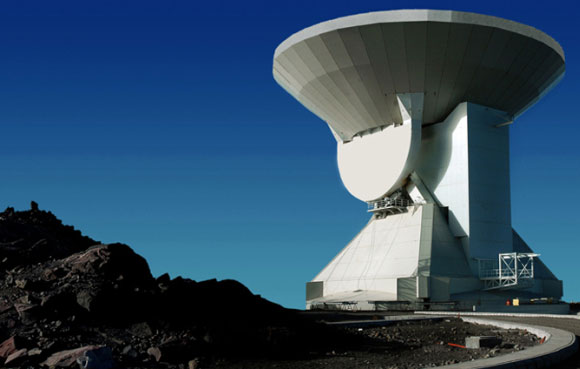
Using the Large Millimeter Telescope in its first stages of operation, astronomers study the gas and dust properties of luminous galaxies in the early stages of the universe.
In the 1980s, observations of nearby galaxies made with the Infrared Astronomical Satellite, along with observations of the far-infrared /submillimeter background with the Cosmic Background Explorer satellite, showed that the universe emits about as much energy density at infrared and submillimeter wavelengths as it does at optical and ultraviolet wavebands. Where does it all come from?
A breakthrough came with the discovery of a large population of sources very bright at submillimeter wavelengths at large cosmic distances. These so-called submillimeter selected galaxies (SMGs) have luminosities hundreds of times larger than that of the Milky Way, powered in part by star formation. Identifying and understanding the nature of these sources has, however, proven to be challenging because they are so distant and hence smaller in angular size than most single telescopes can resolve.
The Large Millimeter Telescope (LMT) is the world’s largest single-dish, steerable, millimeter-wavelength telescope designed specifically for astronomical observations. Situated on the summit of Volcán Sierra Negra at an altitude of 4600 meters, it is a binational project between México and the United States, and is the largest and most complex scientific instrument constructed in México. CfA astronomers Mark Gurwell and David Wilner and their colleagues used the newly operational LMT in a set of early science spectroscopic studies of submillimeter galaxies. They selected their objects from the Herschel satellite imaging catalog of luminous far infrared galaxies; the sources are distant luminous SMGs that are being gravitationally lensed by foreground galaxy clusters, making them appear particularly bright.
The team used the carbon monoxide molecule as their spectroscopic tracer. The strength of the line enabled them to estimate the amount of gas, which they could then compare to the amount of dust; they reported finding about seventy times more gas, consistent with expectations. The gas also enables them to determine the Doppler shift of the galaxy and hence its distance, something not possible to do accurately from the imaging data alone. The most distant galaxy in their early science study dates from the epoch only one and one-half billion years after the Big Bang.
Remarkably, they were also able to use the spectroscopic measurements to discover that one object is in fact three galaxies, at three different very different cosmic distances, that just happen to all lie along the same line-of-sight. The new results demonstrate the power of this new astronomical telescope, and mark the beginning of a detailed exploration of the cosmic sources responsible for the infrared background.
Reference: “Early Science with the Large Millimeter Telescope: Observations of Dust Continuum and CO Emission Lines of Cluster-lensed Submillimetre Galaxies at z = 2.0−4.7” by J. A. Zavala, M. S. Yun, I. Aretxaga, D. H. Hughes, G. W. Wilson, J. E. Geach, E. Egami, M. A. Gurwell, D. J. Wilner, Ian Smail, A. W. Blain, S. C. Chapman, K. E. K. Coppin, M. Dessauges-Zavadsky, A. C. Edge, A. Montana, K. Nakajima, T. D. Rawle, D. Sanchez-Arguelles, A. M. Swinbank, T. M. A. Webb and M. Zeballos, 14 July 2015, MNRAS.
DOI: 10.1093/mnras/stv1351
arXiv: 1506.04747
Never miss a breakthrough: Join the SciTechDaily newsletter.
Follow us on Google and Google News.