
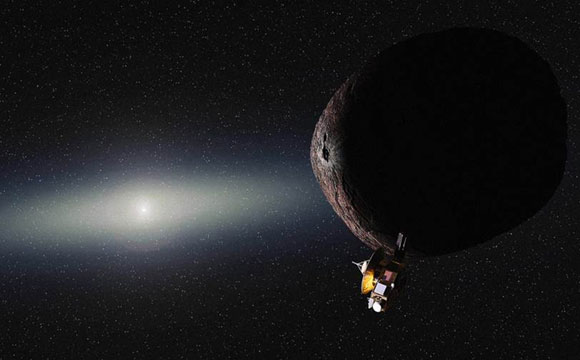
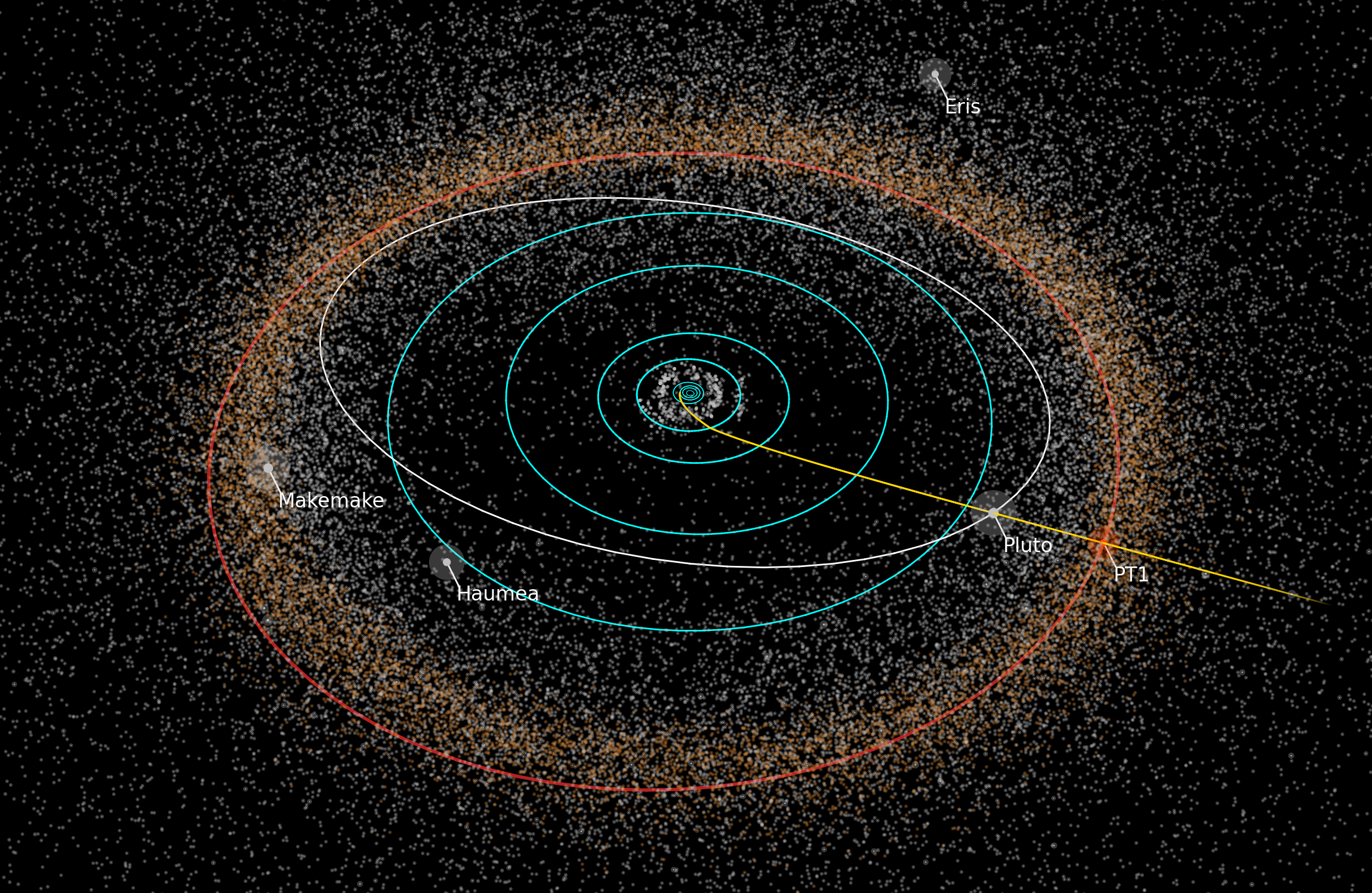
NASA scientists have selected the small Kuiper Belt object (KBO) known as 2014 MU69 as the next potential destination for the New Horizons mission. 2014 MU69 orbits nearly a billion miles beyond Pluto.
This remote KBO was one of two identified as potential destinations and the one recommended to NASA by the New Horizons team. Although NASA has selected 2014 MU69 as the target, as part of its normal review process the agency will conduct a detailed assessment before officially approving the mission extension to conduct additional science.
“Even as the New Horizon’s spacecraft speeds away from Pluto out into the Kuiper Belt, and the data from the exciting encounter with this new world is being streamed back to Earth, we are looking outward to the next destination for this intrepid explorer,” said John Grunsfeld, astronaut and chief of the NASA Science Mission Directorate at the agency headquarters in Washington. “While discussions whether to approve this extended mission will take place in the larger context of the planetary science portfolio, we expect it to be much less expensive than the prime mission while still providing new and exciting science.”
Like all NASA missions that have finished their main objective but seek to do more exploration, the New Horizons team must write a proposal to the agency to fund a KBO mission. That proposal – due in 2016 – will be evaluated by an independent team of experts before NASA can decide about the go-ahead.
Early target selection was important; the team needs to direct New Horizons toward the object this year in order to perform any extended mission with healthy fuel margins. New Horizons will perform a series of four maneuvers in late October and early November to set its course toward 2014 MU69 – nicknamed “PT1” (for “Potential Target 1”) – which it expects to reach on January 1, 2019. Any delays from those dates would cost precious fuel and add mission risk.
“2014 MU69 is a great choice because it is just the kind of ancient KBO, formed where it orbits now, that the Decadal Survey desired us to fly by,” said New Horizons Principal Investigator Alan Stern, of the Southwest Research Institute (SwRI) in Boulder, Colorado. “Moreover, this KBO costs less fuel to reach [than other candidate targets], leaving more fuel for the flyby, for ancillary science, and greater fuel reserves to protect against the unforeseen.”
New Horizons was originally designed to fly beyond the Pluto system and explore additional Kuiper Belt objects. The spacecraft carries extra hydrazine fuel for a KBO flyby; its communications system is designed to work from far beyond Pluto; its power system is designed to operate for many more years; and its scientific instruments were designed to operate in light levels much lower than it will experience during the 2014 MU69 flyby.”
The 2003 National Academy of Sciences’ Planetary Decadal Survey (“New Frontiers in the Solar System”) strongly recommended that the first mission to the Kuiper Belt include flybys of Pluto and small KBOs, in order to sample the diversity of objects in that previously unexplored region of the solar system. The identification of PT1, which is in a completely different class of KBO than Pluto, potentially allows New Horizons to satisfy those goals.
But finding a suitable KBO flyby target was no easy task. Starting a search in 2011 using some of the largest ground-based telescopes on Earth, the New Horizons team found several dozen KBOs, but none were reachable within the fuel supply available aboard the spacecraft.
The powerful Hubble Space Telescope came to the rescue in the summer of 2014, discovering five objects, since narrowed to two, within New Horizons’ flight path. Scientists estimate that PT1 is just under 30 miles (about 45 kilometers) across; that’s more than 10 times larger and 1,000 times more massive than typical comets, like the one the Rosetta mission is now orbiting, but only about 0.5 to 1 percent of the size (and about 1/10,000th the mass) of Pluto. As such, PT1 is thought to be like the building blocks of Kuiper Belt planets such as Pluto.
Unlike asteroids, KBOs have been heated only slightly by the Sun, and are thought to represent a well-preserved, deep-freeze sample of what the outer solar system was like following its birth 4.6 billion years ago.
“There’s so much that we can learn from close-up spacecraft observations that we’ll never learn from Earth, as the Pluto flyby demonstrated so spectacularly,” said New Horizons science team member John Spencer, also of SwRI. “The detailed images and other data that New Horizons could obtain from a KBO flyby will revolutionize our understanding of the Kuiper Belt and KBOs.”
The New Horizons spacecraft – currently 3 billion miles (4.9 billion kilometers) from Earth – is just starting to transmit the bulk of the images and other data, stored on its digital recorders, from its historic July encounter with the Pluto system. The spacecraft is healthy and operating normally.
Never miss a breakthrough: Join the SciTechDaily newsletter.
Follow us on Google and Google News.
2 Comments
KBO or Kuiper Belt Objects are the raw materials in the condensation of any Galaxy into planets and gas giants. They are responsible for bringing ice or water into the planets. They probably are responsible for bringing amino acids or the life forming molecules in the atmosphere, since they travel very far and wide and imbibe all the gamma radiation and X radiations from the sun which presents a laboratory in a test tube. Thank You.
“Unlike asteroids, KBOs have been heated only slightly by the Sun, and are thought to represent a well preserved, deep-freeze sample of what the outer solar system was like following its birth 4.6 billion years ago.”
Hmm, by my calculations PT1 should be less than 50 million years old. I believe it was not even around 4.6 billion years ago when the solar system formed. Who wants to bet me that the KBOs didn’t just recently form(E/c²=m)?