
Close Menu
    Facebook X (Twitter) Instagram
    SciTechDaily
    • Biology
    • Chemistry
    • Earth
    • Health
    • Physics
    • Science
    • Space
    • Technology
    Facebook X (Twitter) Pinterest YouTube RSS
    SciTechDaily
    Home»Space»Astronomers Record Detailed Measurements of the Inner Region of a Quasar Nucleus
    Space

    Astronomers Record Detailed Measurements of the Inner Region of a Quasar Nucleus

    By Harvard-Smithsonian Center for AstrophysicsOctober 23, 2012No Comments3 Mins Read
    Facebook Twitter Pinterest Telegram LinkedIn WhatsApp Email Reddit
    Share
    Facebook Twitter LinkedIn Pinterest Telegram Email Reddit
    Distant Quasar Active Galaxy Core
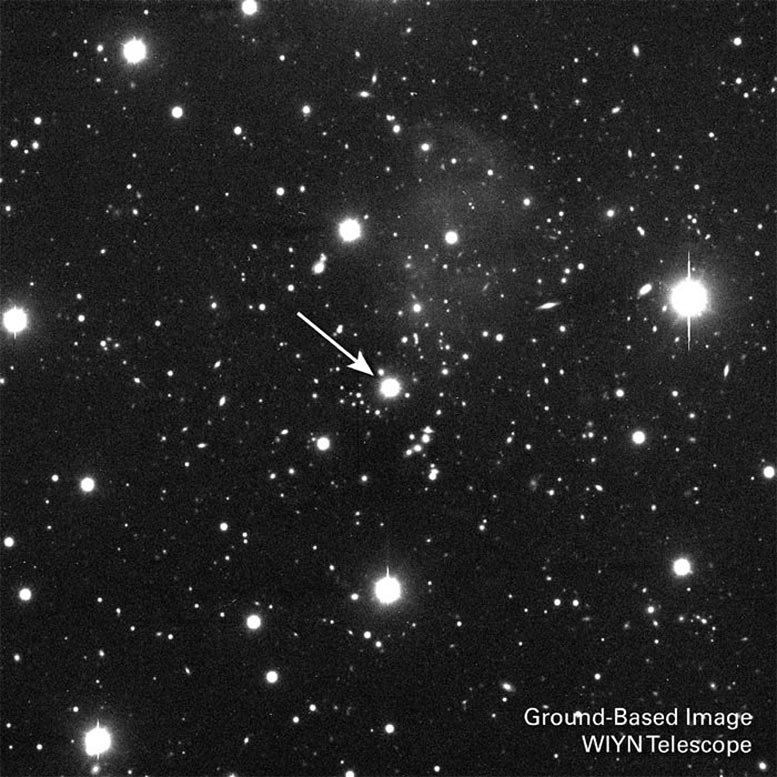
    The arrow in this image, taken by a ground-based telescope, points to a distant quasar the brilliant core of an active galaxy residing billions of light-years from Earth. As light from this faraway object travels across space, it picks up information on galaxies and the vast clouds of material between galaxies as it moves through them. The Space Telescope Imaging Spectrograph aboard NASA/ESA Hubble Space Telescope decoded the quasar’s light to find the spectral “fingerprints” of highly ionized (energized) oxygen, which had mixed with invisible clouds of hydrogen in intergalactic space. The quasar’s brilliant beam pierced at least four separate filaments of the invisible hydrogen laced with the telltale oxygen. The presence of oxygen between the galaxies implies there are huge quantities of hydrogen in the universe. Credit: WIYN Telescope

    Using four submillimeter telescopes working simultaneously around the globe, a team of astronomers from the Smithsonian Astrophysical Observatory and colleagues made the first detailed measurements of the inner region of a quasar nucleus at submillimeter wavelengths.

    Quasars are among the most powerful energy sources known — some are as luminous as one hundred thousand Milky Way galaxies. Astronomers know that quasars have massive black holes at their cores and believe that matter falling into the environment of the black hole powers the quasar’s tremendous luminosity — but the details remain uncertain. No one is quite sure, for example, how quasars form, how they develop into such luminous monsters, or how their massive black holes and environments become so bright.

    Despite their reputation for being pitiless devourers of matter and radiation, black holes have environments that are often sources of powerful radiation as material falls into the region. Quasar nuclei, however, are often embedded in obscuring dust (perhaps a remnant of the violent process that formed the black holes), and although the regions emit from short wavelength X-rays to long wavelength radio bands, it is difficult to study them at the shorter wavelengths which are more effectively blocked.

    Harvard–Smithsonian Center for Astrophysics (CfA) astronomers Jonathan Weintroub, Jim Moran, Rurik Primiani, and Ken Young teamed up with colleagues to make the first detailed measurements of the inner region of a quasar nucleus at submillimeter wavelengths. They used Sub-millimeter Array technology with four submillimeter telescopes working simultaneously around the globe, united into an effective single large array, and they used it to study a quasar about one billion light-years distant.

    The quasar itself was known to have strongly variable emission, indicative of periods of infalling material powering the activity, but until now it had not been possible to probe the spatial structures in the region. Using their new techniques, the scientists were able to resolve dimensions of only about half a light-year (!), enough to conclude that there is a jet of material being ejected from the region of the black hole (confirming earlier conclusions), that the jet is oriented about 53 degrees from the nucleus disk, and that it contains a bend in its length whose cause needs further research. The new results are significant not only because they probe this extreme galaxy, but also because they demonstrate the success and power of the new technique of combining multiple submillimeter telescopes into a single advanced instrument.

    Never miss a breakthrough: Join the SciTechDaily newsletter.
    Follow us on Google and Google News.

    Astronomy Astrophysics Harvard-Smithsonian Center for Astrophysics Quasars
    Share. Facebook Twitter Pinterest LinkedIn Email Reddit

    Related Articles

    Massive X-ray Jet – Extending for 160,000 Light-Years – Spied From Supermassive Black Hole in Early Universe

    Puzzling Astrophysics of Quasars in the Early Universe

    Astronomers Detect Time Delays between Flaring Events in a Quasar

    NuSTAR Reveals the Active Galactic Nucleus of a Quasar

    Study Challenges Prevailing Ideas About How Supermassive Black Holes Grow

    Calculations Show the Ideal Time to Study the Cosmos

    Using Infrared Images from Hubble & Spitzer, Scientists Discover 25 Distant Galaxies

    Supernova Shock Wave Breaks Through a Cocoon of Gas

    Origins of Type Ia Supernovae

    Leave A Reply Cancel Reply

    • Facebook
    • Twitter
    • Pinterest
    • YouTube

    Don't Miss a Discovery

    Subscribe for the Latest in Science & Tech!

    Trending News

    Could Low Vitamin D Be Making Your Pain Worse?

    Scientists Discover Once-Weekly Workout That Melts Belly Fat Surprisingly Effectively

    Scientists Just Tested a Thruster Powerful Enough for Human Missions to Mars

    Doctors Say Your Ice Pack Might Be Making Injuries Worse

    Scientists Discover 43-Foot Sea Reptile Twice the Size of a Great White Shark

    Bees and Birds Are Drinking Alcohol From Flowers

    Scientists Discover How Obesity May Trigger Alzheimer’s Disease

    Scientists Confirm Alcohol Causes Widespread Health Damage

    Follow SciTechDaily
    • Facebook
    • Twitter
    • YouTube
    • Pinterest
    • Newsletter
    • RSS
    SciTech News
    • Biology News
    • Chemistry News
    • Earth News
    • Health News
    • Physics News
    • Science News
    • Space News
    • Technology News
    Recent Posts
    • Magnon Breakthrough Could Shrink Quantum Computers to the Size of a Penny
    • NASA Finds a “Goldilocks” Giant Planet Wrapped in Methane
    • Are There Aliens on the Famous Exoplanet K2-18b? Scientists Just Scanned It for Signals
    • Scientists Have Found a Way To Feed Immune Cells Without Fueling Cancer
    • Scientists Say Exercise May Be the Closest Thing to a Parkinson’s “Medicine” Yet
    Copyright © 1998 - 2026 SciTechDaily. All Rights Reserved.
    • Science News
    • About
    • Contact
    • Editorial Board
    • Privacy Policy
    • Terms of Use

    Type above and press Enter to search. Press Esc to cancel.