
Close Menu
    Facebook X (Twitter) Instagram
    SciTechDaily
    • Biology
    • Chemistry
    • Earth
    • Health
    • Physics
    • Science
    • Space
    • Technology
    Facebook X (Twitter) Pinterest YouTube RSS
    SciTechDaily
    Home»Biology»Peeking Inside Human “Mini-Brains” to Understand the Brain, Study Disease and Test New Medicines
    Biology

    Peeking Inside Human “Mini-Brains” to Understand the Brain, Study Disease and Test New Medicines

    By Wyss Center for Bio and NeuroengineeringJanuary 12, 2021No Comments3 Mins Read
    Facebook Twitter Pinterest Telegram LinkedIn WhatsApp Email Reddit
    Share
    Facebook Twitter LinkedIn Pinterest Telegram Email Reddit
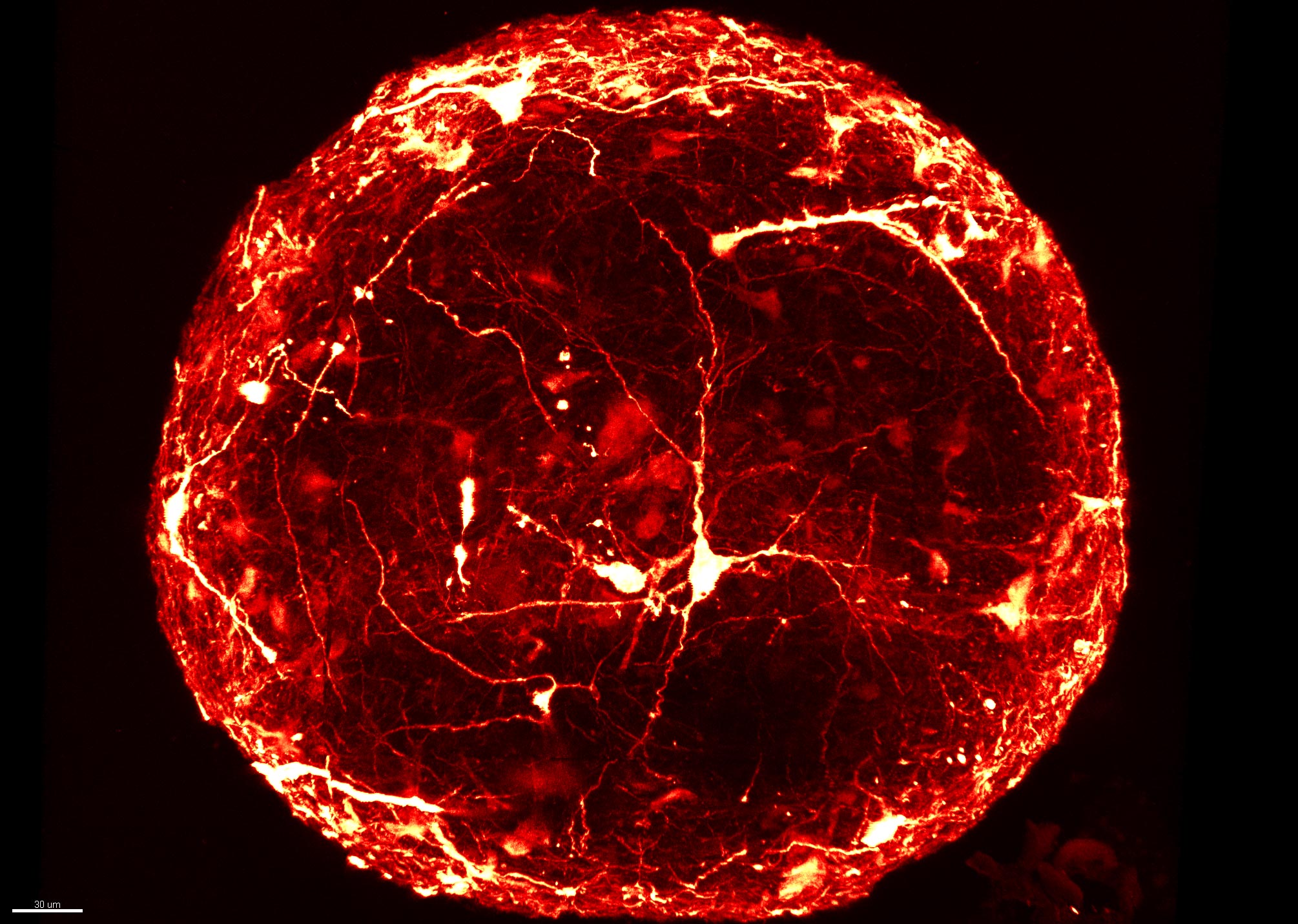
    Seven Month Old 3D Mini Brain
    A seven-month-old 3D ‘mini-brain’ imaged with a confocal microscope to reveal the structure of individual neurons throughout. Credit: HEPIA

    Revealing details of the internal structure of ‘mini-brains’ could help accelerate drug studies and may offer alternatives to some animal testing.

    ‘Mini-brains’ are pin-head-sized collections of several different types of human brain cells. They are used as a tool, allowing scientists to learn about how the brain develops, study disease, and test new medicines. Personalized ‘mini-brains’ can be grown from stem cells generated from a sample of human hair or skin and could shed light on how brain disease progresses in an individual and how this person may respond to drugs.

    Research published today by a team of scientists and engineers from HEPIA and the Wyss Center for Bio and Neuroengineering, in the journal Frontiers in Bioengineering and Biotechnology, has revealed the detailed internal anatomy of ‘mini-brains’, for the first time.

    “Despite advances in growing ‘mini-brains’, it has been difficult to understand in detail what is going on inside – until now,” said Professor Adrien Roux from the Tissue Engineering Laboratory, HEPIA, senior author on the paper.

    High-Resolution 3D Imaging of Intact Mini-Brains

    “Typically, to look inside a ‘mini-brain’, we slice it thinly and view it on a slide under a microscope. This is a slow process that can damage the sample. Now, for the first time, we have produced high-resolution 3D images of single neurons within intact ‘mini-brains’, revealing their remarkable complexity,” added Dr. Subashika Govindan, lead author on the paper, who carried out the work at HEPIA and is now Wellcome DBT early career fellow at the Indian Institute of Technology Madras (IITM).

    The team combined a novel technique for labeling individual neurons with a method to make the whole sample completely transparent.

    Lightsheet Microscope
    The Wyss Center’s lightsheet microscope. Credit: Wyss Center

    Leveraging the Wyss Center’s microscopy capabilities, the team developed a state-of-the-art custom module, including a bespoke sample holder and sensitive imaging detectors, for capturing 3D images of entire intact ‘mini-brains’, without slicing them. They were then able to visualize and analyze the 3D morphology of specific neurons and their anatomical distribution inside the ‘mini-brains’.

    Potential to Reduce Animal Testing

    Dr. Laura Batti, Microscopy Facility Manager at the Wyss Center said: “Human ‘mini-brains’ have a life span of more than a year and, with our new ability to visualize them in more detail, we can envision benefits such as reducing some animal testing.”

    The new approach could also enable imaging of large numbers of ‘mini-brains’, making it suitable for high-throughput screening for drug discovery or toxicity testing. It is reproducible and cost-effective and could potentially help accelerate personalized medicine studies.

    Reference: “Mass generation, neuron labeling, and 3D imaging of minibrains” by Subashika Govindan, Laura Batti, Samira F. Osterop, Luc Stoppini and Adrien Roux, 7 January 2021, Frontiers in Bioengineering and Biotechnology.
    DOI: 10.3389/fbioe.2020.582650

    Never miss a breakthrough: Join the SciTechDaily newsletter.
    Follow us on Google and Google News.

    Biotechnology Brain Neuroscience Popular Wyss Institute
    Share. Facebook Twitter Pinterest LinkedIn Email Reddit

    Related Articles

    Scientists Grow 400+ Brain Cell Types in a Dish – Could This Be the Key to Curing Alzheimer’s?

    Scientists Induce Hibernation-Like State Using Ultrasound Stimulation of the Brain

    “Mindwriting” – Software Is Able to Turn Thoughts About Handwriting Into Words and Sentences

    New Neuroelectronic System Can Read and Manipulate Brain Signals

    Apples May Boost Brain Function, Stimulate the Production of New Brain Cells

    Brain Pacemaker Implanted to Treat Alzheimer’s

    “Area X” of Zebra Finch May Provide Insights to Human Speech Disorders

    Researchers Use FDDNP–PET Scanning to Predict Cognitive Decline

    Neuroscientists Decode Correlation Between Sound and Brain Activity

    Leave A Reply Cancel Reply

    • Facebook
    • Twitter
    • Pinterest
    • YouTube

    Don't Miss a Discovery

    Subscribe for the Latest in Science & Tech!

    Trending News

    Researchers Have Found a Dietary Compound That Increases Longevity

    Scientists Baffled by Bizarre “Living Fossil” From 275 Million Years Ago

    Your IQ at 23 Could Predict Your Wealth at 27, Study Finds

    320 Light-Years Away, a Planet Confirms a Fundamental Cosmic Assumption

    The Crown Jewel of Dentistry? Breakthrough Tech Could Transform Tooth Repair

    Python Blood Could Hold the Secret to Weight Loss Without Side Effects

    Naturally Occurring Bacteria Completely Eradicate Tumors in Mice With a Single Dose

    New “Nanozyme Hypothesis” Could Rewrite the Story of Life’s Origins

    Follow SciTechDaily
    • Facebook
    • Twitter
    • YouTube
    • Pinterest
    • Newsletter
    • RSS
    SciTech News
    • Biology News
    • Chemistry News
    • Earth News
    • Health News
    • Physics News
    • Science News
    • Space News
    • Technology News
    Recent Posts
    • How Quantum Mechanics Went From Baffling Theory to Revolutionizing Modern Technology
    • Scientists May Have Found the Key to Jupiter and Saturn’s Moon Mystery
    • Scientists Uncover Hidden Clues to the Origin of the Genetic Code
    • Scientists Discover Unexpected Role of Alzheimer’s Protein in Cell Division
    • Scientists Uncover Brain Changes That Link Pain to Depression
    Copyright © 1998 - 2026 SciTechDaily. All Rights Reserved.
    • Science News
    • About
    • Contact
    • Editorial Board
    • Privacy Policy
    • Terms of Use

    Type above and press Enter to search. Press Esc to cancel.