
April Highlights
Morning planets, a sunset arch, and finding Leo the lion…
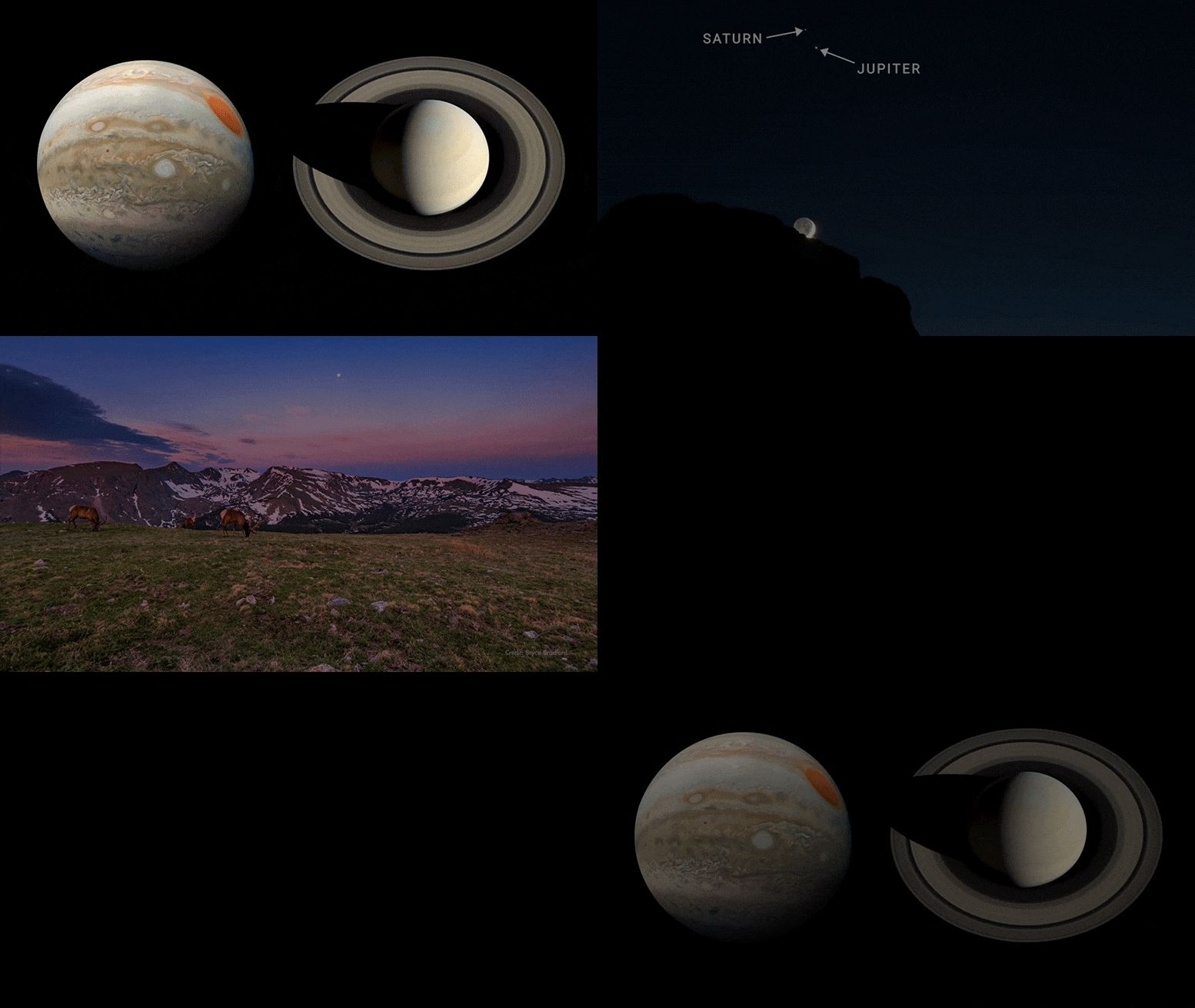
- April 7: Jupiter, Saturn, and the Moon form a lovely trio in the east at dawn.
- April 16: Mars appears about 7 degrees above the waxing crescent Moon.
- April 22: On Earth Day, look for the rosy-hued “Belt of Venus” forming an arch with Earth’s shadow at sunset. The annual Lyrid meteor shower is expected to peak early in the morning.
- April 26: Check out the Full Pink Moon.
- All month: The constellation Leo, named for a mythical super-powered lion, is easy to find high overhead on April nights. Find the bright blue-white star Regulus that forms the lion’s heart; at least two of Leo’s stars have confirmed exoplanets!
Daily Guide
April 7
On Wednesday morning, April 7, 2021, the waning crescent Moon will have shifted to appear about 5 degrees to the lower right of the bright planet Jupiter, with the planet Saturn farther to the right. The Moon will rise last in the east-southeast about 45 minutes before morning twilight begins at 4:58 a.m. EDT. The Moon will appear about 7 degrees above the east-southeastern horizon as morning twilight begins at 5:44 a.m.
April 11
Sunday night, April 11, 2021, at 10:31 p.m. EDT, will be the new Moon, when the Moon passes between the Earth and the Sun and will not be visible from the Earth. The day of – or the day after – the New Moon marks the start of the new month for most lunisolar calendars. In the Hebrew calendar, sundown on Sunday, April 11, 2021, will mark the start of Iyar.
April 12
The third month of the Chinese year of the Ox starts on Monday, April 12, 2021 (at midnight in China’s time zone, which is 12 hours ahead of EDT).
In the Islamic calendar, the months start with the first sighting of the waxing crescent Moon. Many Muslim communities now follow the Umm al-Qura Calendar of Saudi Arabia, which uses astronomical calculations to start the months in a more predictable way (intended for civil and not religious purposes). Because of its religious significance, Ramadan is one of four months in the Islamic year where the start of the month is updated in the Umm al-Qura calendar based upon the actual sighting of the crescent Moon. This calendar predicts the holy month of Ra.m.adan may start with sunset on Monday, April 12, 2021, but the actual start will be adjusted based on observations of the crescent Moon. Ramadan is honored as the month in which the Quran was revealed. Observing this annual month of charitable acts, prayer, and fasting from dawn to sunset is one of the Five Pillars of Islam.
April 13
In India’s time zone, Tuesday, April 13, 2021, marks the start of Chaitra, the first month of the Hindu lunisolar religious calendar. The first of Chaitra is celebrated as New Year’s Day and is known as Gudi Padwa in Maharashtra, Chaitra Vishu, or Puthandu in Tamil Nadu, and Ugadi in Karnataka and Andhra Pradesh. This starts the nine-day New Years’ celebration called Chaitra Navratri. These nine days are dedicated to forms of the Goddess Shakti. Many of the customs and rituals followed during Chaitra Navratri are similar to those for the fall celebration called Shardiya Navratri (in September or October). Chaitra Navratri ends with Rama Navami on April 21, 2021, celebrating the birthday of Lord Raa, so Chaitra Navratri is also called Rama Navratri.
April 14
Wednesday afternoon, April 14, 2021, at 1:48 p.m. EDT, the Moon will be at apogee, its farthest from the Earth for this orbit.
April 15
On Thursday evening, April 15, 2021, the bright star Aldebaran will appear about 6 degrees to the left of the waxing crescent Moon. The pair will appear about 26 degrees above the western horizon as evening twilight ends at 8:46 p.m. EDT. Aldebaran will set first in the west-northwest a little more than 2.5 hours later at 11:05 p.m. EDT.
April 16
On Friday evening, April 16, 2021, the planet Mars will appear about 7 degrees above the waxing crescent Moon. The Moon will appear about 37 degrees above the western horizon as evening twilight ends at 8:47 p.m. EDT. The Moon will set first in the west-northwest a little more than 3.5 hours later on Saturday morning at 12:18 a.m. EDT.
April 17
By Saturday evening, April 17, 2021, the waxing crescent Moon will appear to have shifted to the other side of the planet Mars. The Moon will appear about 47 degrees above the western horizon as evening twilight ends at 8:48 p.m. EDT with Mars appearing about 7 degrees to the lower right of the Moon. Mars will set first in the northwest a little less than 4 hours later on Sunday morning at 12:39 a.m. The Moon and Mars appeared at their closest together on Saturday morning when they appeared on the other side of the Earth.
April 18
On Sunday evening, April 18, 2021, the planet Mercury will be passing on the far side of the Sun as seen from the Earth, called superior conjunction. Because Mercury orbits inside of Earth, Mercury will be shifting from the morning sky to the evening sky and will begin emerging from the glow of dusk on the western horizon later in April (depending upon viewing conditions).
April 19
On Monday evening into early Tuesday morning, April 19 to 20, 2021, the bright star Pollux will appear to the right of the waxing half Moon. Pollux will appear about 5 degrees to the right as evening twilight ends at 8:51 p.m. EDT. The pair will appear to separate as the night progresses, with Pollux setting in the northwest on Tuesday morning about 6 minutes before moonset at 2:45 a.m.
April 20
Early Tuesday morning, April 20, 2021, the Moon will appear half-full as it reaches its first quarter at 2:59 a.m. EDT, about 8 minutes after moonset for the Washington, D.C. area.
Tuesday evening will be the first evening that the bright planet Venus will be just barely above the horizon in the west-northwest 30 minutes after sunset (an approximation of when Venus will start becoming visible in the evening sky).
April 21
Wednesday evening into Thursday morning, April 21 to 22, 2021, the bright star Regulus will appear to the lower left of the waxing gibbous Moon. Regulus will be about 8 degrees to the lower left of the Moon as evening twilight ends at 8:53 p.m. EDT – when the Moon will be near its highest in the sky for the evening. The pair will appear to shift closer together and reach about 6 degrees apart as Regulus sets in the west-northwest Thursday morning at 3:57 a.m.
April 22
The annual Lyrid meteor shower is expected to peak early in the morning on Thursday, April 22, 2021. This year, the light of the waxing gibbous Moon will interfere with the visibility of these meteors, which under ideal conditions (which we don’t have this year) might be expected to produce about 18 visible meteors per hour. On the morning of April 22, the Moon will set about 30 minutes before any sign of dawn begins to show in the east – at 4:07 a.m. and 4:44 a.m. EDT, respectively – so there will only be a short window without light interference.
April 24
Saturday evening, April 24, 2021, will be the first evening that the planet Mercury will join Venus just barely above the horizon in the west-northwest 30 minutes after sunset (an approximation of when Mercury will start becoming visible in the evening sky).
April 25-26
Sunday evening into Monday morning, April 25 to 26, 2021, the bright star Spica will appear near the Moon. As evening twilight ends at 8:58 p.m. EDT, the Moon will appear about 27 degrees above the horizon in the east-southeast, with Spica about 7 degrees to the lower right. The Moon will reach its highest in the sky for the night on Monday morning just after midnight at 12:19 a.m., with Spica about 6 degrees below the Moon. As morning twilight begins on Monday morning at 5:14 a.m., the Moon will appear about 9 degrees above the horizon in the west-southwest with Spica about 5 degrees below the Moon.
Sometime around Monday (2021-Apr-26 13:05 UTC with 4 days, 14 hours, 59 minutes uncertainty), Near-Earth Object (2015 HA177), between 25 to 56 feet (8 and 17 meters) across, will pass the Earth at between 0.8 and 47.4 lunar distances (nominally 18.6), traveling at 19,480 miles per hour (8.71 kilometers per second).
Also around Monday (2021-Apr-26 22:24 UTC with 7 days, 20 hours, 11 minutes uncertainty), Near-Earth Object (2019 HF4), between 26 to 59 feet (8 and 18 meters) across, will pass the Earth at between 1.2 and 18.4 lunar distances (nominally 7.7), traveling at 15,120 miles per hour (6.76 kilometers per second).
April 26
The next full Moon will be Monday night, April 26, 2021, appearing opposite the Sun at 11:31 p.m. EDT. The Moon will appear full for about 3 days around this time, from Sunday evening through Wednesday morning.
Never miss a breakthrough: Join the SciTechDaily newsletter.
Follow us on Google and Google News.
1 Comment
… I need my telescope now…
,,, I also think that it would be useful to have this on regular basis…