
Close Menu
    Facebook X (Twitter) Instagram
    SciTechDaily
    • Biology
    • Chemistry
    • Earth
    • Health
    • Physics
    • Science
    • Space
    • Technology
    Facebook X (Twitter) Pinterest YouTube RSS
    SciTechDaily
    Home»Science»The Amygdala Unveiled: How Our Brains Process Threats, Rewards, and Dopamine
    Science

    The Amygdala Unveiled: How Our Brains Process Threats, Rewards, and Dopamine

    By Cold Spring Harbor LaboratoryApril 5, 20232 Comments4 Mins Read
    Facebook Twitter Pinterest Telegram LinkedIn WhatsApp Email Reddit
    Share
    Facebook Twitter LinkedIn Pinterest Telegram Email Reddit
    Brain Signals Activity Technology Concept
    Research at Cold Spring Harbor Laboratory has revealed that specific neurons in the central amygdala are crucial for learning about threats and rewards, and are directly connected to dopamine neurons. This discovery could eventually lead to better treatments for addiction.

    Neuroscientist Bo Li at Cold Spring Harbor Laboratory has made significant discoveries about the role of somatostatin-expressing (Sst+) central amygdala (CeA) neurons in learning about threats and rewards, and their relation to dopamine. By training mice to associate sounds with rewards or punishments and imaging their brains, Li’s team found that the neurons responded differently to various types of rewards, demonstrating a level of specificity previously unknown. Inhibition of Sst+ CeA neurons led to suppressed dopamine neuron responses, confirming their importance in reward learning. Li aims to explore the relationship between these neurons and addiction, which could eventually lead to improved treatments for opioid or methamphetamine addicts.

    Deep within our brain’s temporal lobes, two almond-shaped cell masses help keep us alive. This tiny region, called the amygdala, assists with a variety of brain activities. It helps us learn and remember. It triggers our fight-or-flight response. It even promotes the release of a feel-good chemical called dopamine. Scientists have learned all this by studying the amygdala over hundreds of years. But we still haven’t reached a full understanding of how these processes work.

    Now, Cold Spring Harbor Laboratory neuroscientist Bo Li has brought us several important steps closer. His lab recently made a series of discoveries that show how neurons called somatostatin-expressing (Sst+) central amygdala (CeA) neurons help us learn about threats and rewards. He also demonstrated how these neurons relate to dopamine. The discoveries could lead to future treatments for anxiety or drug addiction.
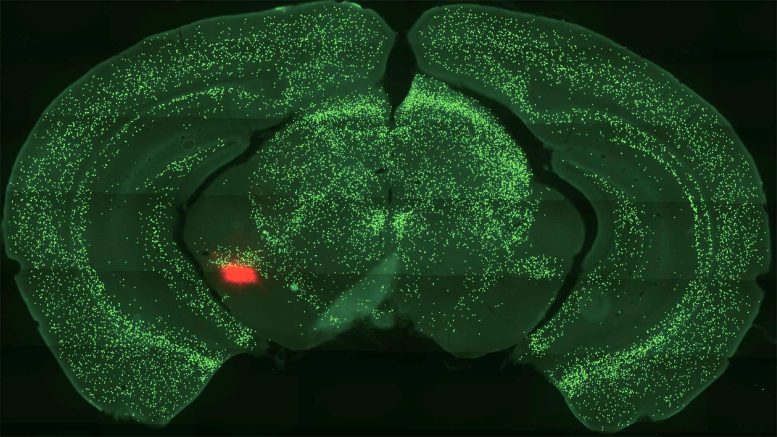
    Mouse Central Amygdala
    A cross-section of a mouse brain. The area highlighted red is the midbrain dopamine region that neuroscientists believe controls reward learning. Credit: Li lab/Cold Spring Harbor Laboratory

    Neurons That Distinguish Rewards and Threats

    To test how Sst+ CeA neurons help us learn, Professor Li and his colleagues trained mice to associate specific sounds with particular rewards or punishments. They imaged the mice’s brains along the way.

    Previously, scientists had assumed that the amygdala couldn’t distinguish between good and bad stimuli. Li’s team found that not only did the neurons respond differently to rewards versus punishments, but they responded differently to particular types of rewards. For example, if mice received water, their neurons fired differently than if they received food or sugar water.

    Li says: “This is entirely new to us. These neurons really care about the nature of each individual stimulus. It’s almost like a sensory area.”
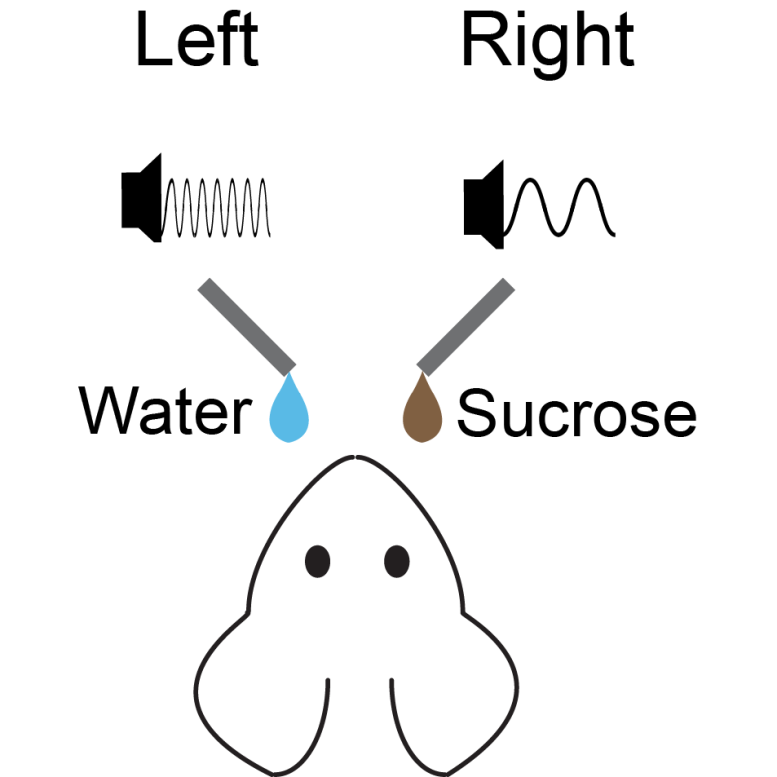
    Associating Specific Sounds With Certain Rewards
    This schematic illustrates how Li’s team trained mice to associate specific sounds with certain rewards. When the mice heard one sound, water would come out of a spout on their left. But when they heard a sound of another frequency, yummy sugar water would come out on their right. Credit: Li lab/Cold Spring Harbor Laboratory

    The team also saw that the mice’s brains fired more Sst+ CeA neurons more strongly after training. This suggested the neurons are important for learning. To test this suspicion, the neuroscientists inhibited Sst+ CeA neurons in some of the mice. They found that these animals could not learn to associate sounds with rewards or punishments.

    Linking Amygdala Neurons to Dopamine Function

    With the neurons inhibited, the team made another key finding. Normal dopamine neuron responses were also suppressed. While previous research had linked the CeA to dopamine neurons, it was unclear exactly how they were connected.

    “We found those neurons are required for normal function for dopamine neurons, and therefore are important for reward learning,” Li says. “That is direct evidence of how CeA neurons regulate the function of dopamine neurons.”

    Next, Li plans to examine the relationship between Sst+ CeA neurons and addiction. This could one day lead to better treatments for opioid or methamphetamine addicts, he says.

    “Our study provides a basis for developing more specific ways to regulate these neurons in different disease conditions,” Li says.

    Reference: “Plastic and stimulus-specific coding of salient events in the central amygdala” by Tao Yang, Kai Yu, Xian Zhang, Xiong Xiao, Xiaoke Chen, Yu Fu and Bo Li, 5 April 2023, Nature.
    DOI: 10.1038/s41586-023-05910-2


    Funding: NIH/National Institutes of Health, Human Frontier Science Program, Wodecroft Foundation, Cold Spring Harbor Laboratory, Northwell Health, Feil Family Neuroscience Endowment, National Medical Research Council

    Never miss a breakthrough: Join the SciTechDaily newsletter.
    Follow us on Google and Google News.

    Brain Cold Spring Harbor Laboratory Neuroscience Popular
    Share. Facebook Twitter Pinterest LinkedIn Email Reddit

    Related Articles

    Singing Mice Unlock the Mysteries of Brain Time Perception

    Neuroscientists Uncover Why the Brain Enjoys Music

    How Touching Is Perceived in the Brain – Investigated With Two-Person MRI Scans on Couples

    MIT Neuroscientists Demonstrate Controlling Attention With Brain Waves

    Dreams May Serve a Real Purpose: Preparing Us to Face Our Fears

    DMT Creates Vivid Waking Dream State in the Brain – “It’s Like Dreaming but With Your Eyes Open”

    Scientists Establish Functional Brain-to-Brain Interface between Human and Animal

    Photos of Einstein’s Brain Show Unique Features

    Be Like Neo and Learn New Skills Matrix-Style

    2 Comments

    1. Richardson David Sarfo-Yeboah on April 6, 2023 1:13 pm

      Very interesting and education stuff

      Reply
    2. Richardson David Sarfo-Yeboah on April 6, 2023 1:13 pm

      educative*

      Reply
    Leave A Reply Cancel Reply

    • Facebook
    • Twitter
    • Pinterest
    • YouTube

    Don't Miss a Discovery

    Subscribe for the Latest in Science & Tech!

    Trending News

    New Pill Lowers Stubborn Blood Pressure and Protects the Kidneys

    Humans May Have Hidden Regenerative Powers, New Study Suggests

    Scientists Just Solved the Mystery of Why Crabs Walk Sideways

    Doctors Are Surprised by What This Vaccine Is Doing to the Heart

    This Popular Supplement May Boost Your Brain, Not Just Your Muscles

    Scientists Say This Simple Supplement May Actually Reverse Heart Disease

    Warming Oceans Could Trigger a Dangerous Methane Surge

    This Simple Movement Could Be Secretly Cleaning Your Brain

    Follow SciTechDaily
    • Facebook
    • Twitter
    • YouTube
    • Pinterest
    • Newsletter
    • RSS
    SciTech News
    • Biology News
    • Chemistry News
    • Earth News
    • Health News
    • Physics News
    • Science News
    • Space News
    • Technology News
    Recent Posts
    • New Discovery Challenges Decades-Old Theory of DNA Damage and Aging
    • Scientists Just Rewrote Biology: “Hidden” Mechanism Could Transform Diabetes Treatment
    • Scientists Solve 320-Million-Year Mystery of Reptile Skin Armor
    • Hidden Heart Risk Found in 1 in 5 People, Study Warns
    • Scientists Say This Daily Walking Habit May Be the Secret to Keeping Weight Off After Dieting
    Copyright © 1998 - 2026 SciTechDaily. All Rights Reserved.
    • Science News
    • About
    • Contact
    • Editorial Board
    • Privacy Policy
    • Terms of Use

    Type above and press Enter to search. Press Esc to cancel.