

Close Menu
    Facebook X (Twitter) Instagram
    SciTechDaily
    • Biology
    • Chemistry
    • Earth
    • Health
    • Physics
    • Science
    • Space
    • Technology
    Facebook X (Twitter) Pinterest YouTube RSS
    SciTechDaily
    Home»Biology»Overeating? Researchers Discover That These Cells May Be To Blame
    Biology

    Overeating? Researchers Discover That These Cells May Be To Blame

    By Cold Spring Harbor LaboratoryDecember 1, 2022No Comments4 Mins Read
    Facebook Twitter Pinterest Telegram LinkedIn WhatsApp Email Reddit
    Share
    Facebook Twitter LinkedIn Pinterest Telegram Email Reddit
    Junk Food
    Researchers have identified a set of neurons that drive mice to consume fatty or sugary foods even when they are not hungry.

    A new study reveals that a region of the brain called the amygdala may be responsible for overeating. 

    The amygdala, a region of the brain, is responsible for strong emotions such as fear. Researchers have recently shown that the amygdala may also be to blame for overeating. Professor Bo Li of Cold Spring Harbor Laboratory (CSHL) has identified a section of neurons in the amygdala that causes mice to eat fatty or sugary foods even when they are not hungry. Therapeutics targeting these neurons might lead to new obesity treatments with few side effects.

    Neurons That Drive Hedonic Eating

    Mice, like the majority of humans, like foods that are high in fat and sugar. Instead of eating these foods to survive, they may do so for enjoyment. They may indulge in these treats for pleasure, rather than for survival. The neurons Li and his colleagues studied trigger this behavior, called hedonic eating.

    Li notes: “Even if the animal is supposed to stop eating because they are already full, if those neurons are still active, it can still drive those animals to eat more.”
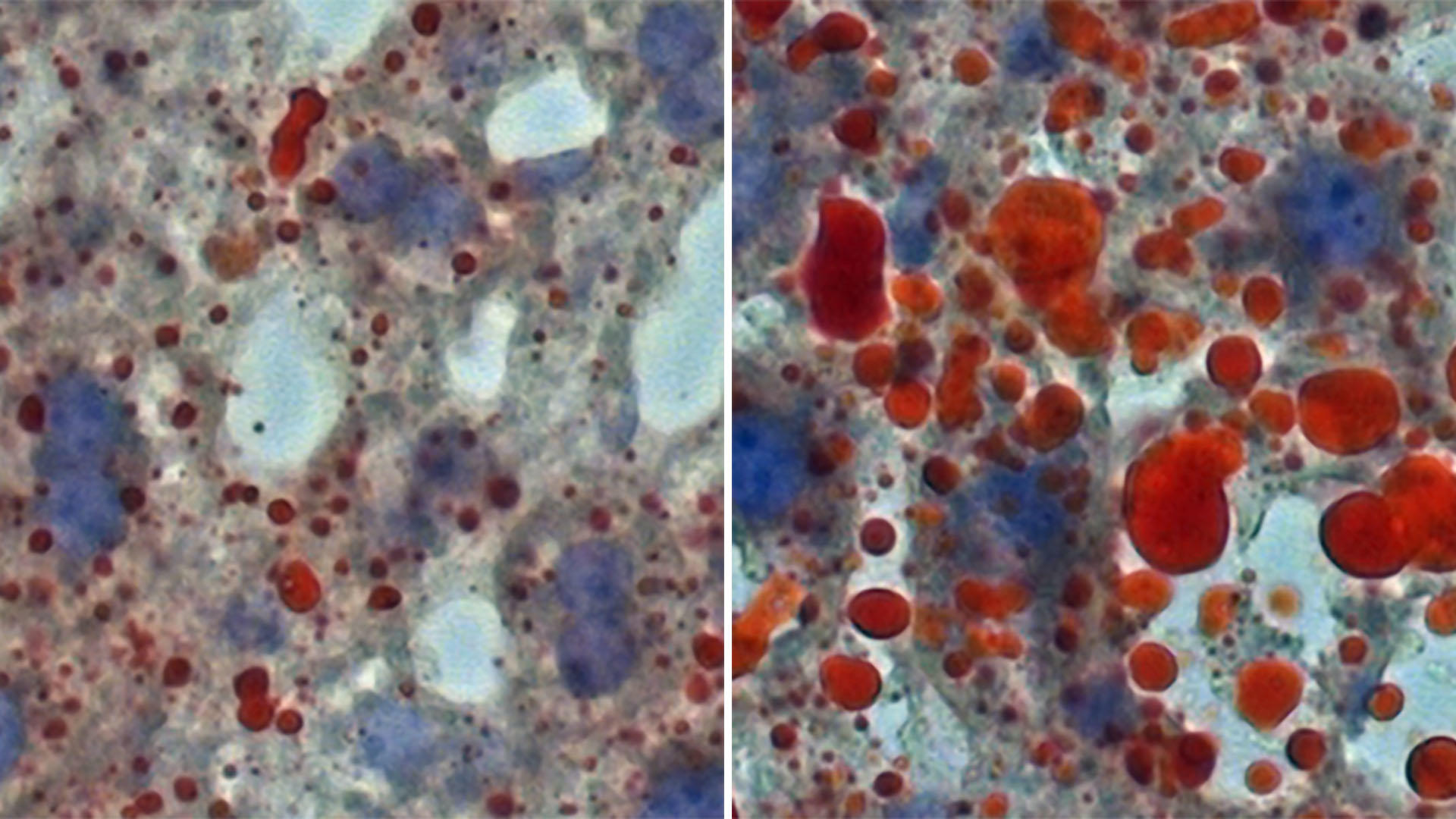
    Lipid Droplets in Mouse Liver
    When the neurons Li studied were inactivated, it protected mice against long-term weight gain. The left image shows lipid droplets (red) in the liver of a mouse that had those neurons turned off. In contrast, the right image shows many more lipid droplets in mice that did not have the neurons turned off. Credit: Bo Li Lab/CSHL/2022

    According to Li, almost no one succeeds in long-term weight management while treating obesity. Metabolic processes in the body often undo any progress made. Therapeutics may improve the chances of successful treatment, yet many drugs have undesirable side effects.

    “The medications currently available to aid weight management can cause significant side effects. So, a more targeted approach is needed,” Li says. “Identifying the brain circuitry that controls eating is important for developing better treatment options for people who struggle to control their weight.”

    Shutting Off Overeating Neurons

    When the team switched off the specific neurons, mice weren’t drawn to the fatty, sugary foods that had tempted them before. “They just happily ate and stayed healthy,” Li says. “They not only stopped gaining weight but also seemed to be much healthier overall.” Switching these neurons off reduced overeating and protected against obesity. It also boosted the animals’ physical activity, leading to weight loss and better metabolic health.

    Li and his team are exploring ways to manipulate the neurons that trigger hedonic eating. The next step, he says, is to map out how these neurons respond to different types of food and see what makes them so sensitive. He hopes this collaboration will lead to new strategies for effective anti-obesity therapeutics.

    For this study, Li and CSHL Associate Professor Stephen Shea combined their neuroscience expertise with CSHL Professor Tobias Janowitz’s expertise in metabolism and endocrinology. They also collaborated with CSHL Assistant Professor Semir Beyaz, an expert in gut and nutrition research. It’s part of an ongoing, multidisciplinary initiative at CSHL to research the connections between the brain and the body.

    Reference: “Neurotensin neurons in the extended amygdala control dietary choice and energy homeostasis” by Alessandro Furlan, Alberto Corona, Sara Boyle, Radhashree Sharma, Rachel Rubino, Jill Habel, Eva Carlotta Gablenz, Jacqueline Giovanniello, Semir Beyaz, Tobias Janowitz, Stephen David Shea and Bo Li, 20 October 2022, Nature Neuroscience.
    DOI: 10.1038/s41593-022-01178-3

    The study was funded by the European Molecular Biology Organization, the Swedish Research Council, the Charles H. Revson Foundation, the National Institutes of Health, the Feil Family Neuroscience Endowment, Cold Spring Harbor Laboratory and Northwell Health Affiliation, and the German Academic Scholarship Foundation. 

    Never miss a breakthrough: Join the SciTechDaily newsletter.
    Follow us on Google and Google News.

    Brain Cold Spring Harbor Laboratory Diet Neuroscience Weight Gain
    Share. Facebook Twitter Pinterest LinkedIn Email Reddit

    Related Articles

    Aging Rewrites the Brain’s Protein Code – and Scientists Just Found the Switch

    Controlling Appetite Before It Starts: Scientists Identify Group of Neurons Linked to Feeling Full

    Pushing the Limits of Neuroscience: BARseq Is Mapping the Brain at a Million-Neuron Scale

    Scientists Discover How Sex Hormones Define Brain Differences Between Men and Women

    The Brain Balances Pleasure and Pain – Here’s How

    Neural Activity Differences Between an Expert’s Brain and a Novice’s

    Cooking Fueled the Growth of the Human Brain

    Mother’s Nurturing Results in Larger Hippocampus in Children

    Neuroscientists Study Cortical Areas Specialized in Processing Visual Inputs in Mice

    Leave A Reply Cancel Reply

    • Facebook
    • Twitter
    • Pinterest
    • YouTube

    Don't Miss a Discovery

    Subscribe for the Latest in Science & Tech!

    Trending News

    The Universe Is Expanding Too Fast and Scientists Can’t Explain Why

    “Like Liquid Metal”: Scientists Create Strange Shape-Shifting Material

    Early Warning Signals of Esophageal Cancer May Be Hiding in Plain Sight

    Common Blood Pressure Drug Shows Surprising Power Against Deadly Antibiotic-Resistant Superbug

    Scientists Uncover Dangerous Connection Between Serotonin and Heart Valve Disease

    Scientists Discover a “Protector” Protein That Could Help Reverse Hair Loss

    Bone-Strengthening Discovery Could Reverse Osteoporosis

    Scientists Uncover Hidden Trigger Behind Stem Cell Aging

    Follow SciTechDaily
    • Facebook
    • Twitter
    • YouTube
    • Pinterest
    • Newsletter
    • RSS
    SciTech News
    • Biology News
    • Chemistry News
    • Earth News
    • Health News
    • Physics News
    • Science News
    • Space News
    • Technology News
    Recent Posts
    • Scientists Overcome Major Quantum Bottleneck, Potentially Transforming Teleportation and Computing
    • Quantum Physics’ Strangest Problem May Hold the Key to Time Itself
    • Scientists Create “Liquid Gears” That Spin Without Touching
    • The Simple Habit That Could Help Prevent Cancer
    • Forgotten Medicinal Plant Shows Promise in Fighting Dangerous Superbugs
    Copyright © 1998 - 2026 SciTechDaily. All Rights Reserved.
    • Science News
    • About
    • Contact
    • Editorial Board
    • Privacy Policy
    • Terms of Use

    Type above and press Enter to search. Press Esc to cancel.