

Combining exercise with obesity medication helps people with obesity sustain and even improve weight loss, while those without structured treatment plans tend to regain weight.
Half of the Danish population are overweight, while 17 percent live with obesity. Worldwide, almost 40 percent are overweight and 13 percent live with obesity.
The condition is associated with increased risk for early death, as well as sequelae such as Type 2 diabetes, cardiovascular diseases, cancer, and infertility.
Weight regain after an initial successful weight loss in people with obesity, constitutes an important and unsolved problem. Until now, no well-documented study on which treatment method is best for maintaining a healthy weight loss has been available.
Researchers at University of Copenhagen and Hvidovre Hospital have completed a sensational study, which has been published in the world’s most quoted medical journal, The New England Journal of Medicine. By testing four different types of treatment following a diet-induced weight loss, the researchers demonstrate for the first time how it is possible for people with obesity to maintain long-term weight loss, says Professor Signe Torekov at the Department of Biomedical Sciences.
In a randomized clinical trial, the group of researchers has demonstrated a highly effective treatment after a diet-induced weight loss, by combining moderate to vigorous-intensive exercise with appetite-inhibiting obesity medication, an analog to the appetite-inhibiting hormone GLP-1.
“This is new knowledge for doctors, dietitians, and physical therapists to use in practice. This is evidence that we have been missing,” explains Signe Torekov, who has been heading the study.
“The problem is that people are fighting against strong biological forces when losing weight. The appetite increases simultaneously with decreased energy consumption, and this counteracts weight loss maintenance. We have an appetite-stimulating hormone, which increases dramatically when we lose weight, and simultaneously the level of appetite-suppressing hormones drops dramatically. In addition, a weight loss can provoke loss of muscle mass, while the body reduces the energy consumption. Thus, when the focus in obesity treatment has been on how to obtain a weight loss – rather than how to maintain a weight loss – it is really difficult to do something about your situation,” says Signe Torekov.
Highly Efficient When Combining Treatments
215 Danes with obesity and low fitness ratings participated in the study. The participants initially followed a low-calorie diet over eight weeks, where they each lost approximately 13 kg (29 lb), which brought significant improvements to their health with a drop in blood sugar level and blood pressure.
The participants were then randomly divided into four groups. Two of the groups received placebo medication, while the two other groups received obesity medication. Among the two placebo groups, one group followed an exercise program of minimum 150 minutes of physical activity at moderate intensity or 75 minutes at vigorous-intensity during the week or a combination of the two, while the other group maintained their current level of physical activity. The two groups receiving obesity medication were similarly divided into one group with and one group without an exercise program.
All participants in the study were weighed monthly and received nutritional and diet counseling with the focus on healthy weight loss according to the guidelines from the Danish health and food administrations.
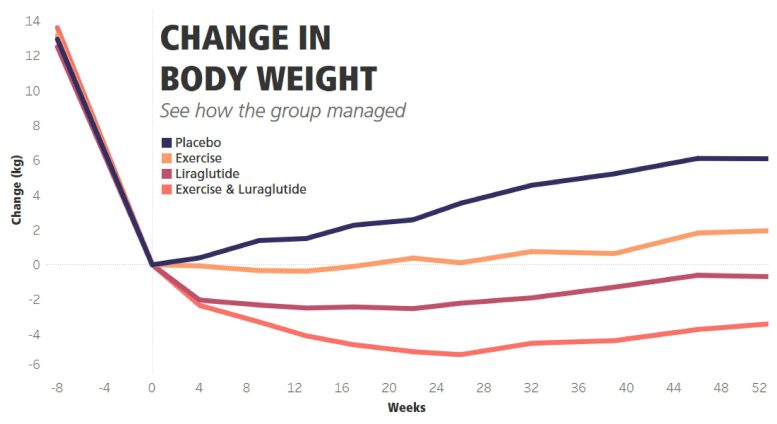
After one year, the group with exercise alone and the group with obesity medication alone maintained the weight loss of 13 kg and health improvements. The placebo group gained half of the weight back with deterioration of all risk factors, for example for development of Type 2 diabetes and cardiovascular disease.
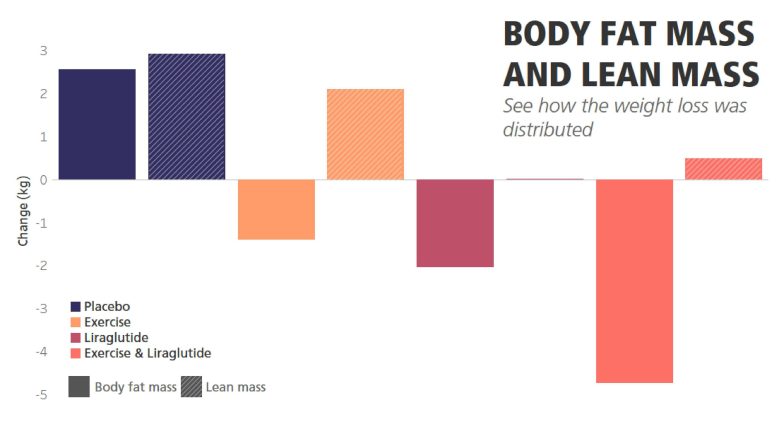
The most dramatic improvements occurred in the combination group, which followed the exercise program and received obesity medication. The researchers observed additional weight loss in this group, and the total weight loss was approximately 16 kg over one year. The health benefits were also double that of each of the single treatments, i.e., twice the loss of fat mass while preserving muscle mass, higher fitness ratings, reduced blood sugar, and improved quality of life.
The two groups that exercised increased their fitness rating, lost fat mass, and gained muscle mass. This could indicate a healthier weight loss than for people, who had only lost fat mass without increasing the fitness rating.
“It is an important aspect to highlight, as you do not necessarily get a healthier body from losing weight if, at the same time, you lose a lot of muscle mass,” says Signe Torekov.
“It is great news for public health that a significant weight loss can be maintained with exercise for approximately 115 minute per week performed mostly at vigorous-intensity, such as cycling. And that by combining exercise with obesity medication, the effect is twice as good as each of the individual treatments.”
With the study, the researchers now hope people with obesity, together with their care provider, can create a useful framework for maintaining the weight loss.
Fundamental Lifestyle Change
Signe Torekov points out that many people with obesity have tried to lose weight before, only to regain the weight. This happens, because the general advice is to eat healthier and exercise more.
“Without a follow-up on whether people actually have support to perform exercise, the treatment will not be enough. Therefore, we also followed up with the participants on an ongoing basis to ensure that they received the support they needed in order to exercise. That is necessary, because maintaining weight loss is extremely hard. People need to understand this. Once you have lost weight, you are not “cured.” “The ongoing exercise and effort will likely need to continue for many years,” says Signe Torekov.
“Our study also demonstrates that without a structured treatment plan, there is a high risk of gaining the weight back. There were 12 individual consultations over the course of a year, including weighing and diet advice from Danish authorities according to guidelines for healthy weight maintenance. This was just not enough for the placebo group without exercise program, in this group all health benefits gained by weight loss during the eight-week program were gone after one year, despite frequent weighing and diet and nutritional counseling based on official guidelines,” Torekov says.
According to Signe Torekov, this underscores the importance of participating in a mutual weight maintenance program based on feedback when starting a weight loss program.
“Therefore, it is important that there is a system for supporting people with obesity in maintaining the lifestyle change. Our study can help with this, because we can say this actually works to doctors, dietitians, and municipalities, if they create a structured, joint treatment plan with the individual using ongoing follow-ups,” says Torekov.
Reference: “Healthy Weight Loss Maintenance with Exercise, Liraglutide, or Both Combined” by Julie R. Lundgren, M.D., Ph.D.; Charlotte Janus, Ph.D.; Simon B.K. Jensen, M.Sc.; Christian R. Juhl, M.D., Lisa M. Olsen, M.Sc.; Rasmus M. Christensen, B.Sc.Med.; Maria S. Svane, M.D., Ph.D.; Thomas Bandholm, Ph.D.; Kirstine N. Bojsen-Møller, M.D., Ph.D.; Martin B. Blond, M.D., Ph.D.; Jens-Erik B. Jensen, M.D., Ph.D.; Bente M. Stallknecht, M.D., D.M.Sc.; Jens J. Holst, M.D., D.M.Sc.; Sten Madsbad, M.D., D.M.Sc. and Signe S. Torekov, Ph.D., 6 May 2021, New England Journal of Medicine.
DOI: 10.1056/NEJMoa2028198
Never miss a breakthrough: Join the SciTechDaily newsletter.
Follow us on Google and Google News.
26 Comments
Yeah, naming the medication would be more helpful in this case. I have lost half of my bodyweight due to bypass surgery. Should I start to regain it would be helpful to refer to the drug used in studies like these. Was it phentermine? Something else?
Liraglutide is mentioned in the title of the study as well as written in the table of the results.
It a whole.class.of drugs led glad trulicity. Byetta etc
The drug name was provided in the article. It’s Liraglutide.
Yeah, seriously. No name?!🙄
The medication used per the article references was Liraglutide.
Thank you, Deborah, for the name of the medication.
This is a terrible article
Contrave and/or Ozempic could also be considered as meds for theses studies
According to the graph, the appetite suppressant was Liraglutide.
I’ve lost and gained, lost again, gained again and more. It has been an ongoing struggle for few years. I am in my late 50’s . Never in my life have I had trouble with my weight as I have these past few years. Diet medication added would sure help!
liraglutide is named in the chart.
Victoza brand makes a liraglutide.
Angie, Liraglutide is titled on the chart. I’m assuming this is the drug name.
I wondered too. Here’s what I learned:
As noted, the article shows luraglutide in the figure.
Currently, it is injectable.
Luraglutide is indicated for the treatment of diabetes type 2 when other treatment fails. It has significant side effects and interactions for some.
Until an indication is approved, insurance companies usually don’t cover it.
The current indications and major side effects should have been described by the authors.
It might be easier to do 30 min of heart pounding cardio every day!
This is a very convoluted and poorly written article. It’s a shame too that the reader is left having to sift through this mess-of-an-article to gain insight to a very important finding.
Back in the 70s we didnt have this problem when everyone ate at home and fast food/restaurant diets were the exception. Also everyone was outside moving their bodies not just their fingers on a qwerty. No meds needed.
Im 54 and still bike, run, lift weights, train karate, hike and dont eat out. Im not as light as i was when I was 25 but its healthy and muscle weight. Of course i have to watch what i eat we all do but i still enjoy a slice of pizza or dining out once in a while. Its the exception though and i watch my portions.
I cant believe the amount of food you get in a single serving at restaurants these days. Enough for 2 ppl. I realize there is always a portion of the population that needs meds/additional help because genetically they are prone to be overweight so by all means get that extra help but thats a much smaller population. Most can do it if they put the donut down. Hell there is even sugar in pretty much every restaurant dish u buy.
Liraglutide is $1250\month & most insurance won’t cover it. It’s an injectable pen for diabetes.
I think medication is indicated in cases that have comorbidities outside your run of the mill metabolic syndrome population, but to market a medication to 40 percent of the population, based on evolving science is pure greed and embelished science. “EVERY” article and study has the small print …exercise and lifestyle.. In reality that transposed to neuroscience and behavior,which includes public education,is the only cure for the “CHARLIE” conspiracy. Just because the NEJ puts in print does not make it “truth”. One obvious citing, if l may, look at the profits made by pharmaceuticals ….ohh let’s say from the 1990s to present on type 2 diabetes medication.Just take a look at the top ten contributions to the ADA… AMERICAN DIABETES ASSOCIATION. .drop a note and learn more well cited information on CHARLIE… oppression through “C”arbohydrates….
Wow the thumbnail just had to be photoshopped-
And caused malignant tumors in the thyriod.
Please see the following- which was not mentioned in the article –
Supported by an Excellence grant (NNF16OC0019968, to Dr. Torekov) from the Novo Nordisk Foundation, by a grant (to Dr. Torekov) from the Novo Nordisk Foundation Center for Basic Metabolic Research, by a grant (NNF15CC0018486, to Dr. Torekov) from the Novo Nordisk Foundation Tripartite Immunometabolism Consortium, by Helsefonden, by a Ph.D. grant (to Dr. Lundgren) from the Faculty of Health and Medical Sciences, University of Copenhagen, and by a Ph.D. grant (to Dr. Janus) from the Danish Diabetes Academy and Department of Biomedical Sciences, University of Copenhagen.
Peddling $500/ month drugs is not new .
But not mentioning its a paid advertisement for the drug in the name of research is not kosher.
Supported by an Excellence grant (NNF16OC0019968, to Dr. Torekov) from the Novo Nordisk Foundation, by a grant (to Dr. Torekov) from the Novo Nordisk Foundation Center for Basic Metabolic Research, by a grant (NNF15CC0018486, to Dr. Torekov) from the Novo Nordisk Foundation Tripartite Immunometabolism Consortium, by Helsefonden, by a Ph.D. grant (to Dr. Lundgren) from the Faculty of Health and Medical Sciences, University of Copenhagen, and by a Ph.D. grant (to Dr. Janus) from the Danish Diabetes Academy and Department of Biomedical Sciences, University of Copenhagen.
Wouldn’t trust any study where they misspell the name of the drug.
Why not just bypass all that nonsense and instruct your subconcious brain to keep you fit and healthy.Anyone struggling with their weight constantly is because they have subconscious thoughts competing with conscious ones. Fix the problem from the inside, not the outside.
The West seems to have an obsession with one form of medication or another for all health problems. I for one have personally undergone a weight loss regime without any such external props. I focussed on the change of diet, switching from the customary diet to an ayurvedic diet plan that not only inhibited my urge to over eat but also brought down my weight much more drastically than what is reported in these medical studies without loss of energy and muscle mass. In fact, my energy levels have shot up and I do not experience fatigue even after a hectic day long schedule. Ayurveda insists that if you want to live long and healthy make your food your medicine, without at the same time sacrificing the taste element in food as most of the vegan food promoted in the West does. It is time the West dug deeper into the secrets of Ayurveda to unravel such remedies which are home made and hence easy on the pockets of the users, which perhaps may not be to the liking of the pharma industry in the West.
Did you notice the lines in the table? All the lines go up in only 52 weeks, that’s only a year. Even when throwing both exercise and the drug at the problem, the line still moves upward toward 52 weeks. Not much encouragement there.