
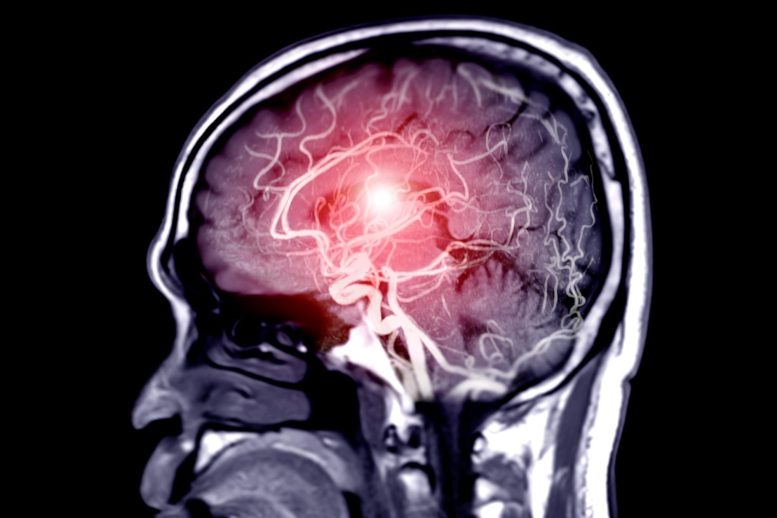
A study conducted at the University of Helsinki and the Helsinki University Hospital suggests that the APOE4 allele may also increase cerebral microhemorrhages related to COVID-19 and associate with mental fatigue related to long COVID.
Roughly one-third of Finns carry the APOE4 allele, a genetic variant that predisposes carriers to Alzheimer’s disease. Globally, researchers have reported observations that show a link between APOE4 and COVID-19, both in terms of increased susceptibility to SARS-CoV-2 infection and COVID-19 mortality. Now, a research group at the University of Helsinki and the Helsinki University Hospital (HUS) has investigated the link between the APOE4 allele and the severity of COVID-19 in the Finnish population.
The multidisciplinary group also investigated microscopic cerebral changes in cadavers who had suffered from COVID-19, as well as the link between APOE4 and symptoms of mental fatigue experienced six months after onset of the disease.
The new findings were published in the Acta Neuropathologica Communications journal.
“The common ε4 allele of the APOE gene appears to be associated with a heightened risk of severe COVID-19 in the Finnish population. The significance of APOE4 is emphasized in the Finnish population, which may be due to its genetic homogeneity,” says Liisa Myllykangas, a consultant neuropathologist from the University of Helsinki and HUS.
APOE4 Allele More Than Doubles the Risk of Severe COVID-19
According to the results, the risk of developing a form of COVID-19 that requires intensive care more than doubled in carriers of the APOE4 allele. Moreover, more microscopic hemorrhages were found in the brain as a result of severe COVID-19 in the study among carriers of this allele, compared to others.
According to Chief Physician, intensivist Johanna Hästbacka, APOE4 may also affect the severity of certain long-term symptoms, especially in cases of COVID-19 that require hospitalization.
“In the study, mental fatigue, which was defined as difficulty in directing attention and concentrating, emerged as one such symptom,” Hästbacka says.
More Research Needed
Myllykangas points out that, in the datasets now studied, the number of COVID-19 patients was relatively small, and the results must at this point be considered indicative.
“To ascertain our findings, these phenomena must be investigated in larger datasets,” she notes.
An important question not answered in the study is the connection between COVID-19 and the onset of memory disorders in APOE4 carriers.
“To answer this question, long-term follow-up studies on patients recovered from COVID-19 are needed, as is basic research focused on the combined effects of APOE4 and systemic inflammation on the mechanisms of memory in the brain. Our research group has already launched these lines of further research at the University of Helsinki and HUS,” Myllykangas says.
Reference: “APOE ε4 associates with increased risk of severe COVID-19, cerebral microhaemorrhages and post-COVID mental fatigue: a Finnish biobank, autopsy and clinical study” by Samu N. Kurki, Jonas Kantonen, Karri Kaivola, Laura Hokkanen, Mikko I. Mäyränpää, Henri Puttonen, FinnGen, Juha Martola, Minna Pöyhönen, Mia Kero, Jarno Tuimala, Olli Carpén, Anu Kantele, Olli Vapalahti, Marjaana Tiainen, Pentti J. Tienari, Kai Kaila, Johanna Hästbacka and Liisa Myllykangas, 23 December 2021, Acta Neuropathologica Communications.
DOI: 10.1186/s40478-021-01302-7
The study utilized research data from the FinnGen project that combines genome data produced from biobank samples with health data compiled from national registries. The results are based on data concerning more than 46,000 individuals, of whom over 2,600 had been diagnosed with COVID-19. In addition, tissue specimens collected from 21 deceased individuals who had suffered from COVID-19 were included in the study for the purpose of investigating microscopic changes in the brain. To investigate mental fatigue symptoms, the researchers utilized the RECOVID dataset in which patients were divided into three groups on the basis of disease severity. The dataset also included a healthy control group. In all, the RECOVID dataset comprised 156 study subjects.
Never miss a breakthrough: Join the SciTechDaily newsletter.
Follow us on Google and Google News.