
Close Menu
    Facebook X (Twitter) Instagram
    SciTechDaily
    • Biology
    • Chemistry
    • Earth
    • Health
    • Physics
    • Science
    • Space
    • Technology
    Facebook X (Twitter) Pinterest YouTube RSS
    SciTechDaily
    Home»Space»Brighter Than a Thousand Suns: Scientists Unravel Physics Behind Unusual Behavior of Stars’ Super Flares
    Space

    Brighter Than a Thousand Suns: Scientists Unravel Physics Behind Unusual Behavior of Stars’ Super Flares

    By University of Hawaii at ManoaJanuary 27, 2024No Comments4 Mins Read
    Facebook Twitter Pinterest Telegram LinkedIn WhatsApp Email Reddit
    Share
    Facebook Twitter LinkedIn Pinterest Telegram Email Reddit
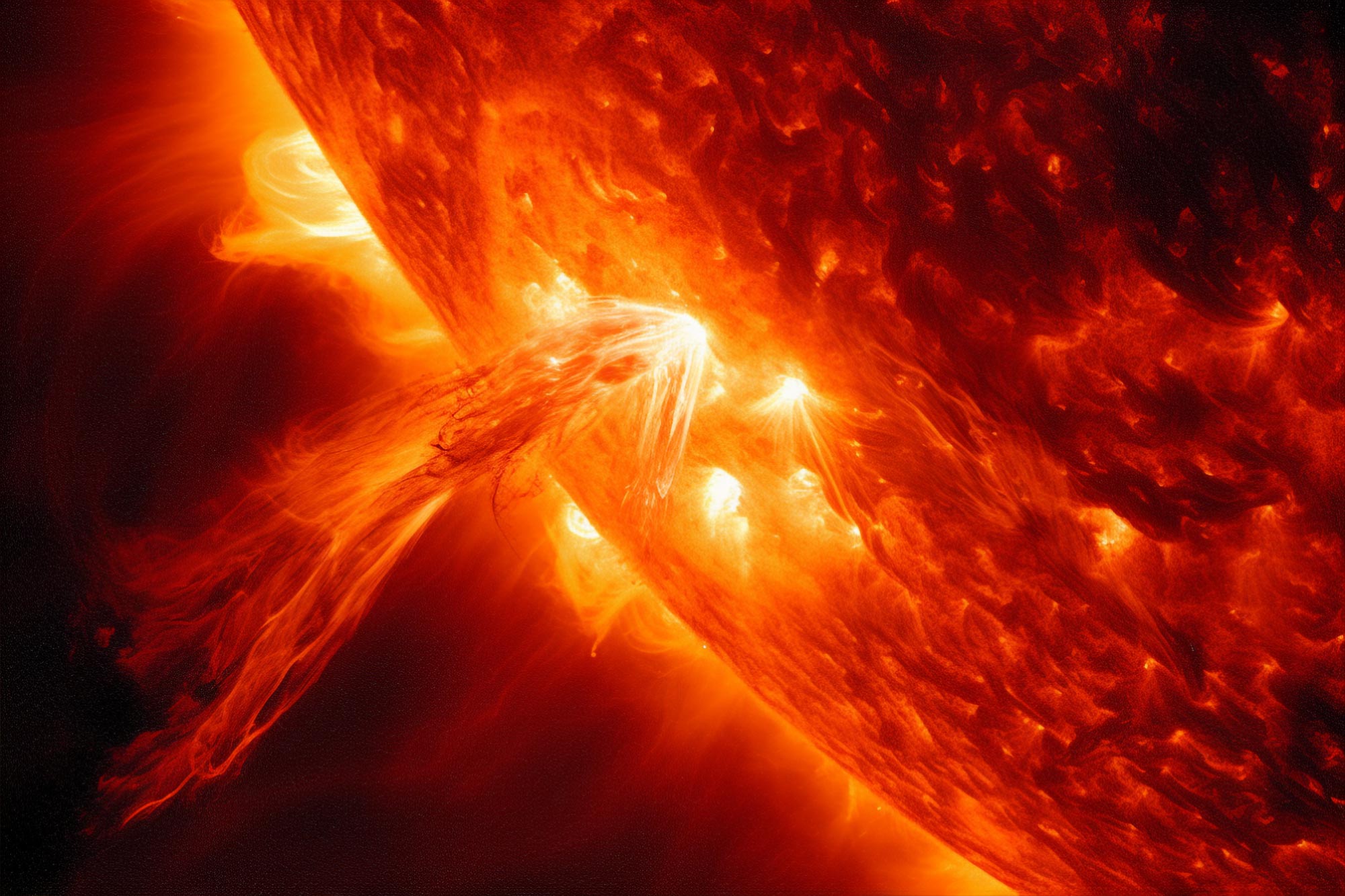
    Solar Flare Art Concept
    Intense solar flares, including larger “super flares” from other stars, are being studied to understand their impact and origins, with recent models indicating similar underlying physics and contributions from various star layers (Artist’s concept). Credit: SciTechDaily.com

    The Sun generates solar flares that can affect Earth, with the most intense ones capable of causing blackouts and communication disruptions worldwide. However, these solar flares are relatively mild compared to the “super flares” seen by NASA’s Kepler and TESS missions. These “super flares” come from stars and are 100 to 10,000 times brighter than those on the Sun.

    The physics are thought to be the same between solar flares and super flares: a sudden release of magnetic energy. Super-flaring stars have stronger magnetic fields and thus brighter flares but some show an unusual behavior—an initial, short lived brightness enhancement, followed by a secondary, longer-duration but less intense flare. A team led by University of Hawaiʻi Institute for Astronomy Postdoctoral Researcher Kai Yang and Associate Professor Xudong Sun developed a model to explain this phenomenon, which was published in The Astrophysical Journal.

    “By applying what we’ve learned about the Sun to other, cooler stars, we were able to identify the physics driving these flares, even though we could never see them directly,” said Yang. “The changing brightness of these stars over time actually helped us ʻsee’ these flares that are really far too small to observe directly.”

    Light curves

    The visible light in these flares was thought to come only from the lower layers of a star’s atmosphere. Particles energized by magnetic reconnection, rain down from the hot, tenuous corona (outer layer of a star) and heat these layers. Recent work hypothesized that the emission from coronal loops—hot plasma trapped by the Sun’s magnetic field—may also be detectable for super-flaring stars, but the density in these loops would need to be extremely high. Unfortunately, astronomers had no way to test this, since there is no way to see these loops on stars besides our own Sun.
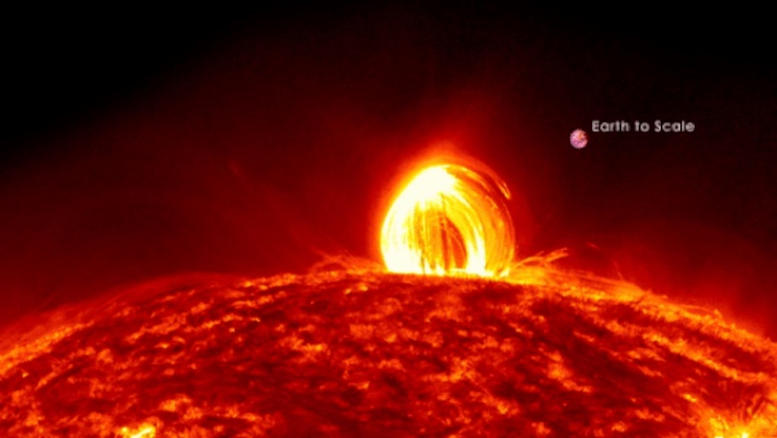
    Coronal Loop on the Sun
    A image of a coronal loop on the Sun from the Solar Dynamics Observatory, showing the ʻcoronal rainʻ phenomenon. An image of the Earth is included to provide a scale for the loop, which is more than 10 times larger than Earth. Credit: NASA’s Solar Dynamics Observatory/Scientific Visualization Studio/Tom Bridgman

    Other astronomers, using data from Kepler and TESS telescopes, spotted stars with a peculiar light curve—similar to a celestial “peak-bump,” a jump in brightness. It turns out, this light curve bears a resemblance to a solar phenomenon where a second, more gradual peak follows the initial burst.

    “These light curves reminded us of a phenomenon we’ve seen on the Sun, called solar late-phase flares,” said Sun.

    Producing similar late-phase brightness

    Researchers asked, “Could the same process—energized, large stellar loops—produce similar late-phase brightness enhancements in visible light?”

    Yang tackled this question by adapting fluid simulations that had been frequently used to simulate solar flare loops, and scaling up the loop length and magnetic energy. He found that the large flare energy input pumps significant mass into the loops—resulting in dense, bright, visible-light emission, just as predicted.

    These studies revealed that we only see such “bump” flaring light when the super-hot gas cools down at the highest part of the loop. Because of gravity, this glowing material then falls, creating what we call “coronal rain,” which we often see on the Sun. This gives the team confidence that the model must be realistic.

    Reference: “A Possible Mechanism for the “Late Phase” in Stellar White-light Flares” by Kai E. Yang, Xudong Sun, Graham S. Kerr and Hugh S. Hudson, 6 December 2023, The Astrophysical Journal.
    DOI: 10.3847/1538-4357/ad077d

    Never miss a breakthrough: Join the SciTechDaily newsletter.
    Follow us on Google and Google News.

    Astronomy Astrophysics Popular Solar Flares Sun University of Hawaii at Manoa
    Share. Facebook Twitter Pinterest LinkedIn Email Reddit

    Related Articles

    Mysterious Aurora-Like Radio Emissions Uncovered Above a Sunspot

    Incredible New Views of the Sun – As You’ve Never Seen It Before

    Mysteries of Sun’s Corona Illuminated by Eclipse Data

    Magnetic Explosions Observed on Sun – Unlike Anything Seen Before [Video]

    Astronomers Predict What Will Happen When Our Sun Dies

    Astronomers Reveal How a Magnetic Cage Stopped a Solar Eruption

    VLA Provides New Insights into Solar Flares

    NASA Spacecraft Observe Magnetic Reconnection in Action

    New Observations Help Astronomers Learn How Young Stars Accrete Material and Grow

    Leave A Reply Cancel Reply

    • Facebook
    • Twitter
    • Pinterest
    • YouTube

    Don't Miss a Discovery

    Subscribe for the Latest in Science & Tech!

    Trending News

    Largest-Ever Study Finds Medicinal Cannabis Ineffective for Anxiety, Depression, PTSD

    250-Million-Year-Old Egg Solves One of Evolution’s Biggest Mysteries

    Living With Roommates Might Be Changing Your Gut Microbiome Without You Knowing

    Century-Old Cleaning Chemical Linked to 500% Increased Risk of Parkinson’s Disease

    What if Your Memories Never Happened? Physicists Take a New Look at the Boltzmann Brain Paradox

    One of the Universe’s Largest Stars May Be Getting Ready To Explode

    Scientists Discover Enzyme That Could Supercharge Ozempic-Like Weight Loss Drugs

    Popular Sweetener Linked to DNA Damage – “It’s Something You Should Not Be Eating”

    Follow SciTechDaily
    • Facebook
    • Twitter
    • YouTube
    • Pinterest
    • Newsletter
    • RSS
    SciTech News
    • Biology News
    • Chemistry News
    • Earth News
    • Health News
    • Physics News
    • Science News
    • Space News
    • Technology News
    Recent Posts
    • What Did Prehistoric Europeans Eat? Scientists Uncover Surprising Answers
    • Scientists Say This Overlooked Organ Could Hold the Key to Longer Life
    • Want Less Stress? Landmark Study Points to a Simple Habit
    • Scientists Reveal Eating Fruits and Vegetables May Increase Your Risk of Lung Cancer
    • AI Reveals Explosive Growth of Floating Algae Across the World’s Oceans
    Copyright © 1998 - 2026 SciTechDaily. All Rights Reserved.
    • Science News
    • About
    • Contact
    • Editorial Board
    • Privacy Policy
    • Terms of Use

    Type above and press Enter to search. Press Esc to cancel.