
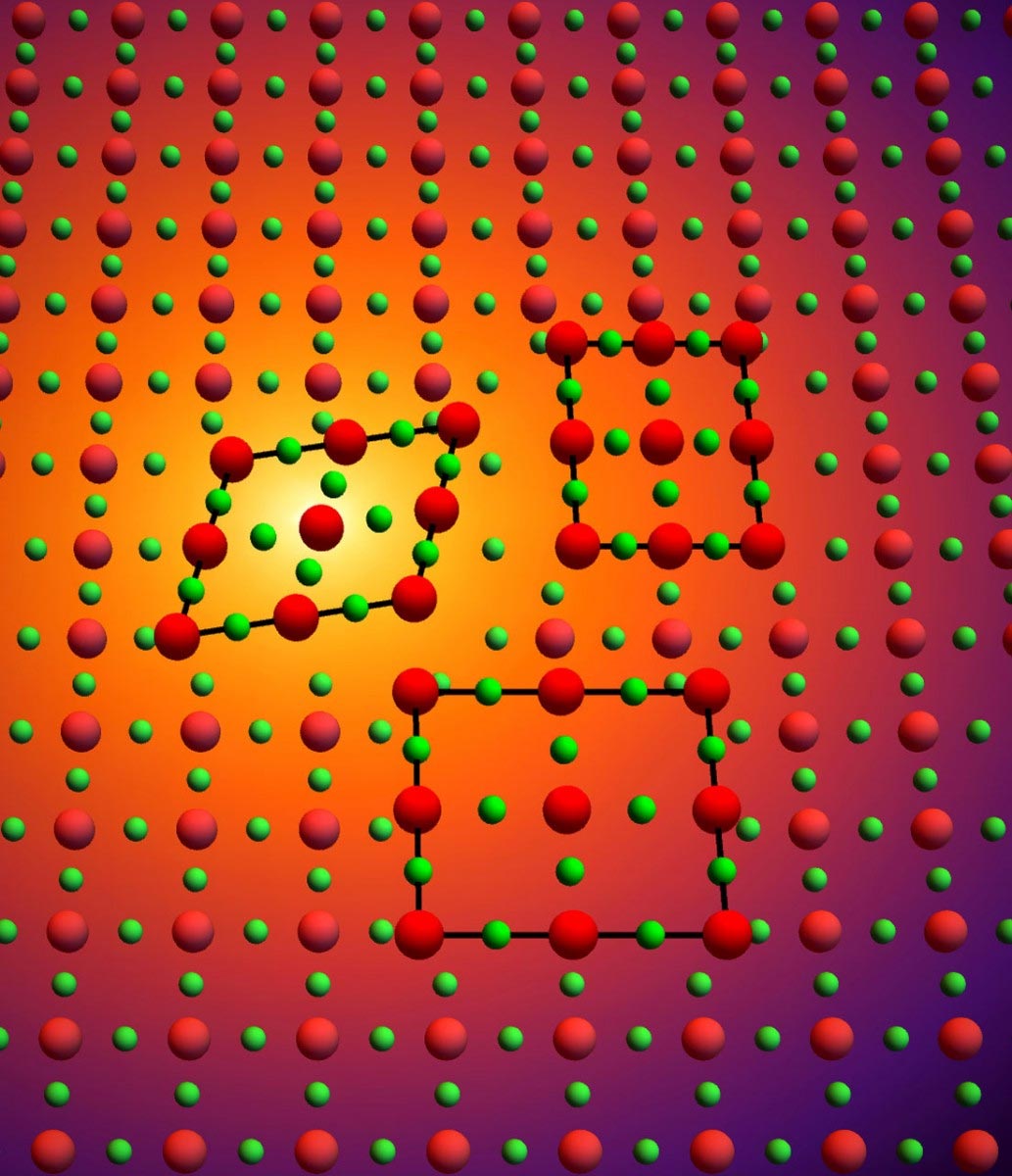
Until now, the history of superconducting materials has been a tale of two types: s-wave and d-wave.
Now, Cornell researchers — led by Brad Ramshaw, the Dick & Dale Reis Johnson Assistant Professor in the College of Arts and Sciences — have discovered a possible third type: g-wave.
Their paper, “Thermodynamic Evidence for a Two-Component Superconducting Order Parameter in Sr2RuO4,” published on September 21, 2020, in Nature Physics. The lead author is doctoral student Sayak Ghosh, M.S. ’19.
Electrons in superconductors move together in what are known as Cooper pairs. This “pairing” endows superconductors with their most famous property — no electrical resistance — because, in order to generate resistance, the Cooper pairs have to be broken apart, and this takes energy.
In s-wave superconductors — generally conventional materials, such as lead, tin, and mercury — the Cooper pairs are made of one electron pointing up and one pointing down, both moving head-on toward each other, with no net angular momentum. In recent decades, a new class of exotic materials has exhibited what’s called d-wave superconductivity, whereby the Cooper pairs have two quanta of angular momentum.
Physicists have theorized the existence of a third type of superconductor between these two so-called “singlet” states: a p-wave superconductor, with one quanta of angular momentum and the electrons pairing with parallel rather than antiparallel spins. This spin-triplet superconductor would be a major breakthrough for quantum computing because it can be used to create Majorana fermions, a unique particle which is its own antiparticle.
For more than 20 years, one of the leading candidates for a p-wave superconductor has been strontium ruthenate (Sr2RuO4), although recent research has started to poke holes in the idea.
Ramshaw and his team set out to determine once and for all whether strontium ruthenate is a highly desired p-wave superconductor. Using high-resolution resonant ultrasound spectroscopy, they discovered that the material is potentially an entirely new kind of superconductor altogether: g-wave.
“This experiment really shows the possibility of this new type of superconductor that we had never thought about before,” Ramshaw said. “It really opens up the space of possibilities for what a superconductor can be and how it can manifest itself. If we’re ever going to get a handle on controlling superconductors and using them in technology with the kind of fine-tuned control we have with semiconductors, we really want to know how they work and what varieties and flavors they come in.”
As with previous projects, Ramshaw and Ghosh used resonant ultrasound spectroscopy to study the symmetry properties of the superconductivity in a crystal of strontium ruthenate that was grown and precision-cut by collaborators at the Max Planck Institute for Chemical Physics of Solids in Germany.
However, unlike previous attempts, Ramshaw and Ghosh encountered a significant problem when trying to conduct the experiment.
“Cooling down resonant ultrasound to 1 kelvin (minus 457.87 degrees Fahrenheit) is difficult, and we had to build a completely new apparatus to achieve this,” Ghosh said.
With their new setup, the Cornell team measured the response of the crystal’s elastic constants — essentially the speed of sound in the material — to a variety of sound waves as the material cooled through its superconducting transition at 1.4 kelvin (minus 457 degrees Fahrenheit).
“This is by far the highest-precision resonant ultrasound spectroscopy data ever taken at these low temperatures,” Ramshaw said.
Based on the data, they determined that strontium ruthenate is what’s called a two-component superconductor, meaning the way electrons bind together is so complex, it can’t be described by a single number; it needs a direction as well.
Previous studies had used nuclear magnetic resonance (NMR) spectroscopy to narrow the possibilities of what kind of wave material strontium ruthenate might be, effectively eliminating p-wave as an option.
By determining that the material was two-component, Ramshaw’s team not only confirmed those findings, but also showed strontium ruthenate wasn’t a conventional s- or d-wave superconductor, either.
“Resonant ultrasound really lets you go in and even if you can’t identify all the microscopic details, you can make broad statements about which ones are ruled out,” Ramshaw said. “So then the only things that the experiments are consistent with are these very, very weird things that nobody has ever seen before. One of which is g-wave, which means angular momentum 4. No one has ever even thought that there would be a g-wave superconductor.”
Now the researchers can use the technique to examine other materials to find out if they are potential p-wave candidates.
However, the work on strontium ruthenate isn’t finished.
“This material is extremely well studied in a lot of different contexts, not just for its superconductivity,” Ramshaw said. “We understand what kind of metal it is, why it’s a metal, how it behaves when you change temperature, how it behaves when you change the magnetic field. So you should be able to construct a theory of why it becomes a superconductor better here than just about anywhere else.”
Reference: “Thermodynamic evidence for a two-component superconducting order parameter in Sr2RuO4” by Sayak Ghosh, Arkady Shekhter, F. Jerzembeck, N. Kikugawa, Dmitry A. Sokolov, Manuel Brando, A. P. Mackenzie, Clifford W. Hicks and B. J. Ramshaw, 21 September 2020, Nature Physics.
DOI: 10.1038/s41567-020-1032-4
Co-authors include researchers from the Max Planck Institute for Chemical Physics of Solids; the National High Magnetic Field Laboratory at Florida State University; and the National Institute for Materials Science in Tsukuba, Japan.
The Cornell research was supported by U.S. Department of Energy’s Office of Basic Energy Sciences and the Cornell Center for Materials Research, which is supported by the National Science Foundation’s Materials Research Science and Engineering Center program.
Never miss a breakthrough: Join the SciTechDaily newsletter.
Follow us on Google and Google News.