

Close Menu
    Facebook X (Twitter) Instagram
    SciTechDaily
    • Biology
    • Chemistry
    • Earth
    • Health
    • Physics
    • Science
    • Space
    • Technology
    Facebook X (Twitter) Pinterest YouTube RSS
    SciTechDaily
    Home»Physics»A Sensor So Good, It’s “Spooky” – Using Quantum Entanglement to Detect Magnetic Excitation
    Physics

    A Sensor So Good, It’s “Spooky” – Using Quantum Entanglement to Detect Magnetic Excitation

    By Japan Science and Technology AgencyFebruary 23, 2020No Comments3 Mins Read
    Facebook Twitter Pinterest Telegram LinkedIn WhatsApp Email Reddit
    Share
    Facebook Twitter LinkedIn Pinterest Telegram Email Reddit
    Quantum Sensor Artists Impression
    Artist’s impression of quantum sensor. Scientists have developed a new method to detect a single magnetic excitation in a sphere using quantum entanglement, representing a significant step towards quantum systems that can interact with magnetic materials.

    A sensor using quantum entanglement can determine if a single magnetic excitation is present in a millimeter-sized sphere. This moves us closer to the limit of magnetic detection possible under the laws of physics.

    Scientists from the Research Center for Advanced Science and Technology (RCAST) at The University of Tokyo demonstrated a method for coupling a magnetic sphere with a sensor via the strange power of quantum entanglement. They showed that the existence of even a single magnetic excitation in the sphere could be detected with a one-shot measurement. This work represents a major advancement toward quantum systems that can interact with magnetic materials.

    Imagine having a sensor powerful enough to tell you, in a single sweep, if a nearby haystack contained a needle or not. Such a device might seem like it could exist only in science fiction, but, using one of the most counterintuitive effects of quantum mechanics, this level of sensitivity can become reality. Entanglement, the strange process at the heart of quantum mechanics that allows linked particles to interact instantly over long distances, was once called “spooky action at a distance” by Albert Einstein.
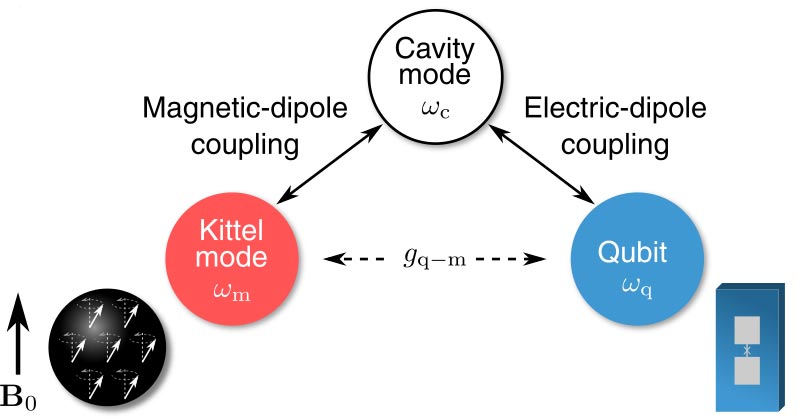
    Single-Magnon Detector Schematic
    Schematic of modes of interest in the single-magnon detector. The uniformly-processing mode of collective spin excitations in the ferromagnetic crystal, called Kittel mode, is coherently coupler to a superconducting qubit through a microwave cavity mode. Credit: ©Dany Lachance-Quirion

    Experiments have confirmed that quantum mechanics permits situations in which parts of a system can no longer be described separately, but rather become fundamentally entangled, such that the measurement of one automatically determines the fate of the other. For example, two electrons can become entangled so that they are both pointing up or both pointing down – so measuring one instantly affects the state of the other. “Entanglement has been in quantum mechanics textbooks for decades,” says first author Dr. Dany Lachance-Quirion, “but the applications for producing very sensitive detectors with it are only now starting to be realized.”

    In the experiments conducted at RCAST, a millimeter-sized sphere of yttrium iron garnet was placed in the same resonant cavity as a superconducting Josephson junction qubit, which acted as the sensor. Because of the coupling of the sphere to resonant cavity, and, in turn, between the cavity to the qubit, the qubit could only be excited by an electromagnetic pulse if no magnetic excitations were present in the sphere. Reading the state of the qubit then reveals the state of the sphere.

    “By using single-shot detection instead of averaging, we were able to make our device both highly sensitive and very fast,” Professor Yasunobu Nakamura explains. “This research could open the way for sensors powerful enough to help with the search for theoretical dark-matter particles called axions.”

    “Entanglement-based single-shot detection of a single magnon with a superconducting qubit” by Dany Lachance-Quirion, Samuel Piotr Wolski, Yutaka Tabuchi, Shingo Kono, Koji Usami and Yasunobu Nakamura, 24 January 2020, Science.
    DOI: 10.1126/science.aaz9236

    The work is published in the journal Science as “Entanglement-based single-shot detection of a single magnon with a superconducting qubit.”

    Never miss a breakthrough: Join the SciTechDaily newsletter.
    Follow us on Google and Google News.

    Particle Physics Popular Quantum Computing Quantum Physics Superconductor
    Share. Facebook Twitter Pinterest LinkedIn Email Reddit

    Related Articles

    Viking Knots Linked With Quantum Vortices – A Vortex Structure That Is Impervious to Decay

    A-List Candidate for Fault-Free Quantum Computing Delivers Puzzling Surprise

    This Exotic Particle Had an Out-of-Body Experience – These Surprised Scientists Took a Picture of It

    Levitation: Classic Magic Trick May Enable Quantum Computing

    Quantum Entanglement of Electrons Using Heat

    Closer Look at Quantum Weirdness Through a New Way to Control and Measure Atoms

    Teleportation Is Indeed Possible – At Least in the Quantum World

    A Playground for Exotic Physics, A Platform for Stable Quantum Computing

    Evidence of Elusive Majorana Fermions Raises Possibilities for Quantum Computing

    Leave A Reply Cancel Reply

    • Facebook
    • Twitter
    • Pinterest
    • YouTube

    Don't Miss a Discovery

    Subscribe for the Latest in Science & Tech!

    Trending News

    New Pill Lowers Stubborn Blood Pressure and Protects the Kidneys

    Humans May Have Hidden Regenerative Powers, New Study Suggests

    Scientists Just Solved the Mystery of Why Crabs Walk Sideways

    Doctors Are Surprised by What This Vaccine Is Doing to the Heart

    This Popular Supplement May Boost Your Brain, Not Just Your Muscles

    Scientists Say This Simple Supplement May Actually Reverse Heart Disease

    Warming Oceans Could Trigger a Dangerous Methane Surge

    This Simple Movement Could Be Secretly Cleaning Your Brain

    Follow SciTechDaily
    • Facebook
    • Twitter
    • YouTube
    • Pinterest
    • Newsletter
    • RSS
    SciTech News
    • Biology News
    • Chemistry News
    • Earth News
    • Health News
    • Physics News
    • Science News
    • Space News
    • Technology News
    Recent Posts
    • Your Blood Pressure Reading Could Be Wrong Because of One Simple Mistake
    • Scientists Discover Cheap Material That Kills Deadly Superbugs
    • This Magnetic Field Trick Creates Entirely New Forms of Matter
    • Astronomers Stunned by Ancient Galaxy With No Spin
    • Physicists May Be on the Verge of Discovering “New Physics” at CERN
    Copyright © 1998 - 2026 SciTechDaily. All Rights Reserved.
    • Science News
    • About
    • Contact
    • Editorial Board
    • Privacy Policy
    • Terms of Use

    Type above and press Enter to search. Press Esc to cancel.