
Northeastern researchers have used a powerful computer model to probe a puzzling class of copper-based materials that can be turned into superconductors. Their findings offer tantalizing clues for a decades-old mystery, and a step forward for quantum computing.
The ability of a material to let electricity flow comes from the way electrons within their atoms are arranged. Depending on these arrangements, or configurations, all materials out there are either insulators or conductors of electricity.
But cuprates, a class of mysterious materials that are made from copper oxides, are famous in the scientific community for having somewhat of an identity issue that can make them both insulators and conductors.
Under normal conditions, cuprates are insulators: materials that inhibit the flow of electrons. But with tweaks to their composition, they can transform into the world’s best superconductors.
The finding of this kind of superconductivity in 1986 won its discoverers a Nobel Prize in 1987, and fascinated the scientific community with a world of possibilities for improvements to supercomputing and other crucial technologies.
But with fascination came 30 years of bewilderment: Scientists have not been able to fully decipher the arrangement of electrons that encodes for superconductivity in cuprates.
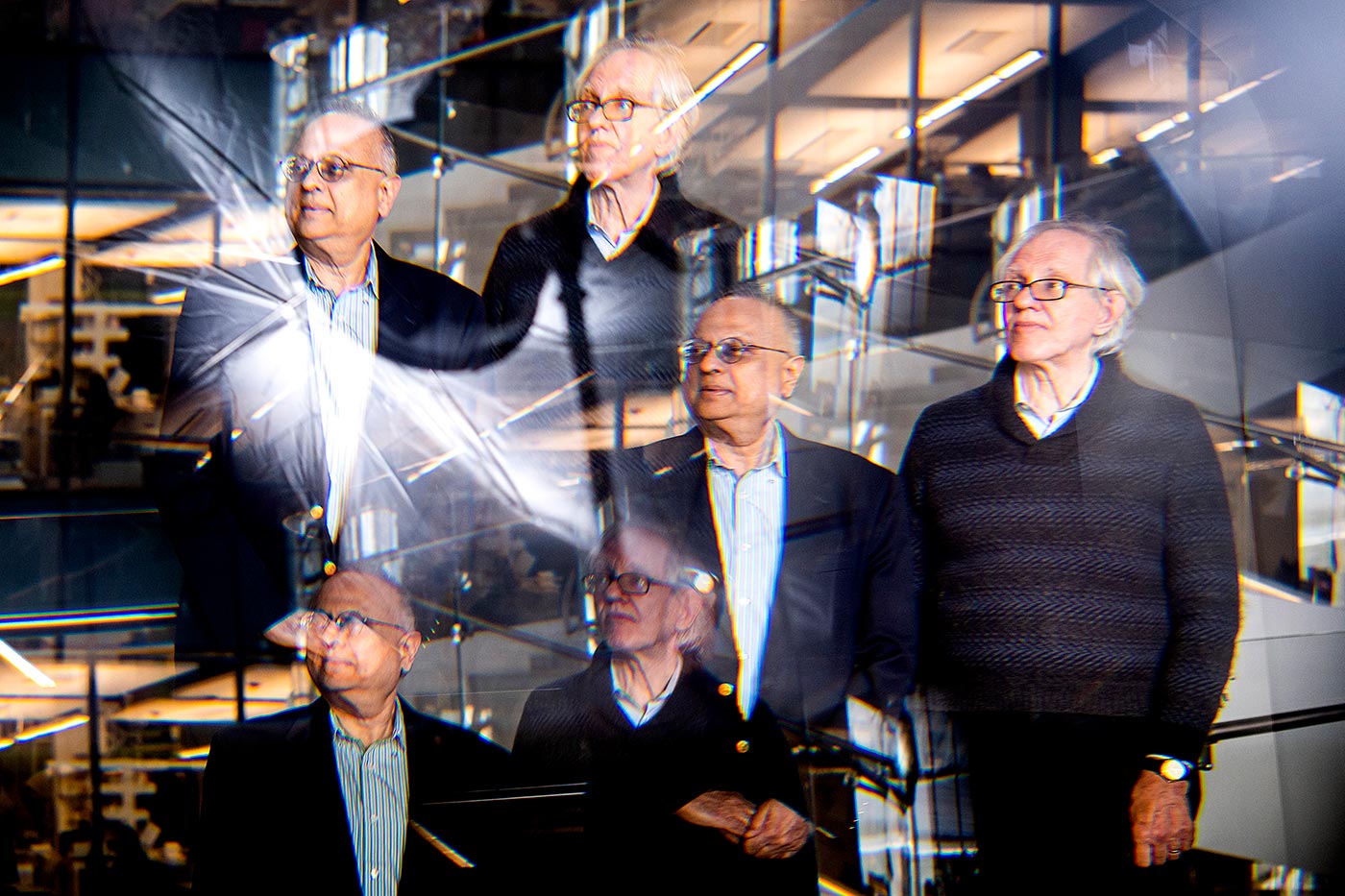
Mapping the electronic configuration of these materials is arguably one of the toughest challenges in theoretical physics, says Arun Bansil, University Distinguished Professor of physics at Northeastern. And, he says, because superconductivity is a weird phenomenon that only happens at temperatures as low as -300 F (or about as cold as it gets on Uranus), figuring out the mechanisms that make it possible in the first place could help researchers make superconductors that work at room temperature.
Now, a team of researchers that includes Bansil and Robert Markiewicz, a professor of physics at Northeastern, is presenting a new way to model these strange mechanisms that lead to superconductivity in cuprates.
In a study published in Proceedings of the National Academy of Sciences, the team accurately predicted the behavior of electrons as they move to enable superconductivity in a group of cuprates known as yttrium barium copper oxides.
In these cuprates, the study finds, superconductivity emerges from many types of electron configurations. A whopping 26 of them, to be specific.
“During this transition phase, the material will, in essence, become some kind of a soup of different phases,” Bansil says. “The split personalities of these wonderful materials are being now revealed for the first time.”
The physics within cuprate superconductors are intrinsically weird. Markiewicz thinks of that complexity as the classical Indian myth of the blind men and the elephant, which has been a joke for decades among theoretical physicists who study cuprates.
According to the myth, blind men meet an elephant for the first time, and try to understand what the animal is by touching it. But because each of them touches only one part of its body—the trunk, tail, or legs, for example—they all have a different (and limited) concept of what an elephant is.
“In the beginning, we all looked [at cuprates] in different ways,” Markiewicz says. “But we knew that, sooner or later, the right way was going to show up.”
The mechanisms behind cuprates could also help explain the puzzling physics behind other materials that turn into superconductors at extreme temperatures, Markiewicz says, and revolutionize the way they can be used to enable quantum computing and other technologies that process data at ultra-fast speeds.
“We’re trying to understand how they come together in the real cuprates that are used in experiments,” Markiewicz says.
The challenge of modeling cuprate superconductors comes down to the weird field of quantum mechanics, which studies the behavior and movement of the tiniest bits of matter—and the strange physical rules that govern everything at the scale of atoms.
In any given material—say, the metal in your smartphone—electrons contained within just the space of a fingertip could amount to the number one followed by 22 zeros, Bansil says. Modeling the physics of such a massive number of electrons has been extremely challenging ever since the field of quantum mechanics was born.
Bansil likes to think of this complexity as butterflies inside a jar flying fast and cleverly to avoid colliding with each other. In a conducting material, electrons also move around. And because of a combination of physical forces, they also avoid each other. Those characteristics are at the core of what makes it hard to model cuprate materials.
“The problem with the cuprates is that they are at the border between being a metal and an insulator, and you need a calculation that is so good that it can systematically capture that crossover,” Markiewicz says. “Our new modeling can capture this behavior.”
The team includes researchers from Tulane University, Lappeenranta University of Technology in Finland, and Temple University. The researchers are the first to model the electronic states in the cuprates without adding parameters by hand to their computations, which physicists have had to do in the past.
To do that, the researchers modeled the energy of atoms of yttrium barium copper oxides at their lowest levels. Doing that allows researchers to trace electrons as they excite and move around, which in turn helps describe the mechanisms supporting the critical transition into superconductivity.
That transition, known as the pseudogap phase in the material, could be described simply as a door, Bansil says. In an insulator, the structure of the material is like a closed door that lets no one through. If the door is wide open—as it would be for a conductor—electrons pass through easily.
But in materials that experience this pseudogap phase, that door would be slightly open. The dynamics of what transforms that door into a really wide open door (or, superconductor) remains a mystery, but the new model captures 26 electron configurations that could do it.
“With our ability to now do this first-principles-parameter-free-type of modeling, we are in a position to actually go further, and hopefully begin to understand this pseudogap phase a bit better,” Bansil says.
Reference: “Competing stripe and magnetic phases in the cuprates from first principles” by Yubo Zhang, Christopher Lane, James W. Furness, Bernardo Barbiellini, John P. Perdew, Robert S. Markiewicz, Arun Bansil, and Jianwei Sun, 8 November 2019, Proceedings of the National Academy of Sciences.
DOI: 10.1073/pnas.1910411116
Never miss a breakthrough: Join the SciTechDaily newsletter.
Follow us on Google and Google News.