
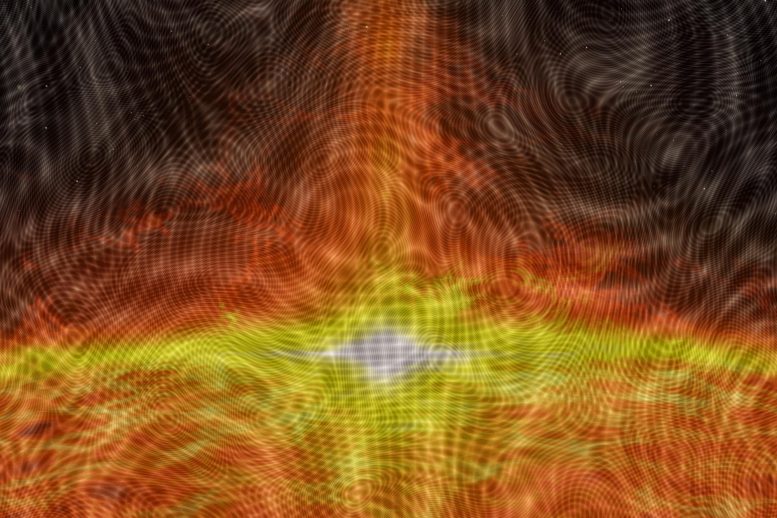
Humans have been studying electric charge for thousands of years, and the results have shaped modern civilization. Our daily lives depend on electric lighting, smartphones, cars, and computers, in ways that the first individuals to take note of a static shock or a bolt of lightning could never have imagined.
Now, physicists at Northeastern have discovered a new way to manipulate electric charge. And the changes to the future of our technology could be monumental.
“When such phenomena are discovered, imagination is the limit,” says Swastik Kar, an associate professor of physics. “It could change the way we can detect and communicate signals. It could change the way we can sense things and the storage of information, and possibilities that we may not have even thought of yet.”
The ability to move, manipulate, and store electrons is key to the vast majority of modern technology, whether we’re trying to harvest energy from the sun or play Plants vs. Zombies on our phone. In a paper published in Nanoscale, the researchers described a way to make electrons do something entirely new: Distribute themselves evenly into a stationary, crystalline pattern.
“I’m tempted to say it’s almost like a new phase of matter,” Kar says. “Because it’s just purely electronic.”
The phenomenon appeared while the researchers were running experiments with crystalline materials that are only a few atoms thick, known as 2D materials. These materials are made up of a repeating pattern of atoms, like an endless checkerboard, and are so thin that the electrons in them can only move in two dimensions.
Stacking these ultra-thin materials can create unusual effects as the layers interact at a quantum level.
Kar and his colleagues were examining two such 2D materials, bismuth selenide and a transition metal dichalcogenide, layered on top of each other like sheets of paper. That’s when things started to get weird.
Electrons should repel one another—they’re negatively charged, and move away from other negatively charged things. But that’s not what the electrons in these layers were doing. They were forming a stationary pattern.
“At certain angles, these materials seem to form a way to share their electrons that ends up forming this geometrically periodic third lattice,” Kar says. “A perfectly repeatable array of pure electronic puddles that resides between the two layers.”
At first, Kar assumed the result was a mistake. The crystalline structures of 2D materials are too small to observe directly, so physicists use special microscopes that fire beams of electrons instead of light. As the electrons pass through the material, they interfere with each other and create a pattern. The specific pattern (and a bunch of math) can be used to recreate the shape of the 2D material.
When the resulting pattern revealed a third layer that couldn’t be coming from either of the other two, Kar thought something had gone wrong in the creation of the material or in the measurement process. Similar phenomena have been observed before, but only at extremely low temperatures. Kar’s observations were at room temperature.
“Have you ever walked into a meadow and seen an apple tree with mangoes hanging from it?” Kar asks. “Of course we thought something was wrong. This couldn’t be happening.”
But after repeated testing and experiments led by doctoral student Zachariah Hennighausen, their results remained the same. There was a new lattice-style pattern of charged spots appearing between the 2D materials. And that pattern changed with the orientation of the two sandwiching layers.
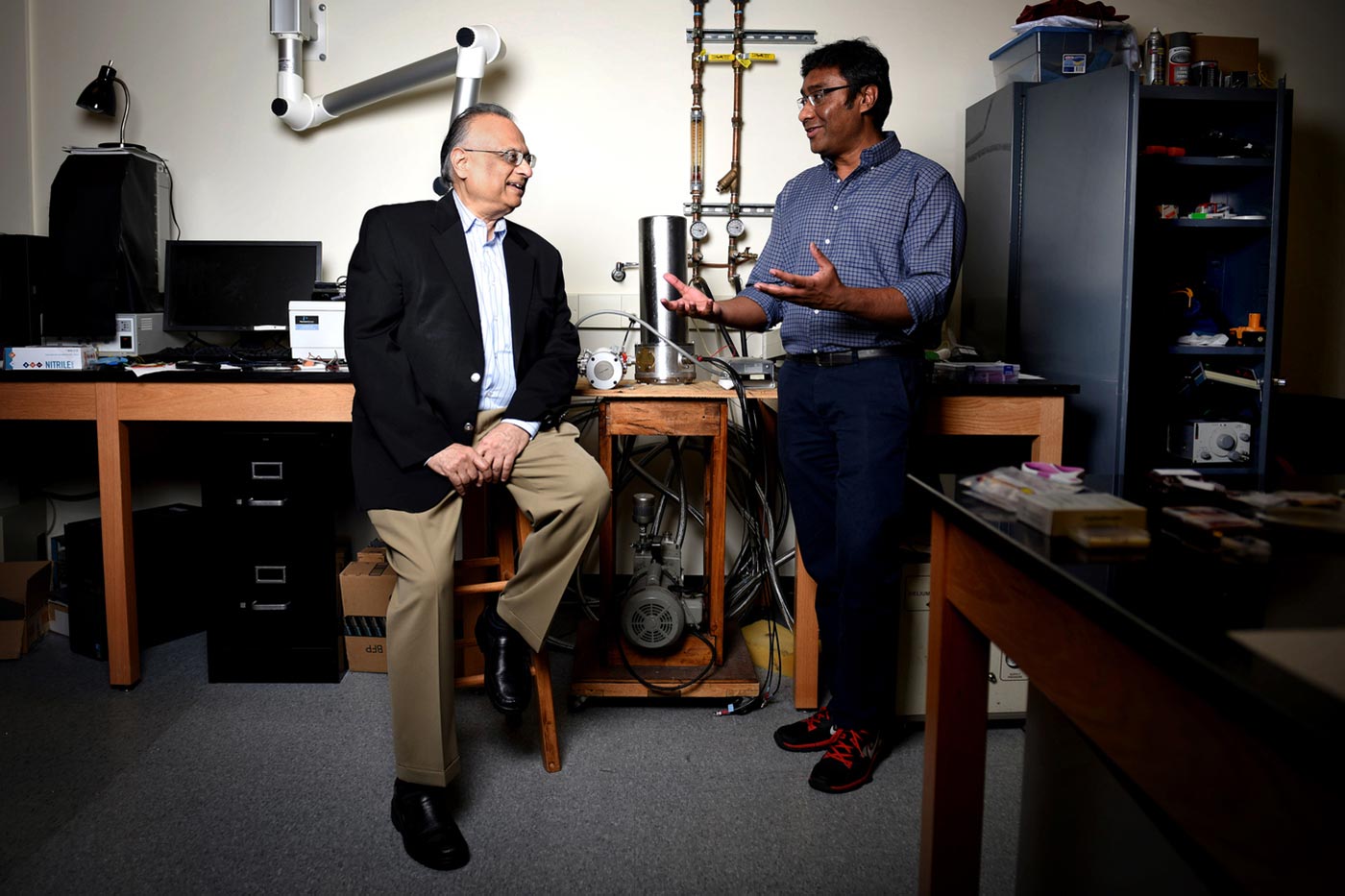
As Kar and his team had been working on the experimental investigation, Arun Bansil, a university distinguished professor of physics at Northeastern, and doctoral student Chistopher Lane were examining the theoretical possibilities, to understand how this could be happening.
Electrons in a material are always bouncing around, Bansil explains, as they are pulled on by the positively charged nuclei of atoms and repelled by other negatively charged electrons. But in this case, something about the way these charges are laid out is pooling electrons in a specific pattern.
“They produce these regions where there are, if you like, ditches of some kind in the potential landscape, which are enough to force these electrons to create these puddles of charge,” Bansil says. “The only reason electrons will form into puddles is because there’s a potential hole there.”
These ditches, so to speak, are created by a combination of quantum mechanical and physical factors, Bansil says.
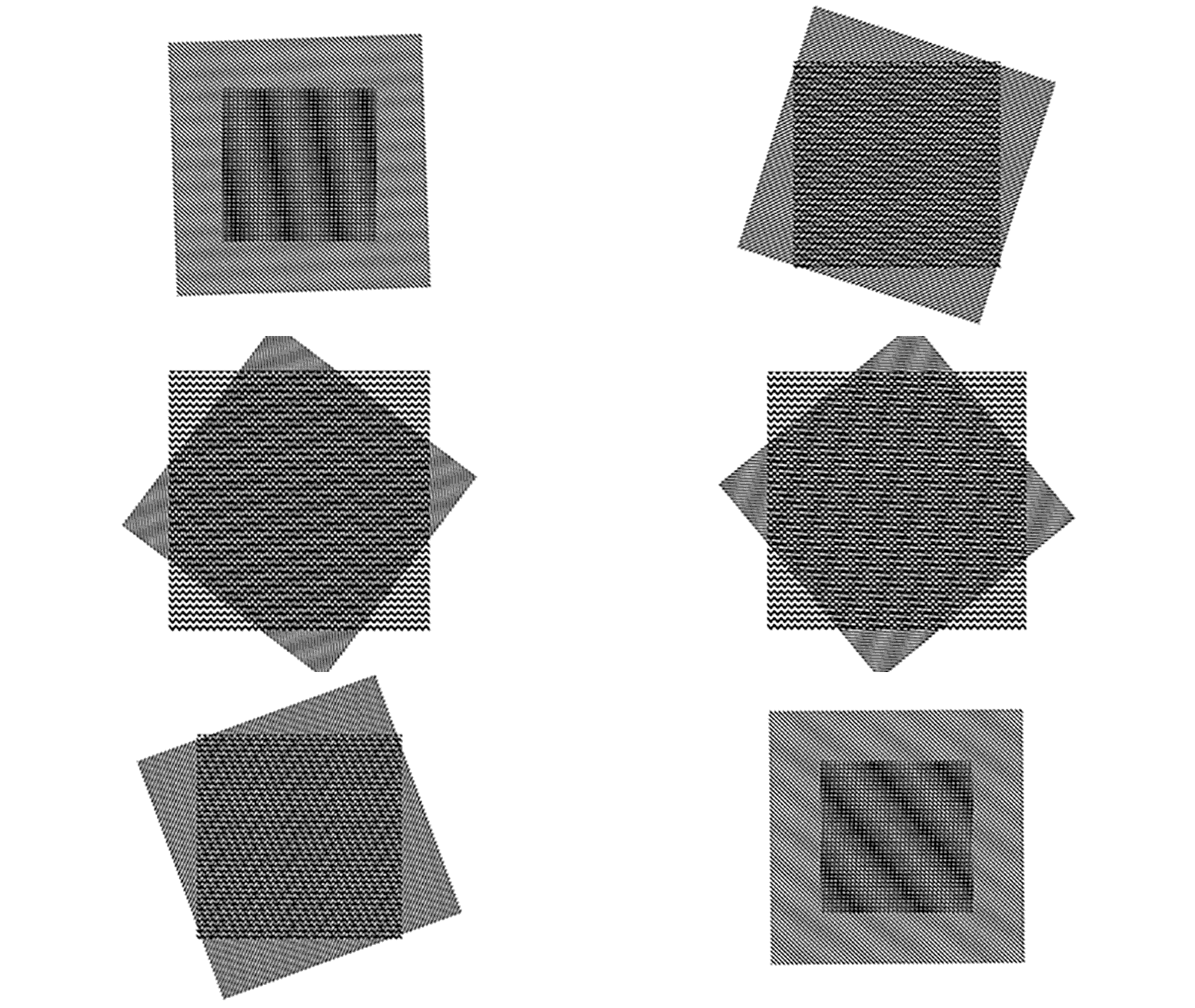
When two repeating patterns or grids are offset, they combine to create a new pattern (you can replicate this at home by overlapping the teeth of two flat combs). Each 2D material has a repeating structure, and the researchers demonstrated that the pattern created when those materials are stacked determines where electrons will end up.
“That is where it becomes quantum mechanically favorable for the puddles to reside,” Kar says. “It’s almost guiding those electron puddles to remain there and nowhere else. It is fascinating.”
While the understanding of this phenomenon is still in its infancy, it has the potential to impact the future of electronics, sensing and detection systems, and information processing.
“The excitement at this point is in being able to potentially demonstrate something that people have never thought could exist at room temperature before,” Kar says. “And now, the sky’s the limit in terms of how we can harness it.”
Reference: “Evidence of a purely electronic two-dimensional lattice at the interface of TMD/Bi2Se3 heterostructures” by Zachariah Hennighausen, Christopher Lane, Ioana Gianina Buda, Vineet K. Mathur, Arun Bansil and Swastik Kar, 1 August 2019, Nanoscale.
DOI: 10.1039/C9NR04412D
Never miss a breakthrough: Join the SciTechDaily newsletter.
Follow us on Google and Google News.