

Close Menu
    Facebook X (Twitter) Instagram
    SciTechDaily
    • Biology
    • Chemistry
    • Earth
    • Health
    • Physics
    • Science
    • Space
    • Technology
    Facebook X (Twitter) Pinterest YouTube RSS
    SciTechDaily
    Home»Science»Neuroscientists Discover Why the Memory of Fear Is Seared Into Our Brains
    Science

    Neuroscientists Discover Why the Memory of Fear Is Seared Into Our Brains

    By Tulane UniversityJune 29, 2022No Comments3 Mins Read
    Facebook Twitter Pinterest Telegram LinkedIn WhatsApp Email Reddit
    Share
    Facebook Twitter LinkedIn Pinterest Telegram Email Reddit
    Nightmare Fear Scared Woman
    Neuroscientists think they have discovered the mechanism behind the formation of fear memories in the amygdala —  the emotional hub of the brain

    Norepinephrine alters brain activity in the amygdala to form fear memories, explaining why frightening events are unforgettable and shedding light on PTSD.

    Experiencing a frightening event is likely something you’ll never forget. But why does it stay with you when other kinds of occurrences become increasingly difficult to recall with the passage of time?

    Norepinephrine, also known as noradrenaline, is a chemical made by some nerve cells and in the adrenal gland. It can function as both a neurotransmitter (a chemical messenger used by nerve cells) and a hormone (a chemical that travels in the blood and controls the actions of other cells or organs). Norepinephrine is released by the adrenal gland in response to stress and low blood pressure.


    A team of neuroscientists from the Tulane University School of Science and Engineering and Tufts University School of Medicine has been studying the formation of fear memories in the emotional hub of the brain – the amygdala —  and think they have discovered a mechanism.

    Changing Brain Wave Patterns in the Amygdala

    In a nutshell, the scientists found that the stress neurotransmitter norepinephrine, also called noradrenaline, facilitates fear processing in the brain by stimulating a certain population of inhibitory neurons in the amygdala to generate a repetitive bursting pattern of electrical discharges. This bursting pattern of electrical activity changes the frequency of brain wave oscillation in the amygdala from a resting state to an aroused state that promotes the formation of fear memories.

    Published recently in the journal Nature Communications, the research was led by Tulane cell and molecular biology professor Jeffrey Tasker, the Catherine and Hunter Pierson Chair in Neuroscience, and his PhD student Xin Fu.

    Tasker used the example of experiencing an armed robbery. “If you are held up at gunpoint, your brain secretes a bunch of the stress neurotransmitter norepinephrine, akin to an adrenaline rush,” he said.
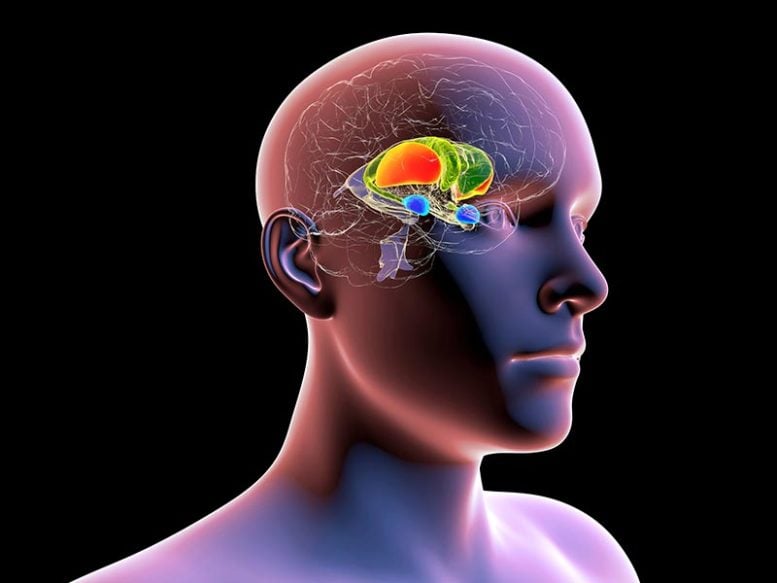
    Amygdala Brain
    The emotional hub of the brain is the amygdala — colored in blue — and it is where fear memories are formed.

    “This changes the electrical discharge pattern in specific circuits in your emotional brain, centered in the amygdala, which in turn transitions the brain to a state of heightened arousal that facilitates memory formation, fear memory, since it’s scary. This is the same process, we think, that goes awry in PTSD and makes it so you cannot forget traumatic experiences.”

    Reference: “Gq neuromodulation of BLA parvalbumin interneurons induces burst firing and mediates fear-associated network and behavioral state transition in mice” by Xin Fu, Eric Teboul, Grant L. Weiss, Pantelis Antonoudiou, Chandrashekhar D. Borkar, Jonathan P. Fadok, Jamie Maguire and Jeffrey G. Tasker, 11 March 2022, Nature Communications.
    DOI: 10.1038/s41467-022-28928-y

    This research was led by Tasker’s lab and was conducted in collaboration with the Jonathan Fadok lab of Tulane and the Jamie Maguire lab of Tufts. Fadok is an assistant professor of psychology who holds the Burk-Kleinpeter Inc. Professorship in Science and Engineering at Tulane. Maguire is an associate professor of neuroscience at the Tufts School of Medicine.

    Never miss a breakthrough: Join the SciTechDaily newsletter.
    Follow us on Google and Google News.

    Fear Memory Neuroscience Tulane University
    Share. Facebook Twitter Pinterest LinkedIn Email Reddit

    Related Articles

    Fear Engrams Unlocked: A Neuroscientific Journey Into Memory and Behavior

    Researchers Explain Why Certain People Possess Amazing Memory Abilities

    Artificially Reactivating Positive Memories Can Reverse Depression

    Chimpanzees Outplay Humans in Brain Games

    Neurobiologists Create New Memories by Directly Altering the Brain

    Study Reveals Cortex Used for Making Sensory Associations, Not the Hippocampus

    Neuroscientists Plant False Memories in the Brains of Mice

    Researchers Find a Link between Poor Sleep, Memory Loss and Brain Deterioration

    Disruption of Memory Reconsolidation Erases a Fear Memory Trace

    Leave A Reply Cancel Reply

    • Facebook
    • Twitter
    • Pinterest
    • YouTube

    Don't Miss a Discovery

    Subscribe for the Latest in Science & Tech!

    Trending News

    The Strange “Spacetime Crystal” That Can Suddenly Turn Into a Black Hole

    The Surprising Way Asteroids May Have Helped Life Begin on Earth

    Vast Hidden Structure Discovered Under Miles of Ice in East Antarctica

    A Surprising Discovery Suggests Autism Is Not One Condition

    New Alzheimer’s Discovery Could Change How Scientists Fight the Disease

    Yale Discovery Overturns Long-Held “Evolutionary Dead End” Theory

    UCLA Scientists Uncover a “Hidden Weakness” in Some of the World’s Deadliest Cancers

    Humpback Whale Stuns Scientists With 15,000 Kilometer Journey Across Oceans

    Follow SciTechDaily
    • Facebook
    • Twitter
    • YouTube
    • Pinterest
    • Newsletter
    • RSS
    SciTech News
    • Biology News
    • Chemistry News
    • Earth News
    • Health News
    • Physics News
    • Science News
    • Space News
    • Technology News
    Recent Posts
    • MIT’s New Dual-Mode Rocket System Could Send Tiny Satellites to Mars
    • Scientists Discover a Biological Clock Unlike Anything Seen Before
    • This “Zombie” Sea Creature Keeps Growing After Being Cut Apart
    • The Brain May Not Need Full Sleep To Recover, New Research Finds
    • Scientists Reveal the Hidden Way Caffeine Sabotages Sleep
    Copyright © 1998 - 2026 SciTechDaily. All Rights Reserved.
    • Science News
    • About
    • Contact
    • Editorial Board
    • Privacy Policy
    • Terms of Use

    Type above and press Enter to search. Press Esc to cancel.