
Close Menu
    Facebook X (Twitter) Instagram
    SciTechDaily
    • Biology
    • Chemistry
    • Earth
    • Health
    • Physics
    • Science
    • Space
    • Technology
    Facebook X (Twitter) Pinterest YouTube RSS
    SciTechDaily
    Home»Space»A Spooky Ghost of a Giant Star: What Remains After the Explosive Death of a Massive Star
    Space

    A Spooky Ghost of a Giant Star: What Remains After the Explosive Death of a Massive Star

    By European Southern ObservatoryOctober 31, 2022No Comments6 Mins Read
    Facebook Twitter Pinterest Telegram LinkedIn WhatsApp Email Reddit
    Share
    Facebook Twitter LinkedIn Pinterest Telegram Email Reddit
    Vela Supernova Remnant VLT Survey Telescope
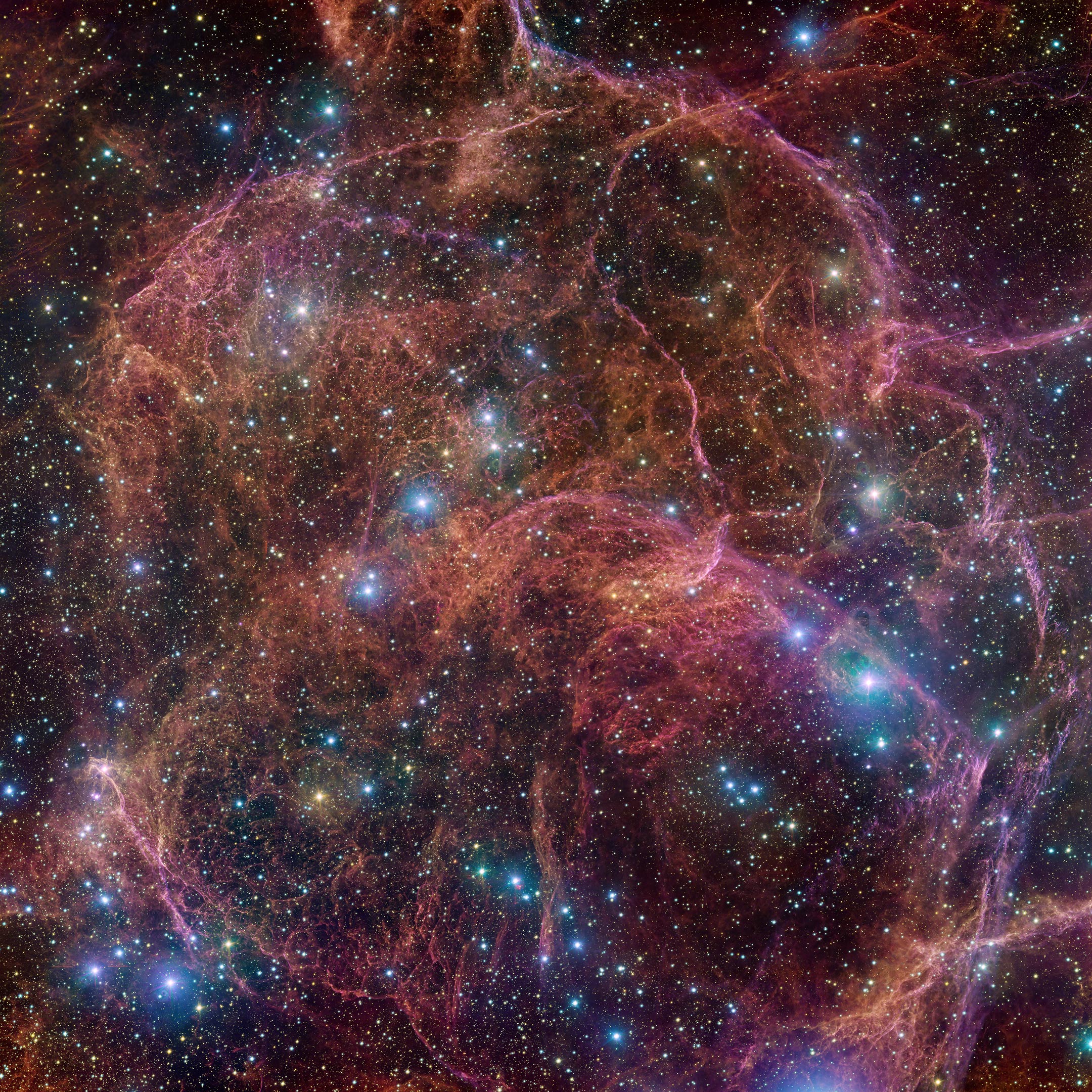
    This image shows a spectacular view of the orange and pink clouds that make up what remains after the explosive death of a massive star — the Vela supernova remnant. This detailed image consists of 554 million pixels, and is a combined mosaic image of observations taken with the 268-million-pixel OmegaCAM camera at the VLT Survey Telescope, hosted at ESO’s Paranal Observatory. OmegaCAM can take images through several filters that each let the telescope see the light emitted in a distinct color. To capture this image, four filters have been used, represented here by a combination of magenta, blue, green, and red. The result is an extremely detailed and stunning view of both the gaseous filaments in the remnant and the foreground bright blue stars that add sparkle to the image. Credit: ESO/VPHAS+ team, Acknowledgment: Cambridge Astronomical Survey Unit

    What do you see in this intricate image of the Vela supernova remnant?

    A spooky spider web, magical dragons, or wispy trails of ghosts?

    This beautiful tapestry of colors shows the ghostly remains of a gigantic star after a cosmic catastrophe. It was captured here in remarkable detail with the VLT Survey Telescope, hosted at the European Southern Observatory’s (ESO’s) Paranal site in Chile.

    All that remains of a massive star that ended its life in a powerful explosion around 11,000 years ago is this wispy structure of pink and orange clouds. When massive stars reach the end of their life, they often go out with a bang, in an outburst called a supernova. These massive cosmic explosions cause shock waves that move through the surrounding gas, compressing it and creating intricate thread-like structures. The energy released heats the gaseous tendrils, making them shine brightly, as seen in this image.
    Vela Supernova Remnant Highlights
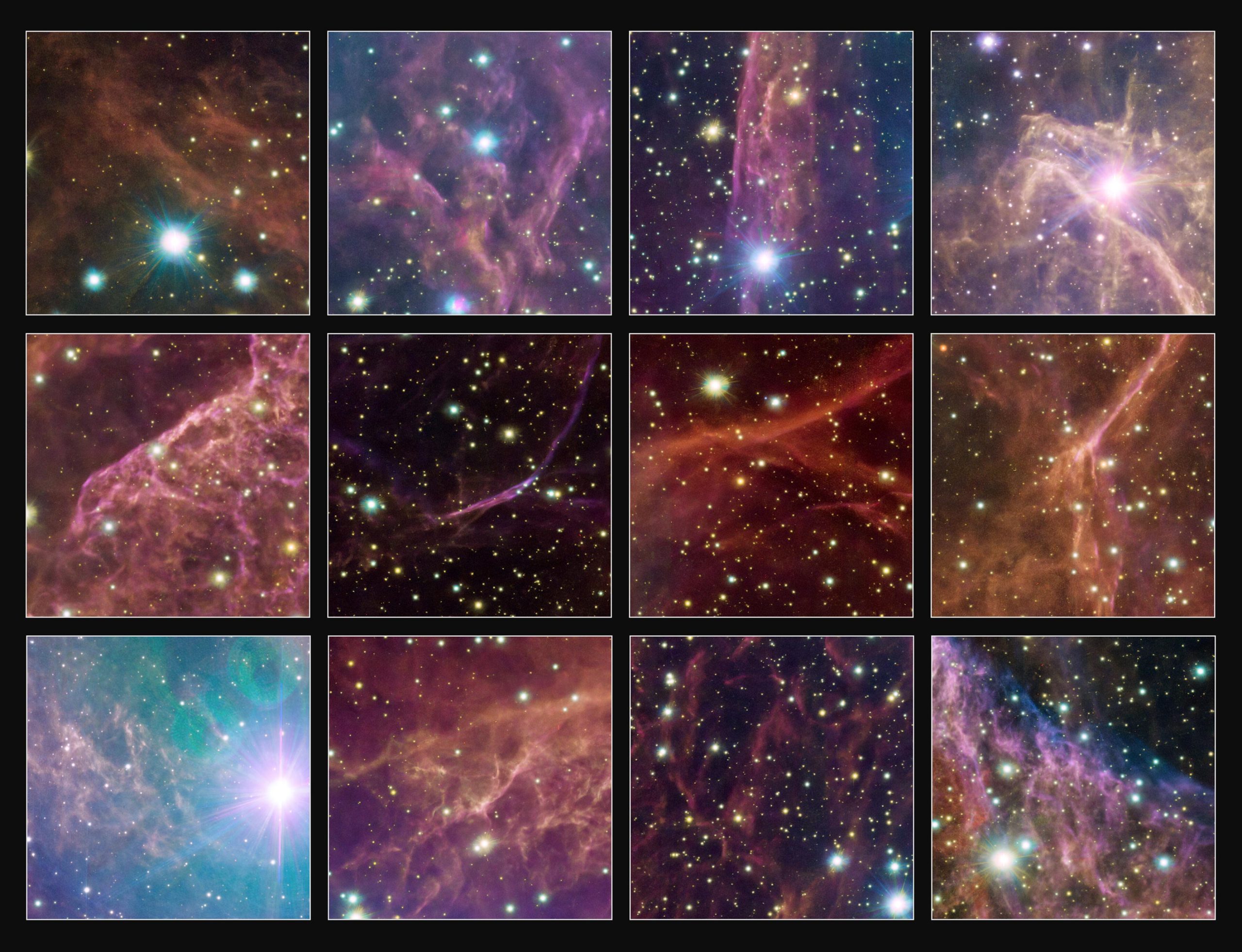
    Dive into the details of the Vela supernova remnant with these 12 highlights, each showing a different intricate part of the beautiful pink and orange gaseous clouds and the bright stars in the foreground and background. Credit: ESO/VPHAS+ team, Acknowledgment: Cambridge Astronomical Survey Unit

    In this 554-million-pixel image, we get an extremely detailed view of the Vela supernova remnant, named after the southern constellation Vela (The Sails). You could fit nine full Moons in this entire image, and the whole cloud is even larger. This dramatic supernova remnant is one of the closest known to us, at a distance of only 800 light-years away from Earth.

    As it exploded, the outermost layers of the progenitor star were ejected into the surrounding gas, producing the spectacular filaments that we observe here. What remains of the star is an ultra-dense ball in which the protons and electrons are forced together into neutrons — a neutron star. The neutron star in the Vela remnant, placed slightly outside of this image to the upper left, happens to be a pulsar that spins on its own axis at an astonishing speed of more than 10 times per second.
    VST Image Processing Workflow
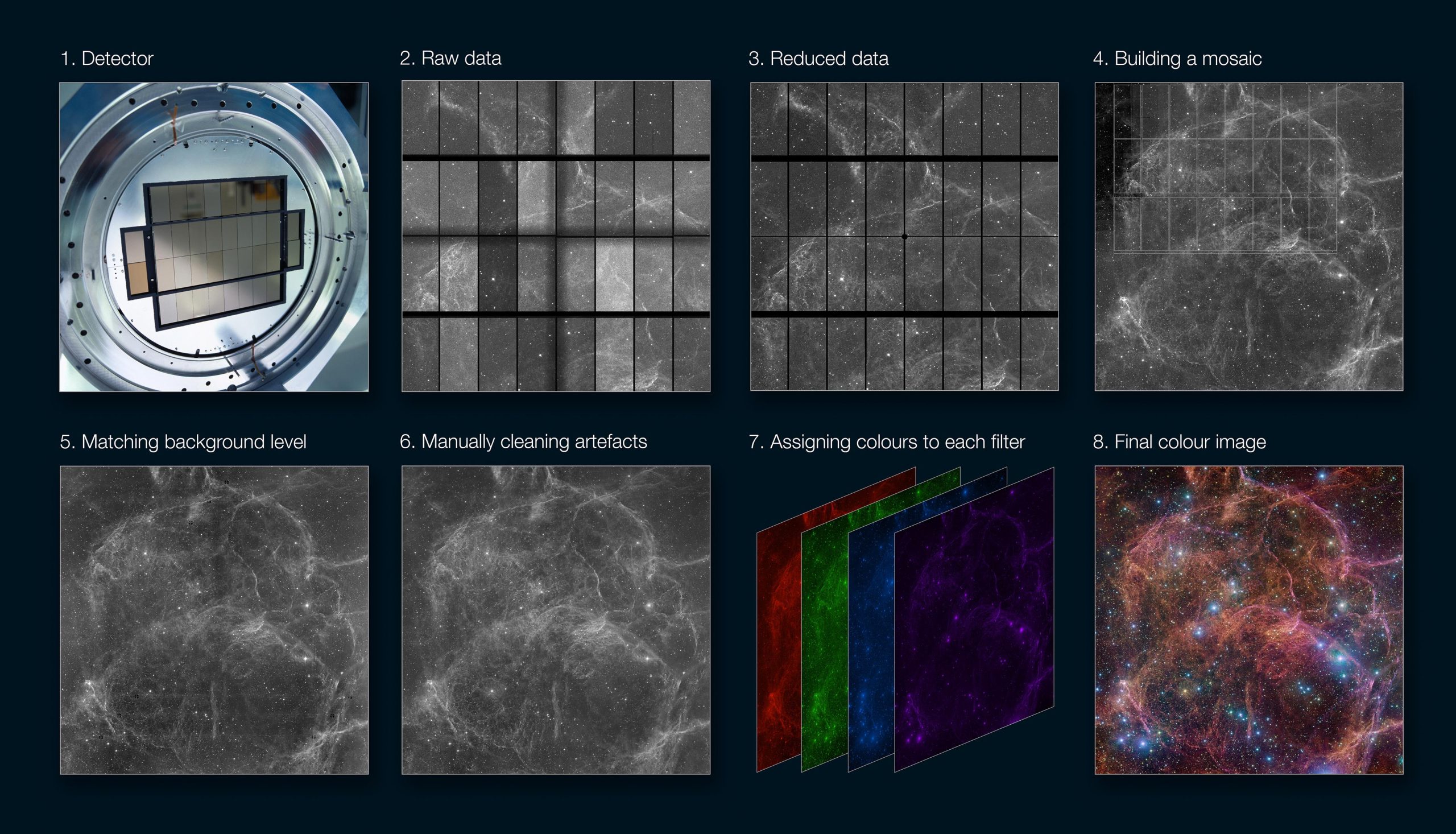
    This image shows the process of going from the raw data captured by a telescope to a stunning astronomical image like the one featured here, showing the Vela supernova remnant as seen with the VLT Survey Telescope (VST). Credit: ESO/M Kornmesser, VPHAS+ team, Acknowledgment: Cambridge Astronomical Survey Unit
    1. The detector registers the light collected by the telescope. OmegaCAM, the camera attached to the VST, has an array of 32 detectors covering a large field of view.
    2. The raw images contain artifacts and instrumental signatures such as dead pixels, shadows, or luminosity variations among detectors. These need to be corrected before the images can be used for scientific purposes.
    3. Astronomers correct these effects using calibration data. This process of going from raw to science-ready data is called ‘data reduction’.
    4. When an astronomical object is larger than the field of view one needs to stitch together different images, typically called a mosaic. This also allows us to fill in the gaps in between the detectors.
    5. The brightness of the background can vary among different parts of the mosaic, especially if they were observed on different nights, because of changes in the phase of the Moon and other effects. For instance, the upper-left corner of image 4 is darker than the rest of the image. By comparing overlapping areas between different images this can be corrected for.
    6. The mosaiced image is visually inspected, and any residual artifacts are corrected for. This includes, for example, imperfect seams between adjacent images.
    7. Astronomical detectors don’t capture color images. Instead, several images are taken separately through filters that let through light of different wavelengths. These images are then assigned different colors and combined into a final color image.
    8. The final color image.

    This image is a mosaic of observations taken with the wide-field camera OmegaCAM at the VLT Survey Telescope (VST), hosted at ESO’s Paranal Observatory in Chile. The 268-million-pixel camera can take images through several filters that let through light of different colors. In this particular image of the Vela remnant, four different filters were used, represented here by a combination of magenta, blue, green, and red.


    In this video we get to fly around in the highly detailed image of the beautiful and dramatic Vela supernova remnant, captured with OmegaCAM at the VST telescope, hosted at ESO’s Paranal Observatory in Chile. The image consists of 554 million pixels, revealing myriad stars and thin gaseous filaments, the latter created by shock waves from the explosion of a massive star 11,000 years ago. Credit: ESO/VPHAS+ team, Acknowledgment: Cambridge Astronomical Survey Unit

    The VST is owned by The National Institute for Astrophysics in Italy, INAF, and with its 2.6-meter mirror it is one of the largest telescopes dedicated to surveying the night sky in visible light. This image is an example from such a survey: the VST Photometric Ha Survey of the Southern Galactic Plane and Bulge (VPHAS+). For over seven years, this survey has mapped a considerable portion of our home galaxy, allowing astronomers to better understand how stars form, evolve, and eventually die.

    Never miss a breakthrough: Join the SciTechDaily newsletter.
    Follow us on Google and Google News.

    Astronomy Astrophysics European Southern Observatory Popular Supernova
    Share. Facebook Twitter Pinterest LinkedIn Email Reddit

    Related Articles

    Astronomers Captured a Star’s Final Explosion in Stunning Detail

    Star Explodes Twice: Astronomers Capture Stunning Supernova Remains

    Reclusive Neutron Star May Have Been Found in Famous Supernova SN 1987A

    Intriguing Remains of a Rare Stellar Explosion Discovered in Milky Way Center

    Distant Colliding Galaxy Dying Out As It Loses the Ability to Form Stars – Ejecting 10,000 Suns-Worth of Gas a Year

    Puzzling Six-Exoplanet System Discovered With Resonant Rhythmic Movement

    Death by Spaghettification: Telescopes Record Last Moments of Star Devoured by a Black Hole

    Galaxies Trapped in the Web of a Supermassive Black Hole – Cosmic “Spider’s Web” of Gas Extends Over 300 Times the Size of the Milky Way

    New ALMA Observations Show Stellar Explosion in Unprecedented Detail

    Leave A Reply Cancel Reply

    • Facebook
    • Twitter
    • Pinterest
    • YouTube

    Don't Miss a Discovery

    Subscribe for the Latest in Science & Tech!

    Trending News

    Scientists Discover 132-Million-Year-Old Dinosaur Tracks on South Africa’s Coast

    Scientists Uncover the Secret Ingredient Behind the Spark That May Have Started Life on Earth

    Physicists Observe Matter in Two Places at Once in Mind-Bending Quantum Experiment

    Stanford Scientists Discover Hidden Brain Circuit That Fuels Chronic Pain

    New Study Reveals Why Ozempic Works Better for Some People Than Others

    Climate Change Is Altering a Key Greenhouse Gas in a Way Scientists Didn’t Expect

    New Study Suggests Gravitational Waves May Have Created Dark Matter

    Scientists Discover Why the Brain Gets Stuck in Schizophrenia

    Follow SciTechDaily
    • Facebook
    • Twitter
    • YouTube
    • Pinterest
    • Newsletter
    • RSS
    SciTech News
    • Biology News
    • Chemistry News
    • Earth News
    • Health News
    • Physics News
    • Science News
    • Space News
    • Technology News
    Recent Posts
    • 320 Light-Years Away, a Planet Confirms a Fundamental Cosmic Assumption
    • Astronomers Solve Decades-Long Mystery About Saturn’s Spin – “Something Strange Was Happening”
    • Scientists Uncover Strange New State of Matter Inside Uranus and Neptune
    • The Crown Jewel of Dentistry? Breakthrough Tech Could Transform Tooth Repair
    • The Surprising Non-Medical Factor That Determines Cancer Survival
    Copyright © 1998 - 2026 SciTechDaily. All Rights Reserved.
    • Science News
    • About
    • Contact
    • Editorial Board
    • Privacy Policy
    • Terms of Use

    Type above and press Enter to search. Press Esc to cancel.