
Close Menu
    Facebook X (Twitter) Instagram
    SciTechDaily
    • Biology
    • Chemistry
    • Earth
    • Health
    • Physics
    • Science
    • Space
    • Technology
    Facebook X (Twitter) Pinterest YouTube RSS
    SciTechDaily
    Home»Space»Astronomy & Astrophysics 101: Neutron Star
    Space

    Astronomy & Astrophysics 101: Neutron Star

    By ESA/HubbleAugust 9, 2022No Comments3 Mins Read
    Facebook Twitter Pinterest Telegram LinkedIn WhatsApp Email Reddit
    Share
    Facebook Twitter LinkedIn Pinterest Telegram Email Reddit
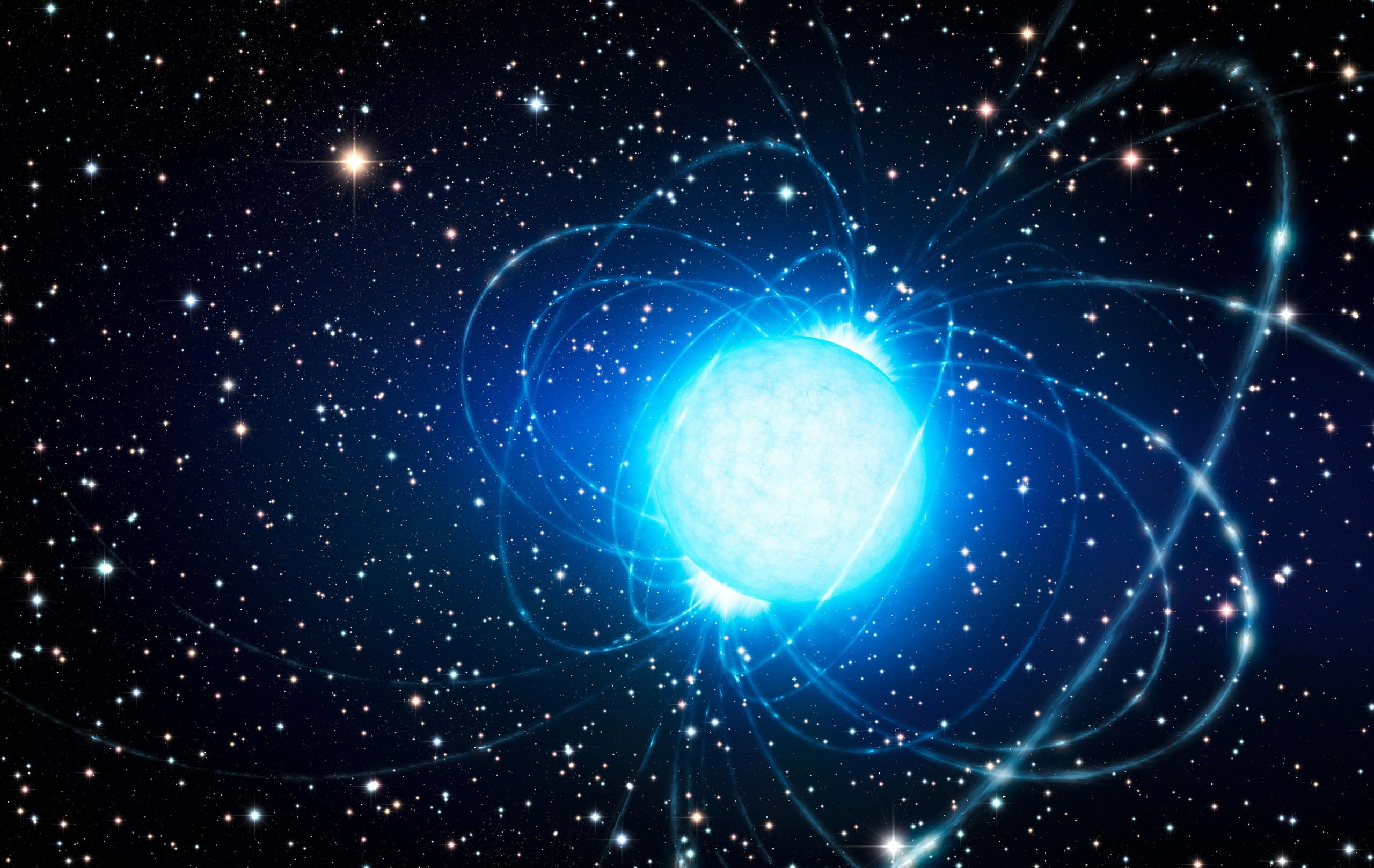
    Neutron Star Artist’s Depiction
    Artist’s depiction of a neutron star. Credit: ESO / L. Calçada

    What Is a Neutron Star?

    Neutron stars are the extremely dense remnants of supermassive stars that have exploded as supernovae.

    A star’s evolution and ultimate fate depend in large part on its mass. All supermassive stars — stars with an initial mass greater than approximately eight times that of the Sun — have the capacity to eventually become neutron stars. When a supermassive star begins to die, it forms a red supergiant. After that, these stars either evolve into white dwarfs, or explode as supernovae. If what remains of the core of the star after the supernova explosion has a mass less than about three times the Sun’s mass, then it forms into a neutron star (if the remnant is more massive, it will collapse into a black hole).

    Neutron stars are incredibly dense. They have a mass greater than that of the entire Sun, but are packed into a radius of only about 10 kilometers (6 miles). A single teaspoon of a neutron star would have a mass of about a trillion kilograms. Neutron stars are so named because they are composed primarily of neutrons, as most of the protons and electrons will have combined to form neutrons under the extremely dense conditions. Even though they do not actively generate heat through nuclear fusion, neutron stars are incredibly hot, with temperatures far exceeding those of regular stars.
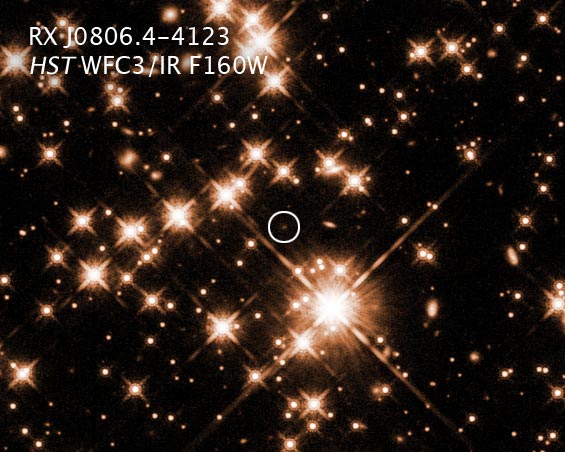
    Neutron Star RX J0806.4–4123
    This is a near-infrared-light image of the neutron star RX J0806.4-4123 taken with the NASA/ESA Hubble Space Telescope. Hubble detected an unusual excess of infrared radiation that might be evidence for a disc around the stellar remnant. Or it could be from a wind of charged particles streaming off the neutron star and slamming into gas in the interstellar medium the neutron star is plowing through. Credit: NASA, ESA, and B. Posselt (Pennsylvania State University)

    In 1997 Hubble provided the first direct look, in visible light, at an isolated neutron star. The telescope’s results showed the star is very hot (670,000 degrees Celsius / 1,200,000 degrees Fahrenheit at the surface), and can be no larger than 28 kilometers (17 miles) across. These results proved that the object must be a neutron star, because no other known type of object can be this hot, small, and dim.

    In 2017 the telescope also observed for the first time the source of gravitational waves created by the merger of two neutron stars. This merger gave rise to an event known as a kilonova — something actually predicted by theory decades ago — that results in the ejection of heavy elements such as gold and platinum into space. This event also provided the strongest evidence to date that short-duration gamma-ray bursts are caused by mergers of neutron stars. Prior to this finding, connecting kilonovae and short gamma-ray bursts to neutron star mergers had been difficult, but the multitude of detailed observations following the detection of the gravitational wave event — including those by Hubble — finally verified these connections.
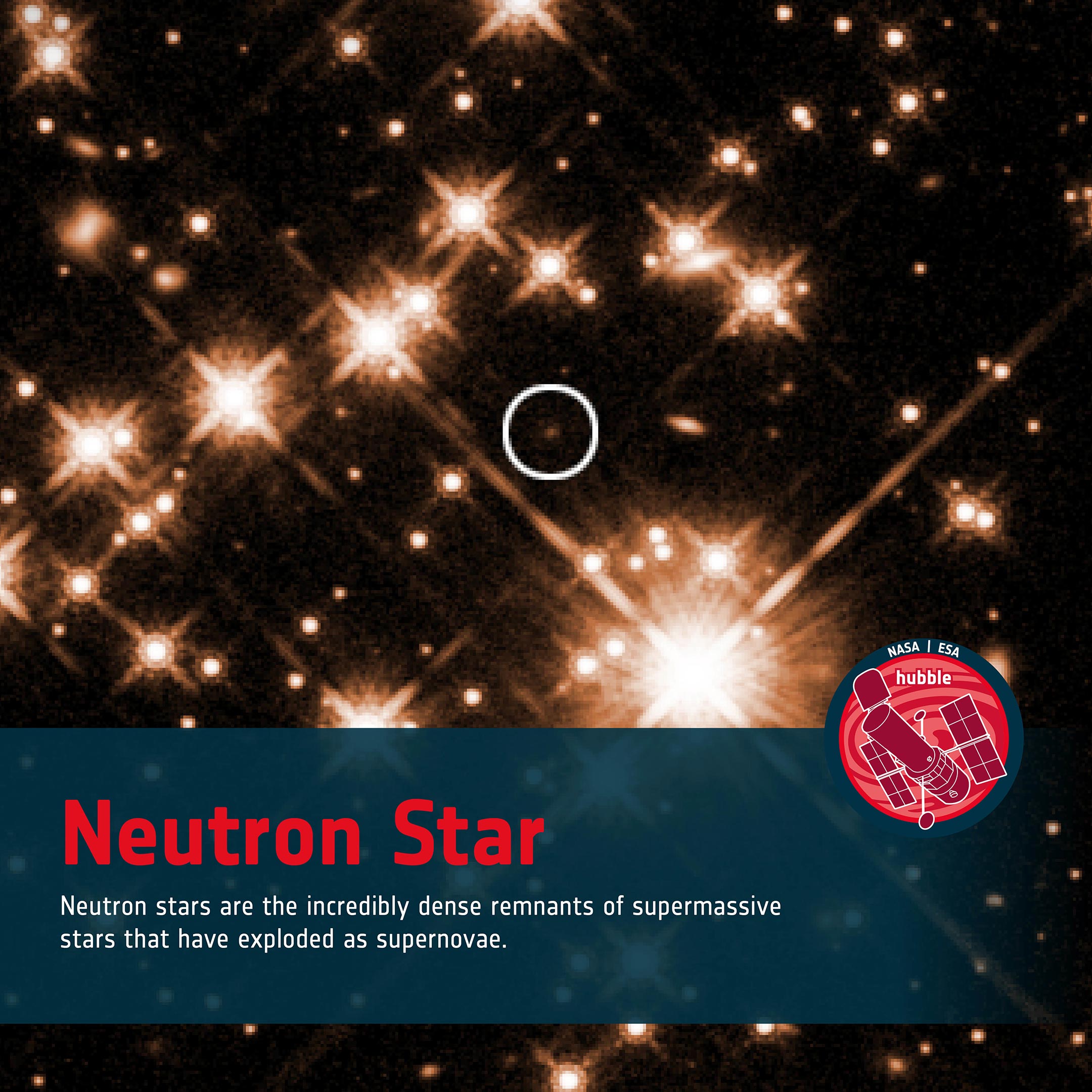
    Word Bank Neutron Star
    Neutron Star. Credit: ESA/Hubble, NASA, ESA, and B. Posselt (Pennsylvania State University)

    In May of 2020, the light from the glow of a kilonova caused by the merger of two neutron stars reached Earth. Hubble was then used to study the explosion’s aftermath and the host galaxy, and found that the near-infrared emission was 10 times brighter than predicted. These results challenged conventional theories of what happens in the aftermath of a short gamma-ray burst.

    Never miss a breakthrough: Join the SciTechDaily newsletter.
    Follow us on Google and Google News.

    Astronomy Astrophysics Hubble Space Telescope
    Share. Facebook Twitter Pinterest LinkedIn Email Reddit

    Related Articles

    Hubble Solves Mystery of Monster Star’s Dimming – Red Hypergiant Is As Bright as 300,000 Suns

    Astronomers Make a Weird Discovery: A Concentration of Smaller Black Holes Lurking Where They Expected a Single Massive Black Hole

    Tantrums of a Baby Star: Herbig-Haro Objects

    Unexpected Discovery: Hubble Space Telescope Uncovers Concentration of Small Black Holes

    Dissecting the Anatomy of Planetary Nebulae Using the Hubble Space Telescope

    HAWC+ Reveals Magnetic Chaos Hidden Within the Whirlpool Galaxy

    Supermassive Black Hole’s Dust Ring May Be Casting Shadows From Heart of a Galaxy

    Quasars Rip Across Galaxies Like Tsunamis – The Most Energetic Outflows Ever Witnessed in the Universe

    “Unprecedented” – Unusual Planetary Nebula Fades Mere Decades After It Arrived

    Leave A Reply Cancel Reply

    • Facebook
    • Twitter
    • Pinterest
    • YouTube

    Don't Miss a Discovery

    Subscribe for the Latest in Science & Tech!

    Trending News

    New “Nanozyme Hypothesis” Could Rewrite the Story of Life’s Origins

    Anatomy Isn’t Finished: The Human Body Still Holds Secrets

    “Pretty Close to Home”: The Hidden Earthquake Threat Beneath Seattle

    The Surprising Reason You Might Want To Sleep Without a Pillow

    Scientists Say This Natural Hormone Reverses Obesity by Targeting the Brain

    35-Million-Year-Old Mystery: Strange Arachnid Discovered Preserved in Amber

    Is AI Really Just a Tool? It Could Be Altering How You See Reality

    JWST Reveals a “Forbidden” Planet With a Baffling Composition

    Follow SciTechDaily
    • Facebook
    • Twitter
    • YouTube
    • Pinterest
    • Newsletter
    • RSS
    SciTech News
    • Biology News
    • Chemistry News
    • Earth News
    • Health News
    • Physics News
    • Science News
    • Space News
    • Technology News
    Recent Posts
    • What If Consciousness Exists Beyond Your Brain
    • Scientists Finally Crack the 100-Million-Year Evolutionary Mystery of Squid and Cuttlefish
    • This Algae Could One Day Pull Microplastics out of Your Drinking Water
    • Scientists Can Now Read Your Body Clock From a Single Hair
    • Beyond “Safe Levels”: Study Challenges What We Know About Pesticides and Cancer
    Copyright © 1998 - 2026 SciTechDaily. All Rights Reserved.
    • Science News
    • About
    • Contact
    • Editorial Board
    • Privacy Policy
    • Terms of Use

    Type above and press Enter to search. Press Esc to cancel.