
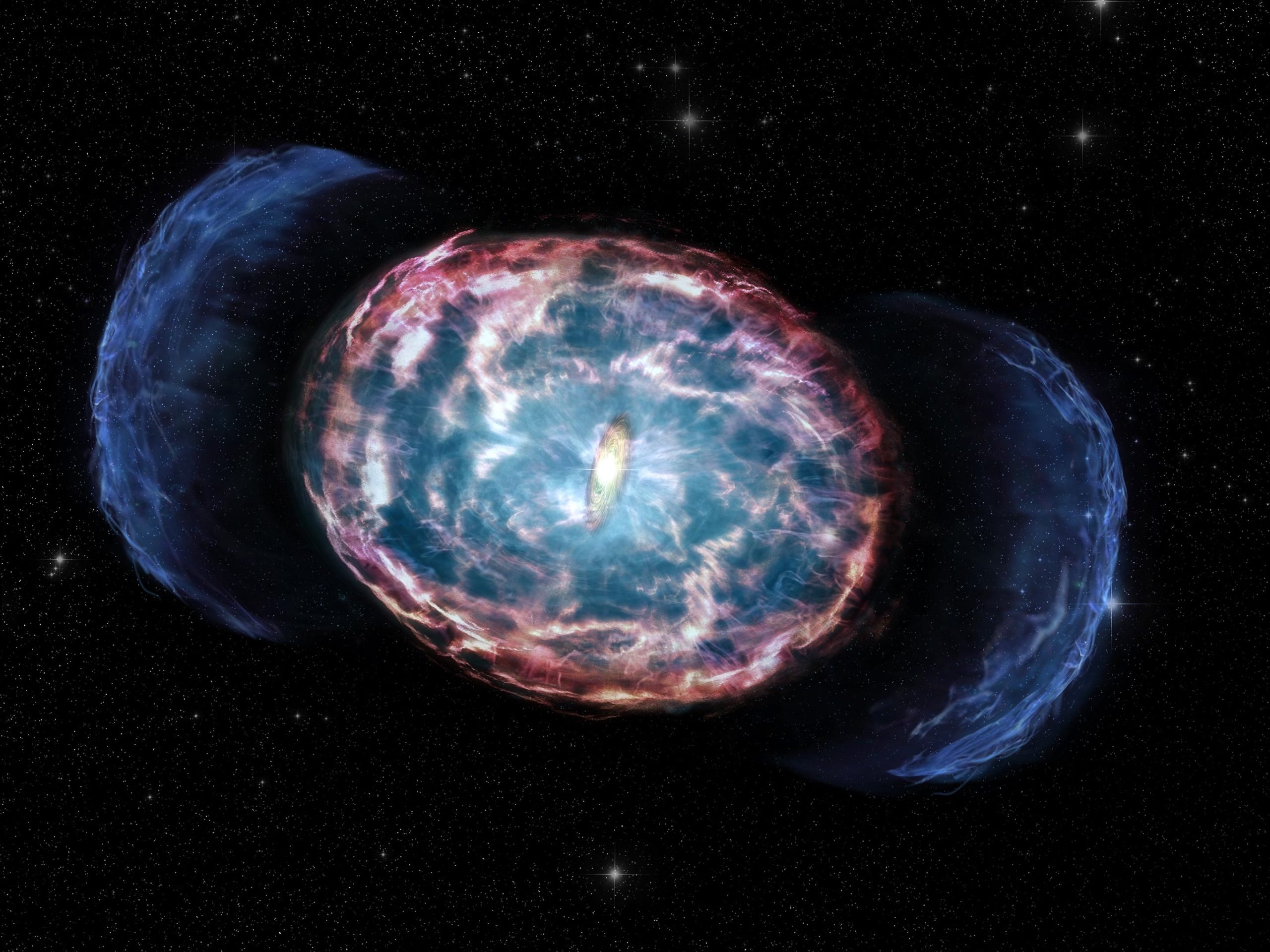
Excess X-ray emissions from remnant four years after merger hint at bounce from delayed collapse.
When two neutron stars spiral into one another and merge to form a black hole — an event recorded in 2017 by gravitational wave detectors and telescopes worldwide — does it immediately become a black hole? Or does it take a while to spin down before gravitationally collapsing past the event horizon into a black hole?
Ongoing observations of that 2017 merger by the Chandra X-ray Observatory, an orbiting telescope, suggests the latter: that the merged object stuck around, likely for a mere second, before undergoing ultimate collapse.
The evidence is in the form of an X-ray afterglow from the merger, dubbed GW170817, that would not be expected if the merged neutron stars collapsed immediately to a black hole. The afterglow can be explained as a rebound of material off the merged neutron stars, which plowed through and heated the material around the binary neutron stars. This hot material has now kept the remnant glowing steadily more than four years after the merger threw material outward in what’s referred to as a kilonova. X-ray emissions from a jet of material that was detected by Chandra shortly after the merger would otherwise be dimming by now.
While the excess X-ray emissions observed by Chandra could come from debris in an accretion disk swirling around and eventually falling into the black hole, astrophysicist Raffaella Margutti of the University of California, Berkeley, favors the delayed collapse hypothesis, which is predicted theoretically.
“If the merged neutron stars were to collapse directly to a black hole with no intermediate stage, it would be very hard to explain this X-ray excess that we see right now, because there would be no hard surface for stuff to bounce off and fly out at high velocities to create this afterglow,” said Margutti, UC Berkeley associate professor of astronomy and of physics. “It would just fall in. Done. The true reason why I’m excited scientifically is the possibility that we are seeing something more than the jet. We might finally get some information about the new compact object.”
Margutti and her colleagues, including first author Aprajita Hajela, who was Margutti’s graduate student when she was at Northwestern University before moving to UC Berkeley, report their analysis of the X-ray afterglow in a paper recently accepted for publication in The Astrophysical Journal Letters.
The Radioactive Glow of a Kilonova
Gravitational waves from the merger were first detected on August 17, 2017, by the Advanced Laser Interferometer Gravitational-wave Observatory (LIGO) and the Virgo collaboration. Satellite- and ground-based telescopes quickly followed up to record a burst of gamma rays and visible and infrared emissions that together confirmed the theory that many heavy elements are produced in the aftermath of such mergers inside hot ejecta that produces a bright kilonova. The kilonova glows because of light emitted during the decay of radioactive elements, like platinum and gold, that are produced in the merger debris.

Chandra, too, pivoted to observe GW170817, but saw no X-rays until nine days later, suggesting that the merger also produced a narrow jet of material that, upon colliding with the material around the neutron stars, emitted a cone of X-rays that initially missed Earth. Only later did the head of the jet expand and begin emitting X-rays in a broader jet visible from Earth.
The X-ray emissions from the jet increased for 160 days after the merger, after which they steadily grew fainter as the jet slowed down and expanded. But Hajela and her team noticed that from March 2020 — about 900 days after the merger — until the end of 2020, the decline stopped, and the X-ray emissions remained approximately constant in brightness.
“The fact that the X-rays stopped fading quickly was our best evidence yet that something in addition to a jet is being detected in X-rays in this source,” Margutti said. “A completely different source of X-rays appears to be needed to explain what we’re seeing.”
The researchers suggest that the excess X-rays are produced by a shock wave distinct from the jets produced by the merger. This shock was a result of the delayed collapse of the merged neutron stars, likely because its rapid spin very briefly counteracted the gravitational collapse. By sticking around for an extra second, the material around the neutron stars got an extra bounce that produced a very fast tail of kilonova ejecta that created the shock.
“We think the kilonova afterglow emission is produced by shocked material in the circumbinary medium,” Margutti said. “It is material that was in the environment of the two neutron stars that was shocked and heated up by the fastest edge of the kilonova ejecta, which is driving the shock wave.”
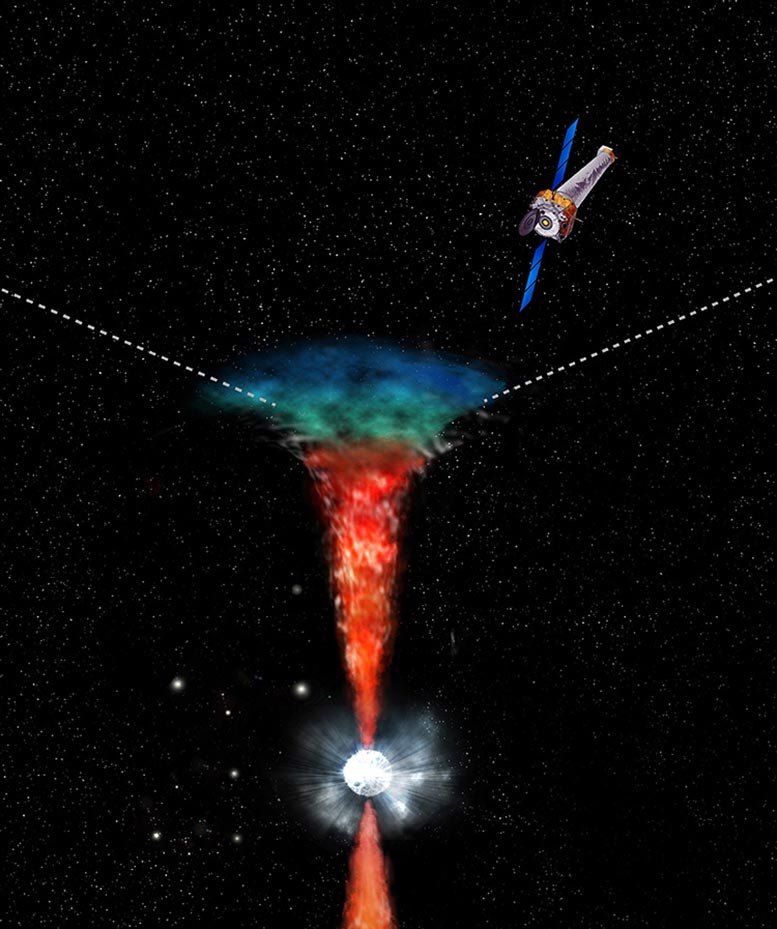
The radiation is reaching us only now because it took time for the heavy kilonova ejecta to be decelerated in the low-density environment and for the kinetic energy of the ejecta to be converted into heat by shocks, she said. This is the same process that produces radio and X-rays for the jet, but because the jet is much, much lighter, it is immediately decelerated by the environment and shines in the X-ray and radio from the very earliest times.
An alternative explanation, the researchers note, is that the X-rays come from material falling towards the black hole that formed after the neutron stars merged.
“This would either be the first time we’ve seen a kilonova afterglow or the first time we’ve seen material falling onto a black hole after a neutron star merger,” said co-author Joe Bright, a UC Berkeley postdoctoral researcher. “Either outcome would be extremely exciting.”
Chandra is now the only observatory still able to detect light from this cosmic collision. Follow-up observations by Chandra and radio telescopes could distinguish between the alternative explanations, however. If it is a kilonova afterglow, radio emission is expected to be detected again in the next few months or years. If the X-rays are being produced by matter falling onto a newly formed black hole, then the X-ray output should stay steady or decline rapidly, and no radio emission will be detected over time.
Margutti hopes that LIGO, Virgo and other telescopes will capture gravitational waves and electromagnetic waves from more neutron star mergers so that the series of events preceding and following the merger can be pinned down more precisely and help reveal the physics of black hole formation. Until then, GW170817 is the only example available for study.
“Further study of GW170817 could have far-reaching implications,” said co-author Kate Alexander, a postdoctoral researcher who also is from Northwestern University. “The detection of a kilonova afterglow would imply that the merger did not immediately produce a black hole. Alternatively, this object may offer astronomers a chance to study how matter falls onto a black hole a few years after its birth.”
Margutti and her team recently announced that the Chandra telescope had detected X-rays in observations of GW170817 performed in December 2021. Analysis of that data is ongoing. No radio detection associated with the X-rays has been reported.
See Mysterious Kilonova Explosion Afterglow Potentially Spotted for First Time for more information on this kilonova.
Reference: “The emergence of a new source of X-rays from the binary neutron star merger GW170817” by A. Hajela, R. Margutti, J. S. Bright, K. D. Alexander, B. D. Metzger, V. Nedora, A. Kathirgamaraju, B. Margalit, D. Radice, E. Berger, A. MacFadyen, D. Giannios, R. Chornock, I. Heywood, L. Sironi, O. Gottlieb, D. Coppejans, T. Laskar, Y. Cendes, R. Barniol Duran, T. Eftekhari, W. Fong, A. McDowell, M. Nicholl, X. Xie, J. Zrake, S. Bernuzzi, F. S. Broekgaarden, C. D. Kilpatrick, G. Terreran, V. A. Villar, P. K. Blanchard, S. Gomez, G. Hosseinzadeh, D. J. Matthews and J. C. Rastinejad, 8 March 2022, The Astrophysical Journal Letters.
DOI: 10.3847/2041-8213/ac504a
arXiv:2104.02070
Never miss a breakthrough: Join the SciTechDaily newsletter.
Follow us on Google and Google News.
7 Comments
But i would have thought in the space time continuum
Take a 10 kilometre sphere place it in xyz space and make it rotate clockwise and call it red neutron star sphere 1c
Place a space gap of 10 kilometres between it and
Take a 10 kilometre sphere place it in x1y1z1 space and make it rotate clockwise and call it red neutron star sphere 2c
or
Take a 10 kilometre sphere place it in x2y2z2 space and make it rotate anticlockwise and call it red neutron star sphere 1ac
or
Take a 10 kilometre sphere place it in x1y1z1 space and make it rotate anticlockwise and call it red neutron star sphere 2ac
That
1c and 2c would merge clockwise
1c and 2ac would splurge and not merge but dark matter would emerge red hot coals in interstellar space
1ac and 2ac would merge anticlockwise
1ac and 2c would splurge and not merge but dark matter would emerge red hot coals in interstellar space
So lets take option 1 ic and 2c would merge clockwise
Now we have an object 12 kilometres wide
8 kilometres wide with 4 kilometre diameter area lost
5 kilometre wide with 7 kilometre diameter area lost
Which in all three cases must have an event horizon if they are a black hole
What distance is this event horizon
The diameter of a solar sun star 0.001au
The diameter of the orbit of mercury 0.3 au
The diameter of the orbit of venus 0.5au
The diameter of the orbit of earth 1.0au
And once we have this event horizon it acts as a solid object wall for any matter falling into it or for any matter trying to fall out of it
And this could cause an x ray source type 1
The two merged neutron stars would cause the narrow columnar jet emissions tens or hundreds or thousands of light years as our object is 130,000,00 light years away along with all the ejected matter of the two neutron star mergers on the inside of the event horizon gamma and x ray source type ii
And the kilonova ejecta the 4 or 7 kilometre area diameter lost that escaped the event horizon of gold and platinum are we made in volumes larger than a planet could hold bolted out from the neutron stars unmerged decades ago and nearly merged 2015 and merged 2017 allowing them light years to escape and rotate around two 10 kilometre spheres before melding and moulding into one sphere and disappearing behind an inner wall of an event horizon while the gold and platimum look on from the outside wall of the event horizon enclosure x ray source type iii
And anything near this event horizon sucked in will give you another x ray source type iv
The day in the life of a 1a and 2a neutron star with x ray emissions type i ii iii iv
As for the others
1c and 2ac would splurge and not merge but dark matter would emerge red hot coals in interstellar space
1ac and 2ac would merge anticlockwise
1ac and 2c would splurge and not merge but dark matter would emerge red hot coals in interstellar space
I await another day to reveal their tale of woo and woe
Is it better to merge than splurge?
Have you recently changed medications?
This is good to resonate spining of two newtron stars merged just to forma black hole after a secod.So in average one second’s spin is required to convert total merged unit of two neutron stars in to black hole.As black holes behave as unit with super massive black hole to accout with galxy for balanced force equation of all motions,this time bit of one second spin is of coversion from neutron stars unit to black hole.In other words this is the spin rotation time period of black hole added to two neutron stars merged unit.
This is good to resonate spining of two newtron stars merged just to forma black hole after a secod.So in average one second’s spin is required to convert total merged unit of two neutron stars in to black hole.As black holes behave as unit with super massive black hole to accout with galxy for balanced force equation of all motions,this time bit of one second spin is of coversion from neutron stars unit to black hole.In other words this is the spin rotation time period of black hole added to two neutron stars merged unit.
All black holes in a galaxy are in a tied state with super massive black hole at the center to function unitedly.Thanks to the authors for supplying observational evidience.
Facts and figures recoded from the observations of merger,GW170817 by the astrophysicists gives a clear notion of time consumption of time by a black hole during the time of evolution.Thus this evidenee is sufficient to detect spin rotation of a black hole in galaxy.In this regard blak hole is different than star.
Could a black hole spin so fast that it would overcome its own gravitational force (acceleration by merging with another spinning black hole (or multiple black holes) with high relative velocity)?