
Close Menu
    Facebook X (Twitter) Instagram
    SciTechDaily
    • Biology
    • Chemistry
    • Earth
    • Health
    • Physics
    • Science
    • Space
    • Technology
    Facebook X (Twitter) Pinterest YouTube RSS
    SciTechDaily
    Home»Space»Hubble Image Shows What Happens When Two Galaxies Become One
    Space

    Hubble Image Shows What Happens When Two Galaxies Become One

    By SciTechDailyOctober 16, 2017No Comments2 Mins Read
    Facebook Twitter Pinterest Telegram LinkedIn WhatsApp Email Reddit
    Share
    Facebook Twitter LinkedIn Pinterest Telegram Email Reddit
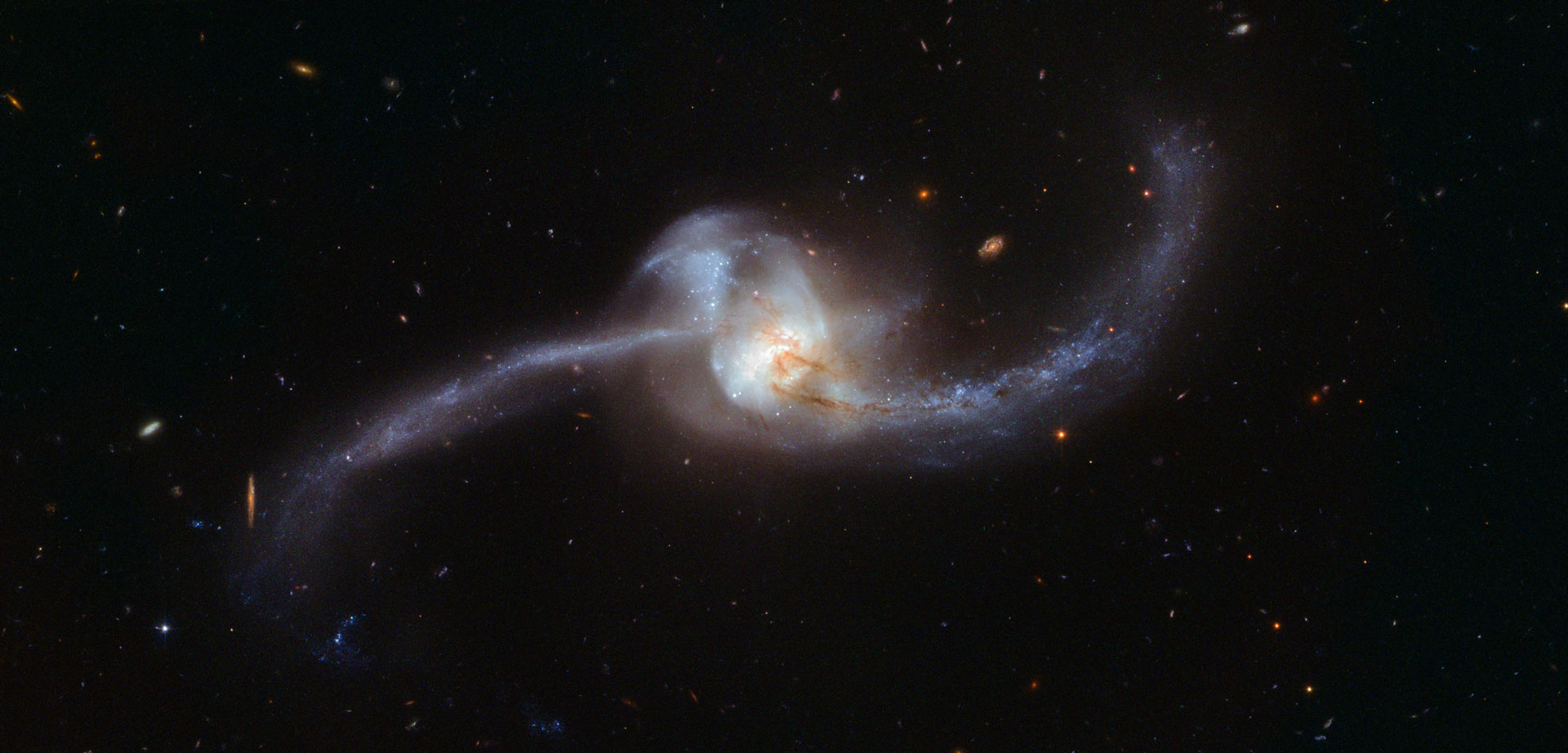
    Two Galaxies Become One NGC 2623
    NGC 2623, also known as Arp 243, is a tangled knot in space located in the constellation of Cancer (The Crab) and situated around 250 million light-years away. Credit: ESA/Hubble & NASA

    This Hubble Space Telescope image of the week shows the result of a major collision and subsequent merger between two separate galaxies.

    This image, captured by the NASA/ESA Hubble Space Telescope, shows what happens when two galaxies become one. The twisted cosmic knot seen here is NGC 2623 — or Arp 243 — and is located about 250 million light-years away in the constellation of Cancer (The Crab).

    NGC 2623 gained its unusual and distinctive shape as the result of a major collision and subsequent merger between two separate galaxies. This violent encounter caused clouds of gas within the two galaxies to become compressed and stirred up, in turn triggering a sharp spike of star formation. This active star formation is marked by speckled patches of bright blue; these can be seen clustered both in the center and along the trails of dust and gas forming NGC 2623’s sweeping curves (known as tidal tails). These tails extend for roughly 50,000 light-years from end to end. Many young, hot, newborn stars form in bright stellar clusters — at least 170 such clusters are known to exist within NGC 2623.

    NGC 2623 is in a late stage of merging. It is thought that the Milky Way will eventually resemble NGC 2623 when it collides with our neighboring galaxy, the Andromeda Galaxy, in four billion years time.

    In contrast to the image of NGC 2623 released in 2009 (heic0912), this new version contains data from recent narrow-band and infrared observations that make more features of the galaxy visible.

    Never miss a breakthrough: Join the SciTechDaily newsletter.
    Follow us on Google and Google News.

    Astronomy Hubble Space Telescope
    Share. Facebook Twitter Pinterest LinkedIn Email Reddit

    Related Articles

    A Morphing Spiral Galaxy Amongst Friends

    Hubble Views Magnificent Lopsided Galaxy NGC 2276

    Hubble Captures Fantastic Detail of Eponymous Spiral Galaxy NGC 691

    Spectacular Image Captured by Hubble Shows a Strangely Contorted Spiral Galaxy

    A Distant Spiral in Virgo: Extraordinary Detail Seen in a Galaxy 150 Million Light-Years Away From Earth

    Magnetic Monsters: Hubble Tracks Down Location of Mysterious Radio Signals From Intergalactic Space

    A Menagerie of Galaxies: Hubble Captures a Cluster With Galaxies of All Shapes and Sizes

    How Habitable Are Planets That Orbit Red Dwarfs – The Most Common Type of Stars in the Galaxy?

    Cosmic Silver Lining: Hubble Spots V565 Surrounded by Four Prominent Diffraction Spikes

    Leave A Reply Cancel Reply

    • Facebook
    • Twitter
    • Pinterest
    • YouTube

    Don't Miss a Discovery

    Subscribe for the Latest in Science & Tech!

    Trending News

    Goodbye Plastic? Scientists Create New Supermaterial That Could Transform Modern Manufacturing

    Beyond Pain Relief: Scientists Discover a Protein That Could Stop Osteoarthritis in Its Tracks

    Scientists Discover Why Alcohol Prevents the Liver From Healing, Even After You Quit

    Scientists Stunned As Volcano Removes Methane From the Air

    Scientists Discover Signs Africa May Be Splitting Apart Beneath Zambia

    Common Blood Pressure Drug Supercharges Cancer Treatment in Surprising New Study

    540-Million-Year-Old Fossils Reveal a Huge Surprise About Early Life on Earth

    Scientists Reverse Stroke Damage Using Stem Cells in Breakthrough Study

    Follow SciTechDaily
    • Facebook
    • Twitter
    • YouTube
    • Pinterest
    • Newsletter
    • RSS
    SciTech News
    • Biology News
    • Chemistry News
    • Earth News
    • Health News
    • Physics News
    • Science News
    • Space News
    • Technology News
    Recent Posts
    • Goodbye Plastic? Scientists Create New Supermaterial That Could Transform Modern Manufacturing
    • Scientists Uncover Hidden Biological Differences Between Men and Women’s Immune Systems
    • Scientists Challenge a Long-Held Belief About Why Human Childbirth Is So Difficult
    • Too Much Sleep May Age Your Body Faster, New Study Warns
    • Scientists Uncover Promising New Strategy To Stop Parkinson’s in Its Tracks
    Copyright © 1998 - 2026 SciTechDaily. All Rights Reserved.
    • Science News
    • About
    • Contact
    • Editorial Board
    • Privacy Policy
    • Terms of Use

    Type above and press Enter to search. Press Esc to cancel.