
A lost papal letter suggests King Harold’s support for a rival pope may have helped turn the Norman Conquest into part of a wider European power struggle.
For generations, the story of 1066 has seemed straightforward: a disputed crown, an invading duke, and a decisive battle that ended Anglo-Saxon rule in England. But new research suggests the fate of King Harold may have been influenced by another conflict hundreds of miles away, one involving two rival popes and a bitter struggle for control of the medieval Church.
Previously overlooked fragments of a lost papal letter preserved in the Vatican point to a possible new explanation for one of the enduring mysteries surrounding the Norman Conquest: why Pope Alexander II supported William of Normandy’s campaign against an already crowned Christian king.
University of East Anglia historian Prof. Tom Licence argues that Harold may have put England on the wrong side of a major European power struggle before William’s invasion. If so, papal support for the Normans was not simply about who had the better claim to England’s throne. It may also have reflected a much larger contest over authority in the Church.
“1066 was not simply decided on the battlefield at Hastings. The outcome may also have been shaped by decisions taken almost a thousand miles away in Rome,” Licence said.
The Papal Power Struggle Behind 1066
His argument appears in ‘Harold: Warrior King,’ a new biography of Harold II published by Yale University Press.
The background to the discovery lies in a crisis that divided Western Christianity in the early 1060s.
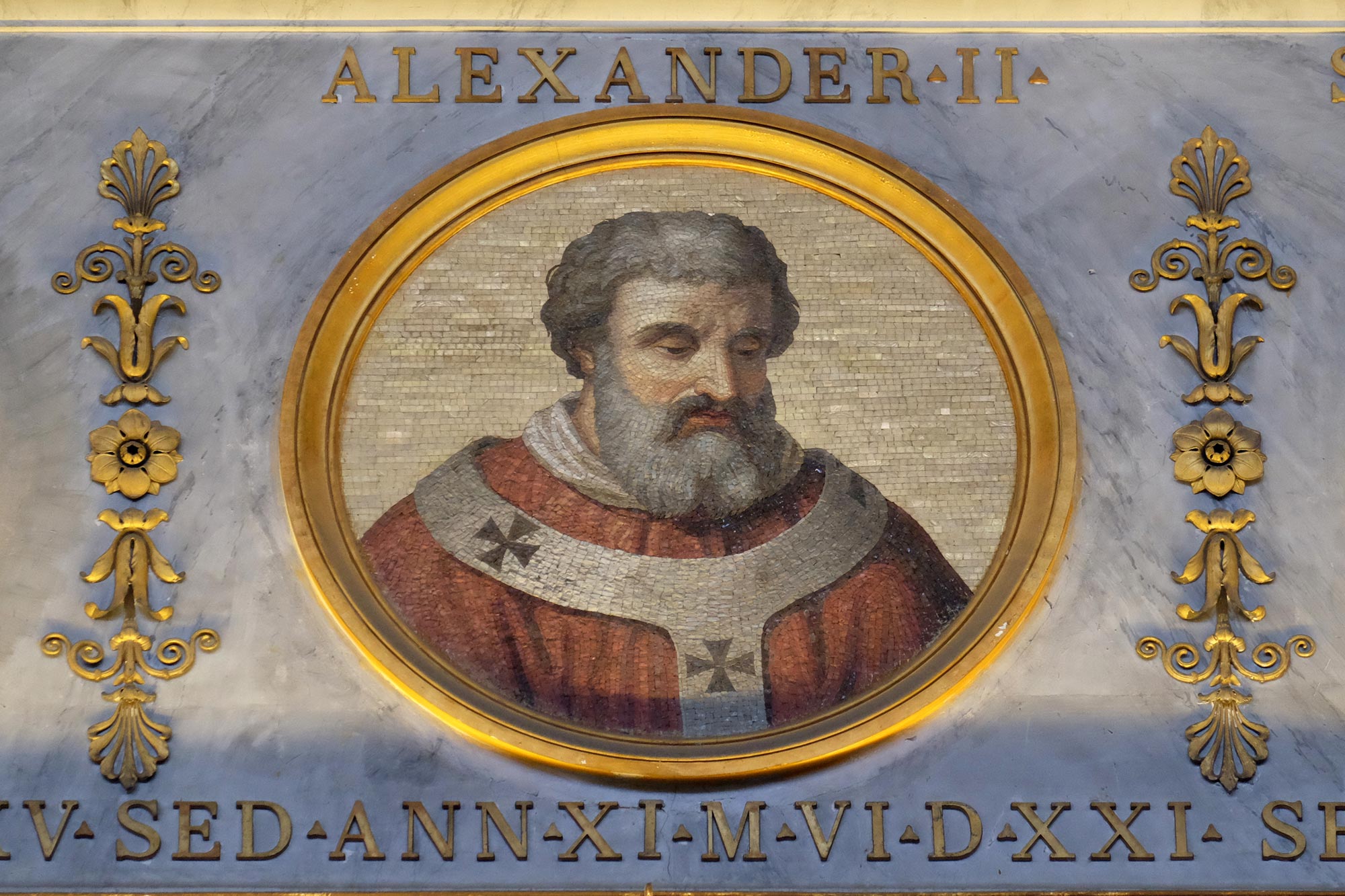
In 1061, competing factions backed two men for the papacy. One was Alexander II. The other was Cadalus, bishop of Parma, who took the name Honorius II and is generally regarded as an antipope.
The dispute was not merely theological. It was tied to an emerging struggle over who had the authority to choose and control popes, with powerful Roman families, church reformers, and the Holy Roman Empire all competing for influence.
Alexander’s election represented an important change in that struggle. The papal election reforms introduced shortly beforehand had increased the role of the cardinals and reduced the traditional influence of secular rulers. Supporters of the imperial court backed Honorius instead. The dispute became violent, and the rival camps fought for control of Rome before Alexander ultimately emerged as the recognized pope.
England Enters the Papal Conflict
License believes England became entangled in this conflict.
“But they can only be fully understood in the context of a fierce dispute that divided Western Christendom during the early 1060s,” he said.
“In 1061, rival factions elected two competing popes, Alexander II and Bishop Cadalus of Parma, who became known as Honorius II.
“For several years the two popes and their supporters fought for control of Rome, with Honorius retaining powerful backing from the Holy Roman Empire and attracting support elsewhere in northern Europe.”
Lost Vatican Letter Reveals New Clues
The original papal document at the center of Licence’s research no longer survives.
“The Pope’s whole register of letters is lost,” Licence said. “But some survive as copies or excerpts. Two excerpts from this particular letter survive in collections of papal rescripts.”
Those fragments were preserved in a medieval collection of canon law in the Vatican. The letter was written by Alexander II after William had taken the English throne, but it looked back at England’s relationship with Rome before the conquest.
Pope Alexander’s Striking Accusation
One passage claims that England had previously enjoyed the protection of St. Peter before people “fired with the pride of their father Satan” drew the English away from “the path of truth”.
The language is unusually severe.
“While historians have occasionally noted these remarks, they have generally treated them as unexplained references,” Licence said.
A Religious Conflict Beyond the Crown
His interpretation is that Alexander was not simply condemning Harold personally. The pope may have been describing England as having abandoned his faction during the papal conflict.
That changes the significance of the accusation.
“In the eyes of Pope Alexander’s supporters, it was no longer simply a battle for a crown, but a struggle against those they regarded as followers of Satan,” Licence said.
Why Rome Backed William’s Invasion
That question has long complicated accounts of William’s invasion.
Harold Godwinson became king in January 1066 following the death of Edward the Confessor. William, duke of Normandy, argued that the English crown had been promised to him and that Harold had previously sworn an oath supporting his claim.
William subsequently invaded England, defeated Harold at the Battle of Hastings on October 14, 1066, and was crowned king on Christmas Day.
Papal Approval and the Norman Conquest
Norman accounts also connected William’s expedition with papal approval. William of Poitiers, a contemporary Norman writer, is the only contemporary source explicitly stating that Alexander II backed the invasion, and later writers described William receiving a papal banner. Historians have therefore debated exactly what papal approval involved and when it was granted.
License’s research proposes an additional motive.
“Harold’s policy on the papacy may ultimately have played into the hands of his enemies, giving William’s opportunistic invasion the legitimacy of a just war,” he said.
Harold’s Possible Political Miscalculation
He believes the critical change may have occurred after Harold became king.
“Historians have traditionally explained papal support for William through Harold’s disputed claim to the throne and allegations of oath-breaking.
“What this evidence suggests is that Pope Alexander II may have had political reasons of his own for backing the Norman invasion.
“If Harold had aligned England with Alexander’s rivals, it would help explain why the pope was willing to support the overthrow of a crowned king. Viewed from Rome, the conquest was not simply a succession dispute but part of a wider struggle over the future of the Church in Europe.”
How Papal Support Reframed William’s Invasion
Papal approval could have been especially valuable to William because it transformed the political meaning of his expedition. Rather than appearing merely as a foreign duke trying to seize another ruler’s kingdom, William could present his campaign as one that had received the blessing of Christianity’s highest religious authority. Scholars have previously noted how carefully William’s claim was constructed as he sought support for the invasion.
Seen from this perspective, the road to Hastings ran through far more than England and Normandy.
The papacy was becoming increasingly assertive, the Holy Roman Empire remained deeply involved in Italian and church politics, and Norman rulers were expanding their power elsewhere in Europe, particularly in southern Italy. Alexander II’s relationship with the Normans extended well beyond England, making William’s invasion part of a larger network of political relationships between Rome and Norman rulers.
License’s argument, therefore, places Harold’s downfall within a European struggle over political and religious authority.
Historians Reframe the Norman Conquest
Prof. David Fergusson, Regius Professor of Divinity at the University of Cambridge, said, “Tom Licence’s research on the European context of the Norman invasion offers us a fresh perspective on the wider political currents that contributed to the events of 1066.
“His account of the likely role of the papacy in legitimizing William’s invasion illustrates the complex dynamics of the relationship between church and monarchy throughout the period. This is a significant contribution to our understanding of the role of the medieval Church in the wider history of Europe.”
Prof. Rory Naismith, Professor of Early Medieval English History at the University of Cambridge, also emphasized the broader setting.
Rome’s Overlooked Role in 1066
“This is indeed an important point. The Norman Conquest did not just involve the English and the Normans. It was tied to developments all over Europe.
“Rome in particular had long been central to England’s religious identity, and to have brought out the Roman dimension of 1066 in this way is a significant contribution.
“Prof. Licence shows what can be achieved when neglected sources are expertly brought out of the shadows,” he added.
The research arrives as one of the conquest’s most famous surviving objects prepares for an unusually prominent return to Britain. The British Museum’s Bayeux Tapestry exhibition is scheduled to open on September 10, 2026.
Never miss a breakthrough: Join the SciTechDaily newsletter.
Follow us on Google and Google News.
2 Comments
Whatever the situation before that, the Catholic Pope up until the reformation years claimed to be the final authority on everything. By Luther’s time priests were using letters from Rome to convince people that enough money in the pocket of the right bishop could guarantee a place in heaven, and forgiveness could be granted in advance of a murder. Luther actually wasn’t trying to start a rebellion. He merely wanted to inform the Pope of the situation and remind him of all the reasons that was simply wrong. The rebellion was caused by egregious overreach on the part of one of the Popes favorites.
all followers of “the god of abraham” are satanists. FACT!