
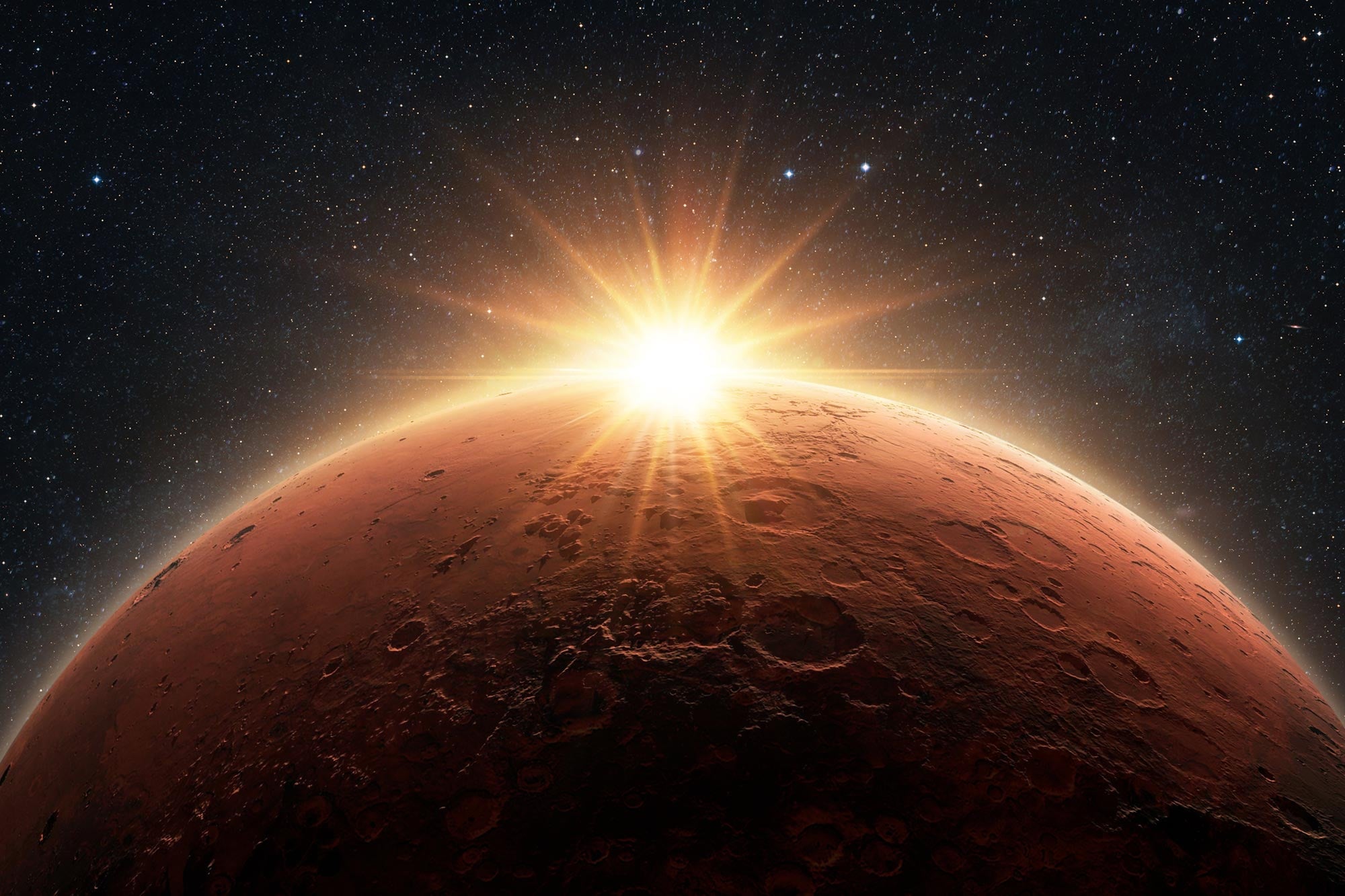
Mars may have built a surprisingly complex crust through large magmatic systems without the plate tectonics long thought necessary.
Mars has no moving tectonic plates, yet deep beneath its surface may lie evidence of the kind of vast, interconnected magmatic systems once thought to require them. Researchers from the University of Oxford have found signs that molten rock once evolved and recycled itself through the Martian crust, creating geological complexity with striking parallels to processes on Earth. The findings were published in Nature Astronomy.
Mars is considered a ‘stagnant lid’ planet because, unlike Earth, its outer surface is not divided into moving tectonic plates. On our planet, plate tectonics drives volcanism, material recycling, and continent–building, leading many researchers to assume that Mars could not have developed similarly complex crust. The new evidence suggests that extensive internal recycling may have allowed it to do so without Earth-like tectonics.
A buried boundary revealed complex crust
The key clue came from seismic measurements collected by NASA’s InSight mission, which recorded waves generated by meteoroid impacts and marsquakes, the Martian equivalent of earthquakes. Researchers in Oxford’s Departments of Earth Sciences and Statistics focused on an unexplained boundary about 24 kilometers below the surface. Earlier studies had detected it, but its geological meaning remained uncertain.
To determine whether the boundary separated distinct rock types, the researchers used thermodynamic modeling and statistical methods to compare the seismic observations with hundreds of possible rock compositions.
Only ‘ultramafic’ (rich in iron and magnesium, but low in silica) rocks consistently reproduced the physical properties below the 24-km boundary. Above it, the observations were better explained by ‘mafic’ (containing a higher proportion of silica) rocks.
The researchers propose that the deeper layer formed when molten rock accumulated far underground and gradually separated into different components. Dense crystals would have remained near the bottom of the crust while lighter, more evolved melts moved upward. Similar processes occur beneath volcanic arcs on Earth and are associated with continent formation.
Lead author Dr Tobermory Mackay-Champion (Department of Earth Sciences, University of Oxford at the time of the study, now University of Bristol) said: “We’ve traditionally assumed that volcanism on Mars was relatively simple compared to that on Earth. But this discovery suggests Mars could sustain large, long-lived systems where molten rock evolved and reprocessed itself throughout the entire crust. It raises exciting possibilities for how common such systems might be on rocky planets beyond our solar system.”
Mars may not need plate tectonics
The buried layer may stretch horizontally for hundreds or even thousands of kilometers across Mars’ northern hemisphere. If so, the planet once contained enormous connected magmatic systems rather than a collection of simple, isolated volcanoes. This process, known as ‘transcrustal magmatism,’ had previously been thought unique to Earth.
That distinction matters because geological recycling is closely tied to the development of atmospheres, oceans, and potentially habitable environments. On Earth, recycling within the planet helps regulate climate and supports the long-term movement of water and other volatile elements. Plate tectonics has often been considered essential to maintaining those processes.
The Martian evidence suggests that rocky planets may be able to develop complex crusts and some of the geological conditions associated with habitability without Earth-style plate tectonics.
Habitability may emerge on more worlds
Co-author Professor Jon Wade (Department of Earth Sciences, University of Oxford) said: “One of the big questions in planetary science is whether Earth is unique. If Mars could develop this kind of complex crust without plate tectonics, then maybe the conditions needed for habitability can emerge on more planets than we realized, including those previously dismissed based on size or their apparent lack of tectonic activity.”
The findings build on observations from NASA’s InSight mission, which placed the first seismometer on Mars in 2018 and gave researchers an unprecedented view of the planet’s interior.
Reference: “Seismic evidence for a melt-depleted lower crust and transcrustal magmatism on Mars” by T. Mackay-Champion, M. Anderson Loake, R. Palin, J. Wade and J.-M. Kendall, 26 June 2026, Nature Astronomy.
DOI: 10.1038/s41550-026-02907-5
Never miss a breakthrough: Join the SciTechDaily newsletter.
Follow us on Google and Google News.