
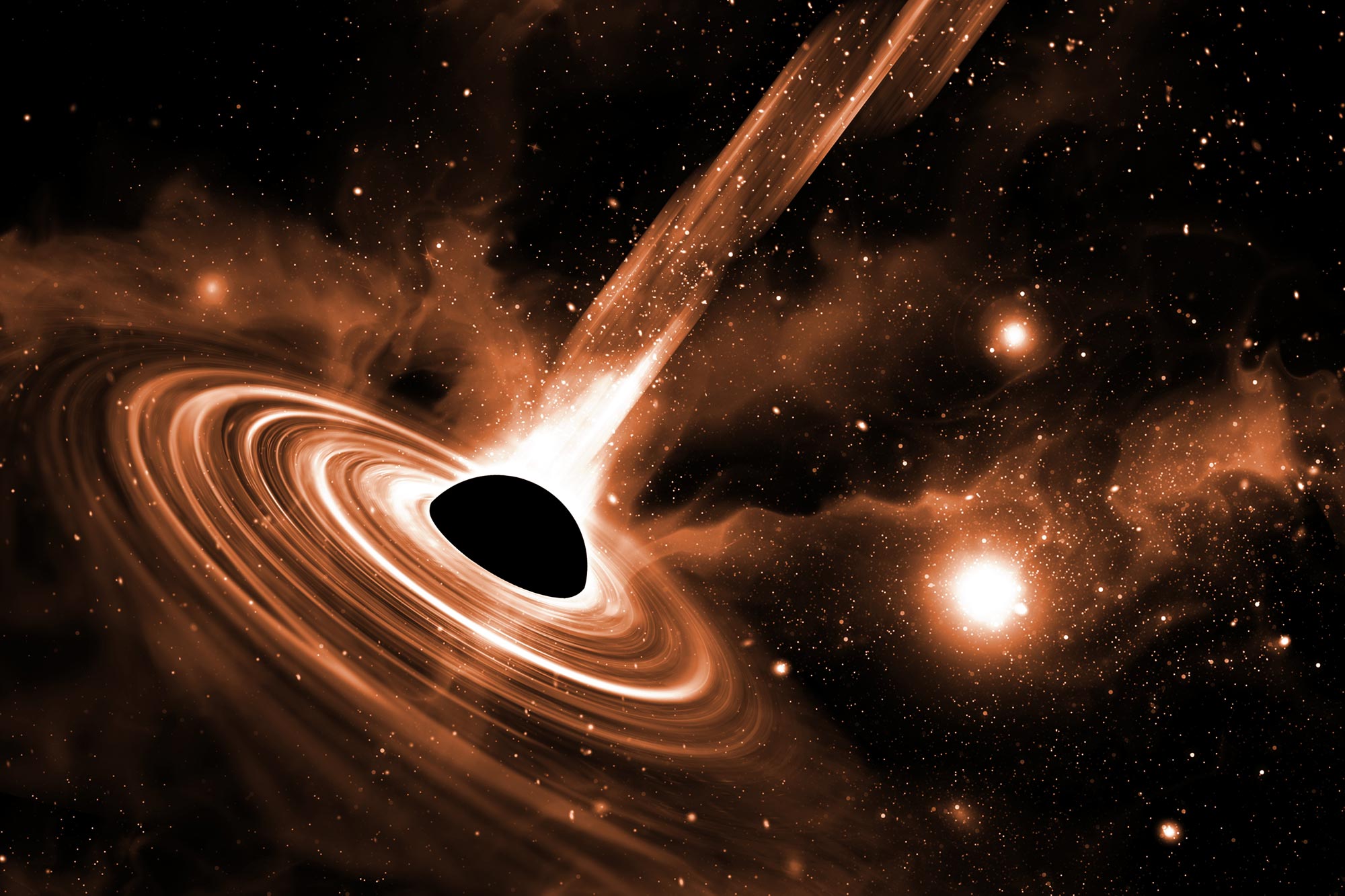
A star’s rotation may help solve a longstanding mystery involving repeated encounters between stars and supermassive black holes.
At the center of most galaxies sits a supermassive black hole, an object millions to billions of times more massive than the Sun. Its gravity is powerful enough to tear apart a star that ventures too close, but not every encounter ends in total destruction.
Some stars survive. After a close passage strips away part of a star, its remaining core can continue orbiting the black hole and return months or years later for another encounter. Each passage removes more material and produces another burst of light, creating what astronomers call a repeating partial tidal disruption event (rpTDE).
Wide-field time-domain surveys, which repeatedly scan large regions of the sky for changes in brightness, have made it possible to follow these same star and black hole interactions over multiple encounters. But several systems have presented astronomers with a persistent problem: instead of producing similar flares each time, they become progressively fainter.
Among the roughly 10 repeating systems identified so far, four show this fading pattern. Existing theoretical models had struggled to reproduce it.
Astrophysicists at Syracuse University now suggest that a property of the surviving star may provide the missing explanation: how rapidly it was already spinning before its first close approach to the black hole.
The study, published in The Astrophysical Journal, was led by doctoral student Ananya Bandopadhyay, working with postdoctoral researcher Benjamin Amend and associate professor Eric Coughlin—all in the Department of Physics—as well as colleagues at other institutions.
Why some stellar flares fade
A standard tidal disruption event (TDE) occurs when the difference in the black hole’s gravitational pull across a nearby star becomes strong enough to tear the star completely apart.
The resulting debris falls back toward, or “accretes” onto, the black hole. As that material loses energy, it produces light that can persist for days to months.
Black holes themselves do not emit light, so these temporary supplies of stellar debris give astronomers an indirect way to study otherwise invisible objects.
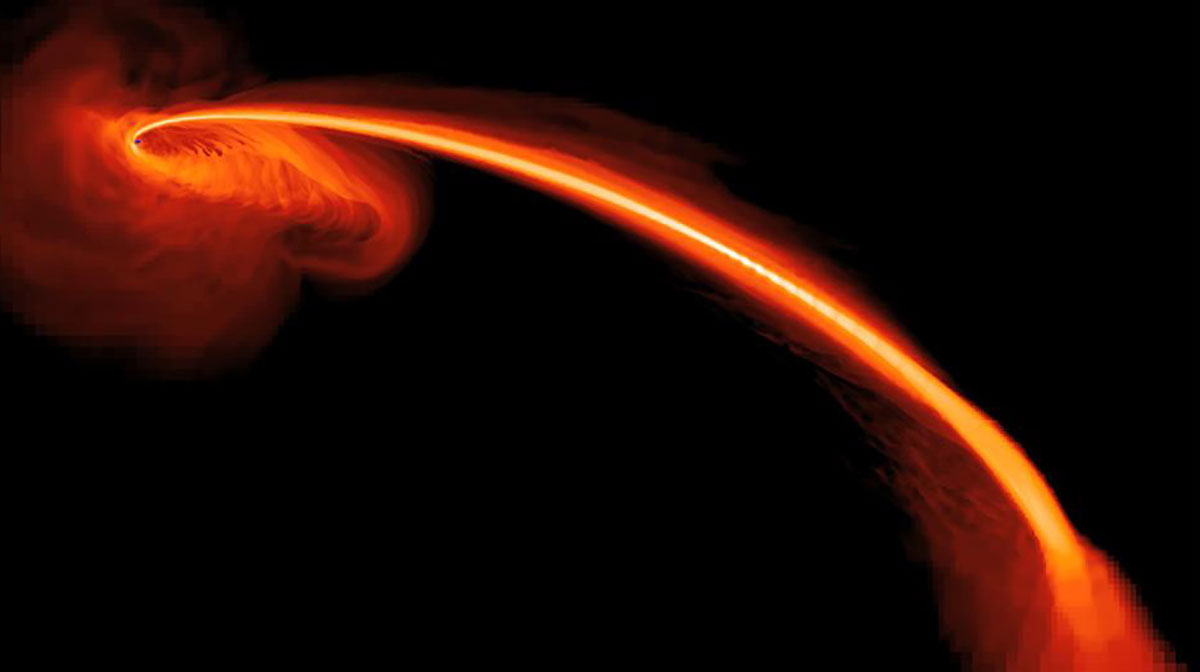
A star that passes somewhat farther from the black hole can escape complete destruction while still losing part of its mass, producing a partial TDE. If the surviving core remains bound to the black hole, it can return repeatedly, shedding additional material during close approaches separated by a few months to several years.
The amount lost on each passage depends partly on the star’s internal structure. Bandopadhyay compares a low-mass star to a fluffy meringue, making it increasingly susceptible to the black hole’s tidal forces. A higher-mass star, by contrast, has a more centrally concentrated, onion-like star and can lose its outer layers while its dense central region remains comparatively unaffected. As a result, it can shed progressively less material during successive encounters.
That distinction helps explain why different rpTDEs behave differently, but it did not resolve the fading flare problem. It would seem reasonable that less material stripped from a star should produce a dimmer flare, yet previous hydrodynamical simulations indicated otherwise. Even as the amount of lost material decreased from one encounter to the next, the simulated flares remained approximately as bright.
“We were puzzled by this for two years,” Bandopadhyay says.
Stellar spin resolves the mismatch
Their previous work had revealed another effect of the black hole’s tidal forces.In addition to stripping material from the star, they exert a torque that causes the star to spin faster with each close encounter. As a result, although less material falls back toward the black hole, it returns over a shorter period of time, helping to keep the predicted flare at roughly the same brightness.
That result suggested that decreasing mass loss alone was not enough. To make the simulated flares fade in the way astronomers actually observe, the researchers needed what Bandopadhyay called “a new ingredient”—a star that was already rotating rapidly before encountering the black hole.
The new study found that a star with substantial initial rotation does not experience the same large increase in spin during each passage. Without that added spin-up, the time required for stripped material to fall back toward the black hole stays relatively stable.
The consequence is different from the earlier models. If progressively less material is removed while the fallback timescale remains similar, the peak rate at which material returns to the black hole declines. The predicted flare can therefore become dimmer with each successive encounter.
A binary breakup may explain the spin
That result raises another question: why would a star caught in one of these systems already be rotating so quickly?
“It is also extremely difficult to ‘bind’ a star to a supermassive black hole so tightly that it orbits the black hole in a matter of months, and yet they seem to do so in rpTDEs,” Coughlin says.
The so-called Hills mechanism could potentially account for both the rapid stellar rotation and the unusually tight orbit. In this scenario, two stars orbiting closely around one another pass near a supermassive black hole. The black hole breaks the binary apart, ejecting one star while gravitationally capturing the other.
Stars in a sufficiently close binary can also become tidally locked, meaning each star rotates on its axis at the same rate that the pair circles one another. A tighter binary has a shorter orbital period, so a tidally locked star in such a system rotates more rapidly.
For a disrupted binary to leave one star captured on the short orbital periods seen in rpTDEs, the original pair would need to have been extremely close together. That same configuration could leave the captured star spinning quickly before its first partial disruption.
“Ananya’s work demonstrates that each of these peculiarities can be explained by the same underlying phenomenon: the tidal destruction of a binary system and the capture of one of the stars,” Coughlin says. “From a theoretical standpoint, this is a major step forward in our understanding of the physics at play in these systems.”
Coughlin notes that the Hills mechanism may have shaped other stellar populations as well. Some of the stars orbiting Sagittarius A*, the supermassive black hole at the center of the Milky Way, may also have been placed there through Hills capture. The findings could therefore help researchers understand some of the properties of stars in what he calls “our own cosmological backyard.”
Reference: “The Role of Stellar Spin in Repeating Partial Tidal Disruption Events” by Ananya Bandopadhyay, Benjamin Amend, Eric R. Coughlin, C. J. Nixon, Dheeraj R. Pasham and T. Wevers, 18 August 2026, The Astrophysical Journal.
DOI: 10.3847/1538-4357/ae8f31
Never miss a breakthrough: Join the SciTechDaily newsletter.
Follow us on Google and Google News.
1 Comment
Astrophysicists are encountering the exact same barrier across every scale: standard models fail when they ignore internal rotation and background matrix dynamics.The new Syracuse University study on repeating partial tidal disruption events (rpTDEs) solves a two-year puzzle. Standard gravitational models predicted periodic black hole flares should stay uniformly bright, but observations showed them fading. The missing link? Initial stellar spin. When researchers account for rapid pre-existing rotation, the star cannot absorb additional torque during periastron. Without a spin boost to speed up fallback accretion, shedding mass naturally leads to fading flares. Whether we look at the micro scale (vacuum birefringence proving space has dynamic impedance), the macro scale (90%+ of baryonic matter living in the intergalactic medium), or stellar dynamics (pre-existing spin governing orbital mass loss), mainstream physics keeps arriving at the same truth from separate buildings:Matter is an active dynamic system, not a static particle.Space is a continuous geometric field matrix with finite clearance limits, governed by Temporal Gradient Impedance ($Z_T$).When field density ($\rho_d$) reaches its saturation limit ($\Psi_{\text{anchor}}$), localized angular stress resolves through phase inversion—the $\pi\text{ Effect}$:$$(2\text{D}+\text{T}) + (3\text{D}+\text{T}) = -1\text{D}+\text{T Effect}$$$$E = mc^2 \cdot \pi$$Celestial bodies aren’t passive objects falling into empty voids—they are high-torque geometric nodes interacting with a continuous matrix. Check the link : https://docs.google.com/document/d/1iHSMitywAsr2YbvXBW65bAR9g5bELPSy1meMg_ik7f8/edit?usp=drive_link .