
Close Menu
    Facebook X (Twitter) Instagram
    SciTechDaily
    • Biology
    • Chemistry
    • Earth
    • Health
    • Physics
    • Science
    • Space
    • Technology
    Facebook X (Twitter) Pinterest YouTube RSS
    SciTechDaily
    Home»Space»18 Million Miles per Hour: Star With the Shortest Orbital Period Around Black Hole Discovered
    Space

    18 Million Miles per Hour: Star With the Shortest Orbital Period Around Black Hole Discovered

    By University of CologneJuly 7, 20224 Comments4 Mins Read
    Facebook Twitter Pinterest Telegram LinkedIn WhatsApp Email Reddit
    Share
    Facebook Twitter LinkedIn Pinterest Telegram Email Reddit
    Black Hole Illustration Stars
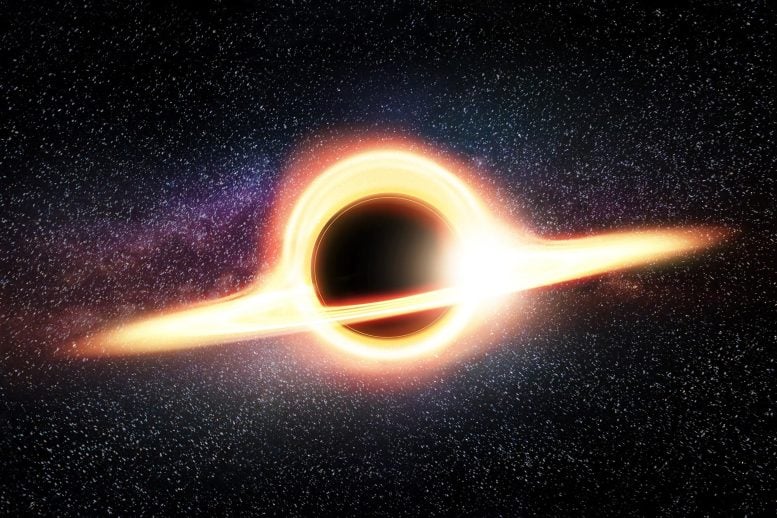
    Artist’s illustration of a black hole. A star was discovered zipping around the black hole at the center of our galaxy, the Milky Way, at an astonishing speed of 8,000 km/s.

    A newly discovered star only takes four years to travel around the black hole at the center of our Milky Way.

    Astronomers have discovered the fastest known star, which travels around a black hole in record time. The star, S4716, orbits Sagittarius A*, the black hole in the center of our galaxy, in four years and reaches a speed of around 8,000 kilometers per second (5,000 miles per second) which is about 30 million kilometers per hour (18 million miles per hour).

    S4716 comes as close as 100 AU (astronomical unit) to the black hole – a small distance by astronomical standards. One AU is the approximate mean distance from the Earth to the Sun and corresponds to 149,597,871 kilometers (92,955,807 miles). The study was conducted by researchers at the University of Cologne and Masaryk University in Brno (Czech Republic) and published on July 5, 2022, in The Astrophysical Journal.

    The S Cluster: A Dense Group of Rapidly Moving Stars

    In the area near the black hole at the center of our galaxy is a densely packed cluster of stars. This cluster, called the S cluster, is home to well over a hundred stars that differ in their brightness and mass. S stars move particularly fast.

    “One prominent member, S2, behaves like a large person sitting in front of you in a movie theater: it blocks your view of what’s important,” said Dr. Florian Peissker, lead author of the new study. “The view into the center of our galaxy is therefore often obscured by S2. However, in brief moments we can observe the surroundings of the central black hole.”


    Stars in the S cluster orbit the black hole at the center of our galaxy at great speed. S4716 is the fastest. Credit: Florian Peissker, University of Cologne

    By means of continuously refining methods of analysis, together with observations spanning almost twenty years, the astronomers have now identified without a doubt a star that travels around the central supermassive black hole in just four years. In total, five telescopes observed the star, with four of these five being combined into one large telescope to allow even more accurate and detailed observations.

    The Unexpected Stability of S4716’s Orbit

    “For a star to be in a stable orbit so close and fast in the vicinity of a supermassive black hole was completely unexpected and marks the limit that can be observed with traditional telescopes,” said Peissker.
    Star With Shortest Orbital Period Around Black Hole Discovered
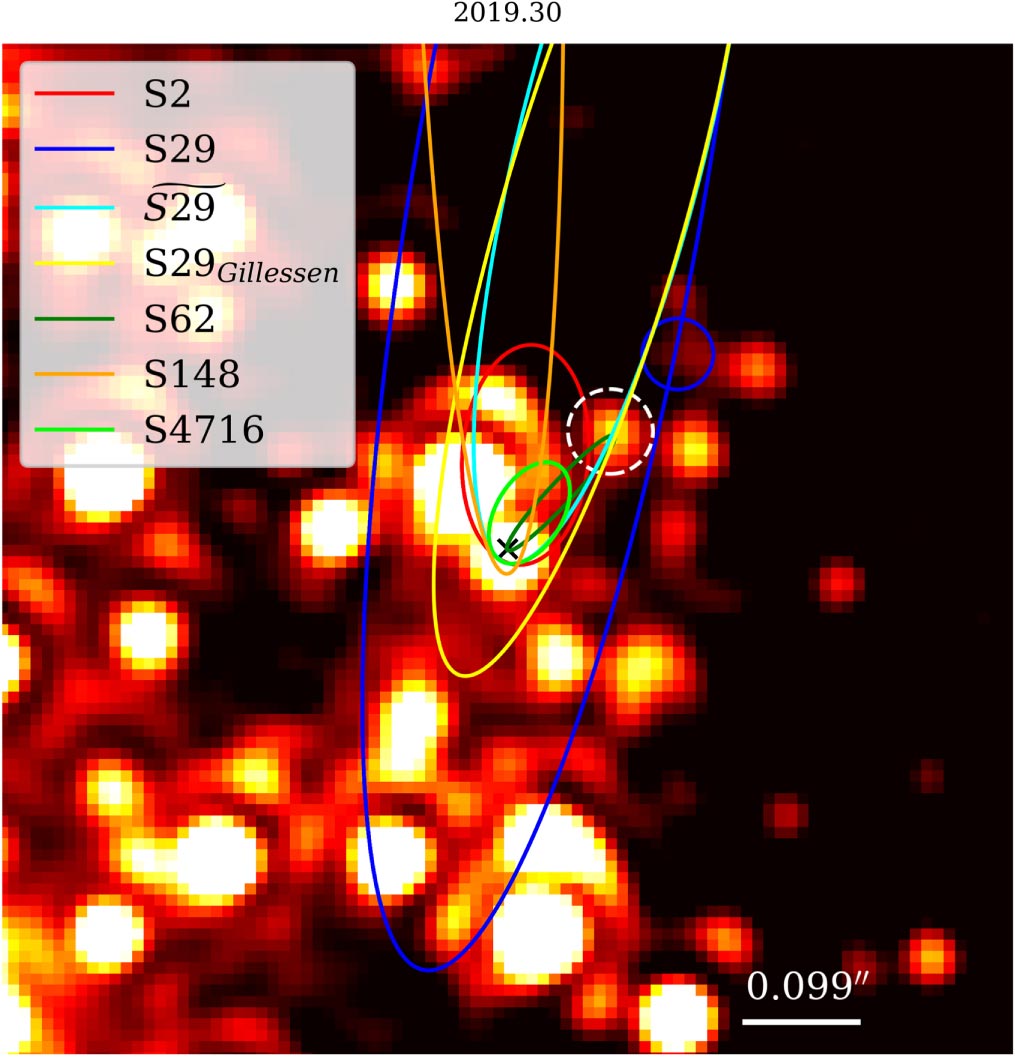
    The K-band view of the GC observed with NIRC2 (Keck) in 2019.30. This image is high-pass filtered and shows the position of several S stars close to Sgr A*, which is indicated by a black cross. The star in the white dashed circle shows a K-band magnitude of 16.3 mag, while the star in the blue circle is 17.0 mag faint. Both K-band magnitudes are consistent with the reported values for S62 by Peißker et al. (2020a) and those for S29 by Gillessen et al. (2017) and Peißker et al. (2021b). Here North is up and east is to the left. Credit: The Astrophysical Journal, DOI: 10.3847/1538-4357/ac752f

    Moreover, the discovery sheds new light on the origin and evolution of the orbit of fast-moving stars in the heart of the Milky Way. “The short-period, compact orbit of S4716 is quite puzzling,” Michael Zajacek, an astrophysicist at Masaryk University in Brno who was involved in the study, said. “Stars cannot form so easily near the black hole. S4716 had to move inwards, for example by approaching other stars and objects in the S cluster, which caused its orbit to shrink significantly,” he added.

    Reference: “Observation of S4716—a Star with a 4 yr Orbit around Sgr A*” by Florian Peißker, Andreas Eckart, Michal Zajacek and Silke Britzen, 5 July 2022, The Astrophysical Journal.
    DOI: 10.3847/1538-4357/ac752f

    Never miss a breakthrough: Join the SciTechDaily newsletter.
    Follow us on Google and Google News.

    Astronomy Astrophysics Black Hole Popular Stars University of Cologne
    Share. Facebook Twitter Pinterest LinkedIn Email Reddit

    Related Articles

    Astronomers Just Found a Star System That Shouldn’t Exist Near a Supermassive Black Hole

    Cosmic Detective Work Leads to Stunning Black Hole Discovery in Our Galaxy

    Vanishing Without a Trace: Why Stars Mysteriously Disappear From the Night Sky

    Supernova Scavenger Hunt: Cracking the Case of Cosmic Ghost Stars

    Behold! Rare Quasar Triplet Forms Most Massive Object in Universe

    Should Not Exist: Baby Star Found in Close Proximity to Milky Way’s Black Hole

    Watch Stars Race Around the Milky Way’s Supermassive Black Hole at Mind-Boggling Speeds

    Artificial Intelligence Helps Resolve Long-Running Astrophysics Debate on Supermassive Black Holes

    Death by Spaghettification: Telescopes Record Last Moments of Star Devoured by a Black Hole

    4 Comments

    1. Alan Rohr on July 7, 2022 10:28 am

      Excellence in information. 🌹🌹

      Reply
    2. Zack on July 23, 2022 10:05 am

      Nice drawing art! I can make a black hole too, only with no direct proof whatsoever of its physical existence.

      Reply
      • skab on April 25, 2024 7:47 pm

        This is only a typical model title for mass density, which is a recycle process of a star. Scientists are not there for science fiction. It’s not their problem, what others may attribute to natural science.

        Reply
    3. skab on April 25, 2024 7:30 pm

      Even shortest orbit takes billions of years. In other words, galactic scale pace is as dead slow as still, compared to billion year time it takes. Now what. If there’s a planet around that star with life, they have billions of years to exist before they complete their million year era there.

      Reply
    Leave A Reply Cancel Reply

    • Facebook
    • Twitter
    • Pinterest
    • YouTube

    Don't Miss a Discovery

    Subscribe for the Latest in Science & Tech!

    Trending News

    Popular Sugar-Free Sweetener Linked to Liver Disease, Study Warns

    What Is Hantavirus? The Deadly Disease Raising Alarm Worldwide

    Scientists Just Discovered How the Universe Builds Monster Black Holes

    Scientists Unveil New Treatment Strategy That Could Outsmart Cancer

    A Simple Vitamin May Hold the Key to Treating Rare Genetic Diseases

    Scientists Think the Real Fountain of Youth May Be Hiding in Your Gut

    Ravens Don’t Follow Wolves, They Predict Them

    This Common Knee Surgery May Be Doing More Harm Than Good

    Follow SciTechDaily
    • Facebook
    • Twitter
    • YouTube
    • Pinterest
    • Newsletter
    • RSS
    SciTech News
    • Biology News
    • Chemistry News
    • Earth News
    • Health News
    • Physics News
    • Science News
    • Space News
    • Technology News
    Recent Posts
    • Popular Supplement Ingredient Linked to Shorter Lifespan in Men
    • Scientists May Have Found a Way To Repair Nerve Damage in Multiple Sclerosis
    • GLP-1 Weight Loss Linked To Dramatically Lower Risk of Sleep Apnea, Kidney Disease and More
    • Scientists Uncover the Surprising Source of Strange Clouds Near the Milky Way’s Supermassive Black Hole
    • This Dazzling Green Snake Was Hiding in Plain Sight for Decades
    Copyright © 1998 - 2026 SciTechDaily. All Rights Reserved.
    • Science News
    • About
    • Contact
    • Editorial Board
    • Privacy Policy
    • Terms of Use

    Type above and press Enter to search. Press Esc to cancel.