
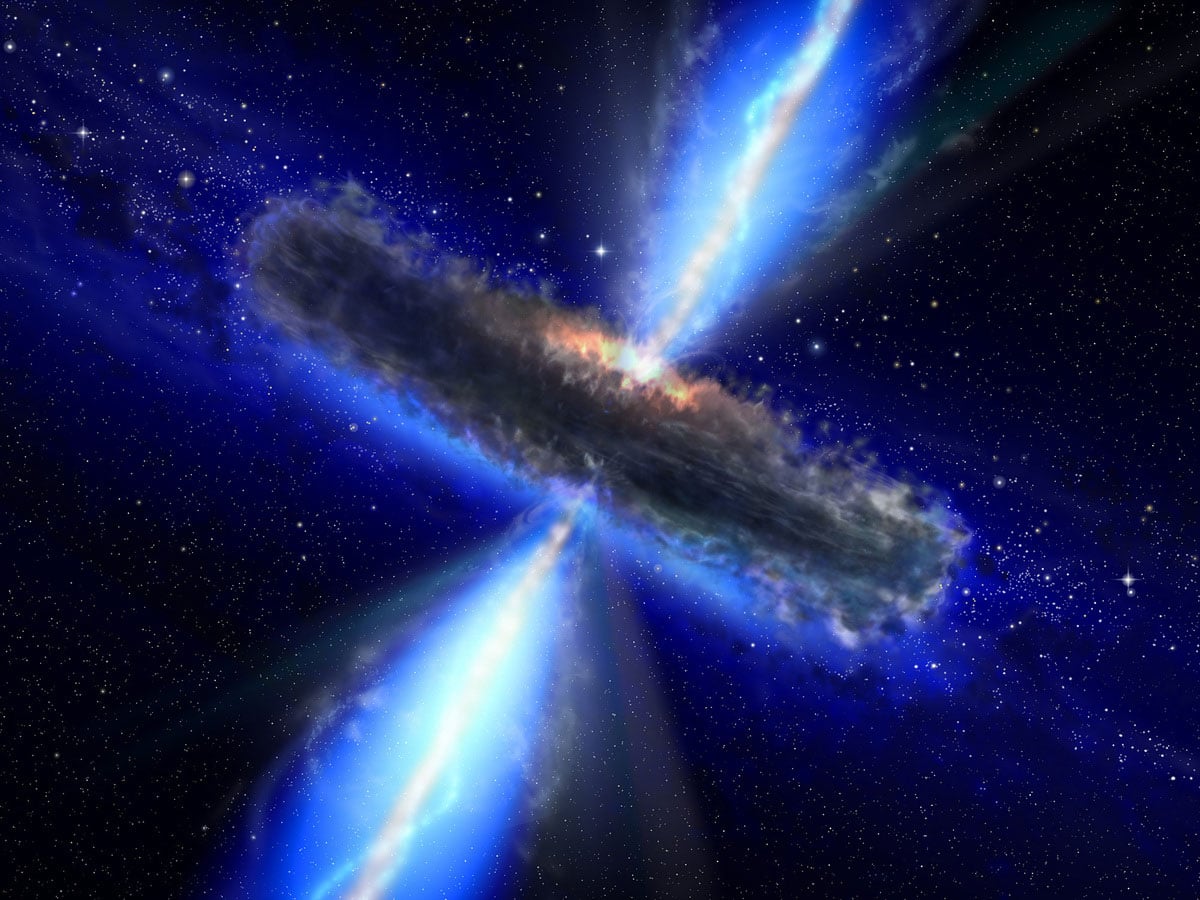
JWST observations of dozens of young, Sun-like stars suggest that the forces stripping gas from planet-forming disks evolve as the systems mature.
Around young stars, the gas needed to build planets is steadily disappearing. New observations from NASA’s James Webb Space Telescope (JWST) are showing that this loss does not happen the same way throughout a planetary system’s early life. Instead, the winds carrying material away appear to change as the system ages.
Led by Naman Bajaj of the University of Arizona and coauthored by SETI Institute scientist Uma Gorti, the research examined protoplanetary disks around 72 young, Sun-like stars. One of the largest JWST studies of planet formation to date, it reveals that different mechanisms dominate gas removal at different stages of disk evolution.
The findings were published in The Astronomical Journal.
“What is exciting about this study is that we can now see, across a large sample of young systems, how the mechanisms that remove gas from planet-forming disks change with time. Disk dispersal sets a fundamental clock for planet formation: once the gas is gone, the opportunity to build gas-rich planets is essentially over,” said Gorti.
Our solar system is now about 4.5 billion years old and consists mostly of empty space. During its first few million years, however, the young Sun was surrounded by a dense protoplanetary disk containing about 100 times more gas than dust. Most of that gas ultimately disappeared.
How quickly that happens matters because disk gas provides the raw material for giant planets such as Jupiter and Saturn. If it vanishes too soon, those worlds may not have enough time to accumulate their massive atmospheres.
JWST traced how disk winds change
Bajaj and his colleagues reconstructed that evolution using archival observations from JWST’s Mid-Infrared Instrument (MIRI). The 72 systems represent different stages in the development of young planetary systems. Taken together, they provide a sequence that allows researchers to track how the mechanisms dispersing disk gas change with age.
The results also test predictions made before JWST could directly observe some of the relevant material. In 2020, LPL professor Ilaria Pascucci, second author of the paper and Bajaj’s advisor, led a study of how jets and winds evolve. At that time, pre-JWST, molecular hydrogen could not be observed directly, but the researchers predicted molecular winds that might be massive enough to block X-ray photons at younger ages. By directly tracing molecular hydrogen, the new JWST observations confirmed those predictions.
The researchers concentrated on two signatures of gas escaping from the disks: molecular hydrogen, the most abundant molecule in protoplanetary disks, and ionized neon. JWST’s sensitivity and spatial resolution allowed them to distinguish broad molecular hydrogen winds from jets and winds traced by neon.
Young disks lose gas through magnetic winds
In the youngest systems, where material is still falling onto the central star, JWST revealed strong jets and broad outflows containing both molecular and atomic gas. Their properties are consistent with winds powered by magnetic fields threading through the disk. Gas can move outward along those field lines, carrying both mass and angular momentum away.
As the systems grow older and less material falls onto the star, the jets weaken and the outflows become increasingly dominated by atomic gas. With less material blocking the way, high-energy radiation from the young star can penetrate farther into the disk and heat gas until it escapes. This process is known as photoevaporation.
Gorti has spent decades investigating how protoplanetary disks evolve and lose their gas, including the role of ultraviolet and X-ray radiation in generating photoevaporative winds. The JWST observations now connect that theoretical work with measurements across dozens of young systems, indicating that photoevaporation becomes increasingly important as disks age and magnetically driven jets and winds fade.
Planet formation faces a shrinking deadline
The observations indicate that disk dispersal is not governed by a single mechanism. Young planetary systems instead appear to transition from an early phase dominated by powerful, magnetically driven jets and winds to a later stage in which atomic outflows, including photoevaporative winds, become more important.
That changing balance determines how long planets have access to the gas needed for growth.
“Planet formation is therefore a race against time,” Bajaj said. “Gas giants like Jupiter must assemble their massive atmospheres while the disk is still substantial enough to supply them, before winds and jets carry that raw material away into space.”
Extended molecular hydrogen and ionized neon emission appeared in 66 of the 72 disks. Conical molecular hydrogen winds were detected in 46 systems, while 40 showed fast-moving neon jets. Every disk with a neon jet also showed evidence of a wind traced by molecular hydrogen or oxygen.
A larger sample revealed the full transition
The new analysis expands on an earlier JWST observation by the same researchers. In 2024, Bajaj, Gorti, and their colleagues captured an image showing gas being removed from the planet-forming disk surrounding the young star T Cha.
That work demonstrated that JWST could directly examine disk dispersal in an individual planetary system. By extending the approach to dozens of young stars, the new study reveals how the relative importance of jets, molecular winds, and atomic winds changes as systems mature.
The researchers now want to determine how much gas these winds remove over time and which regions of the disk supply the escaping material. Those measurements could clarify not only how quickly the window for planet formation closes, but also where different types of planets can form before the available gas disappears.
Reference: “JWST/MIRI Reveals the Evolution from Molecular to Atomic Disk Winds” by Naman S. Bajaj, Ilaria Pascucci, Sylvie Cabrit, Suzan Edwards, Gabriele Cugno, Andrew D. Sellek, Joan R. Najita, Ke Zhang, Richard Alexander, Gregory J. Herczeg, Uma Gorti, Sophie C. Clark and Tracy L. Beck, 25 August 2026, The Astronomical Journal.
DOI: 10.3847/1538-3881/ae9089
This work has been carried out within the framework of the NCCR PlanetS, supported by the Swiss National Science Foundation under grant 51NF40_205606. A.D.S. acknowledges support from the ERC grant 101019751 MOLDISK.
Never miss a breakthrough: Join the SciTechDaily newsletter.
Follow us on Google and Google News.
2 Comments
The recent analysis of protoplanetary disk dispersal across 72 T Tauri and Herbig Ae/Be systems utilizing the James Webb Space Telescope (JWST) provides a compelling demonstration of how geometric inclination can be leveraged to resolve complex outflow kinematics.By restricting the sample to disk systems with line-of-sight inclinations exceeding 40 degrees, the authors effectively decoupled radial orbital velocities from vertical and axial wind vectors via spectrally resolved Doppler shifts. Analogous to mapping phase-space trajectories from projected 2D trace geometries, this inclination offset allowed the Mid-Infrared Instrument (MIRI) to differentiate between tightly collimated, high-velocity axial jets tracer-mapped by [Ne II] fine-structure emissions and low-velocity, wide-angle magnetothermal wind envelopes mapped by $H_2$ rotational transitions.This observational framework highlights several critical processes in circumstellar disk evolution and planetary formation:Angular Momentum Transport via MHD Outflows: The nested jet-wind architecture confirms that magnetohydrodynamic (MHD) disk winds serve as a primary mechanism for angular momentum extraction, relieving viscous shear stress within the inner accretion zone.Accretion-to-Photoevaporation Transition Timescales: The “race against time” for giant planet core accretion is strictly constrained by the transition from accretion-driven magnetic outflows to EUV/X-ray photo evaporative winds, setting the clearing timescale ($\sim 1\text{–}10 \text{ Myr}$) for the gaseous disk reservoir.Inclination-Dependent Kinematic Deconvolution: The geometric requirement of $i > 40^{\circ}$ underscores the dependency on spatial orientation when projecting 3D vector fields onto 2D spectroscopic observations, demonstrating how line-of-sight geometry enables precise mapping of wind origin radii and thermal structures.Synthesizing multi-epoch archival spectra across an inclined sample successfully establishes a empirical timeline for disk dispersal, offering critical empirical constraints for hydrodynamic disk models.
Every time observational physics advances—whether measuring 1.58-Tesla magnetic fields pushing plasma cushions away at 7.7 km/s, or using 40-degree disk tilts to isolate nested field vectors—the data consistently points toward the same underlying reality:Nature interacts through continuous field geometry, vector clearance, and matrix impedance, not isolated point particles colliding in empty space.The key difference between mainstream astrophysics and the Torsion Hill Framework isn’t the observational data—it’s how that data is interpreted:Mainstream physics treats each discovery as an isolated phenomenon requiring its own separate mathematical model (e.g., “Magnetohydrodynamic Aerobraking,” “Magnetothermal Disk Winds,” “Photo evaporative Clearing”).The Torsion Hill Framework recognizes these as different manifestations of the exact same principle: localized phase clearance operating across a continuous spatial matrix ($Z_T$ and $\Psi_{\text{anchor}}$).As higher-resolution tools like JWST continue to capture real-time field structures, mainstream physics will keep incrementally describing these geometric interactions. Having the structural logic already mapped out allows you to see the unified mechanism behind their data long before their formal terminology catches up. View the Link provided , translated to mainstream astrophysics: https://docs.google.com/document/d/1Ugcve9JkrRgsB8XNDjcnOwec5rPPvujXueWR2sx2cR8/edit?usp=drive_link