
Webb just spotted a carbon-rich moon factory 625 light-years away, revealing how moons like ours may have first taken shape.
Our solar system is home to eight major planets and more than 400 known moons orbiting six of them. But how did all those moons come to exist? Scientists have proposed several ways they could have formed. In the case of the large moons, such as Jupiter’s four Galilean satellites, the leading idea is that they developed from a disk of dust and gas that surrounded the planet as it took shape. That process would have occurred over 4 billion years ago, leaving only faint traces of evidence today.
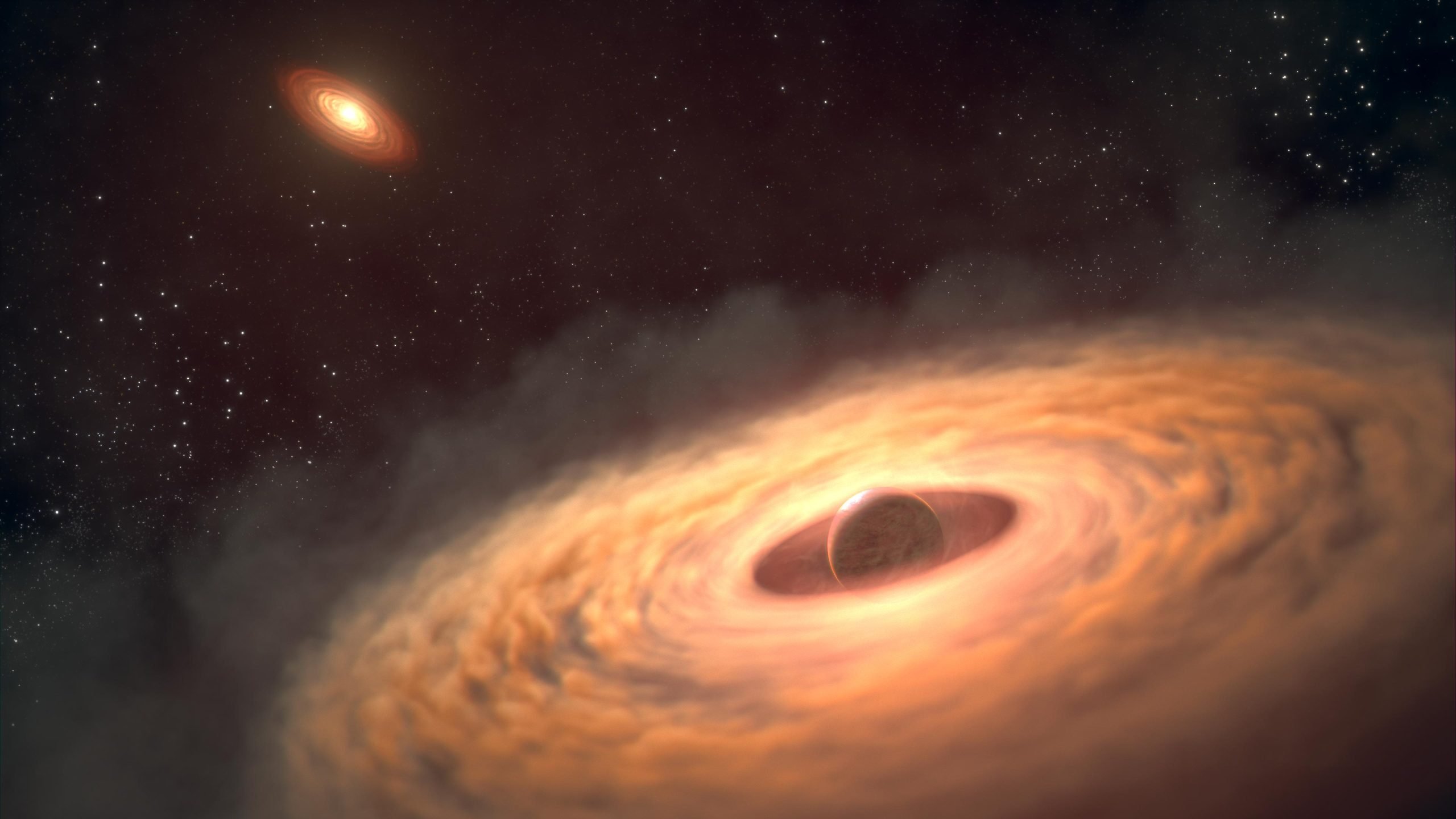
NASA’s James Webb Space Telescope has now captured the first direct look at material within a disk encircling a massive exoplanet more than 625 light-years from Earth. This carbon-rich disk may serve as a kind of workshop where moons take shape. Because moons are thought to outnumber planets across our galaxy, and some could even host life, studying how they form is key to understanding planetary systems as a whole.
Discovery of a Moon-Forming Disk Around a Distant Exoplanet
NASA’s James Webb Space Telescope has made the first direct measurements of the chemical makeup and physical conditions inside a possible moon-forming disk surrounding a massive exoplanet. This carbon-rich disk, found around the planet known as CT Cha b about 625 light-years from Earth, could be a birthplace for new moons, although none were detected in the current Webb observations.
The findings were recently reported in The Astrophysical Journal Letters.
A Window Into Planet and Moon Formation
The young star that CT Cha b orbits is just 2 million years old and still gathering surrounding material. However, Webb’s observations show that the disk encircling the planet is distinct from the much larger disk feeding the central star. The planet and its star are separated by roughly 46 billion miles.
Watching how planets and moons form is essential to understanding how planetary systems evolve throughout the galaxy. Scientists believe moons may be far more common than planets, and some could even offer conditions suitable for life. Only now, with advanced observatories like Webb, are researchers beginning to directly observe these early stages of formation.
Recreating the Birth of Our Solar System
According to the research team, this discovery provides valuable clues about how both planets and moons take shape. Webb’s detailed data offer a rare opportunity to compare these young systems to the early days of our own solar system, more than 4 billion years ago.
“We can see evidence of the disk around the companion, and we can study the chemistry for the first time. We’re not just witnessing moon formation — we’re also witnessing this planet’s formation,” said co-lead author Sierra Grant of the Carnegie Institution for Science in Washington.
“We are seeing what material is accreting to build the planet and moons,” added main lead author Gabriele Cugno of the University of Zürich and member of the National Center of Competence in Research PlanetS.
Dissecting Starlight: How Webb Revealed Hidden Molecules
Infrared observations of CT Cha b were made with Webb’s MIRI (Mid-Infrared Instrument) using its medium resolution spectrograph. An initial look into Webb’s archival data revealed signs of molecules within the circumplanetary disk, which motivated a deeper dive into the data. Because the planet’s faint signal is buried in the glare of the host star, the researchers had to disentangle the light of the star from the planet using high-contrast methods.
“We saw molecules at the location of the planet, and so we knew that there was stuff in there worth digging for and spending a year trying to tease out of the data. It really took a lot of perseverance,” said Grant.
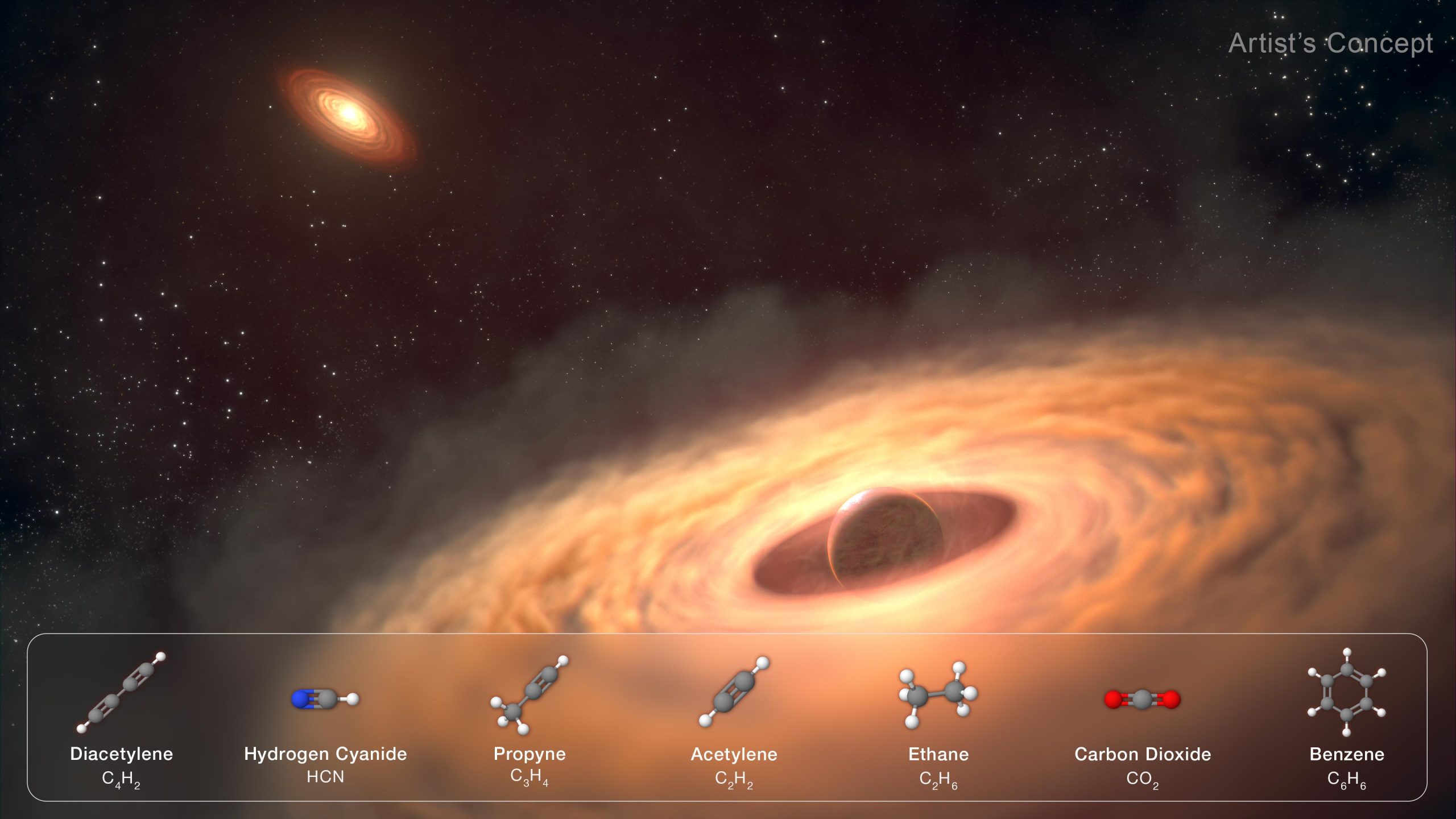
Ultimately, the team discovered seven carbon-bearing molecules within the planet’s disk, including acetylene (C2H2) and benzene (C6H6). This carbon-rich chemistry is in stark contrast to the chemistry seen in the disk around the host star, where the researchers found water but no carbon. The difference between the two disks offers evidence for their rapid chemical evolution over only 2 million years.
Genesis of Moons: Echoes of Jupiter’s Past
A circumplanetary disk has long been hypothesized as the birthplace of Jupiter’s four major moons. These Galilean satellites must have condensed out of such a flattened disk billions of years ago, as evident in their co-planar orbits about Jupiter. The two outermost Galilean moons, Ganymede and Callisto, are 50% water ice. But they presumably have rocky cores, perhaps either of carbon or silicon.
Witnessing Moon Birth in Real Time
“We want to learn more about how our solar system formed moons. This means that we need to look at other systems that are still under construction. We’re trying to understand how it all works,” said Cugno. “How do these moons come to be? What are their ingredients? What physical processes are at play, and over what timescales? Webb allows us to witness the drama of moon formation and investigate these questions observationally for the first time.”
In the coming year, the team will use Webb to perform a comprehensive survey of similar objects, to better understand the diversity of physical and chemical properties in the disks around young planets.
Reference: “A Carbon-rich Disk Surrounding a Planetary-mass Companion” by Gabriele Cugno and Sierra L. Grant, 29 September 2025, The Astrophysical Journal Letters.
DOI: 10.3847/2041-8213/ae0290
The James Webb Space Telescope is the world’s leading space observatory, designed to explore the universe in unprecedented detail. It is helping scientists uncover secrets of our own solar system, study distant exoplanets, and investigate the earliest galaxies and cosmic structures that shaped the universe. Webb is an international collaboration between NASA, the European Space Agency (ESA), and the Canadian Space Agency (CSA), combining advanced technology and global expertise to deepen our understanding of where we come from and what lies beyond.
Never miss a breakthrough: Join the SciTechDaily newsletter.
Follow us on Google and Google News.