
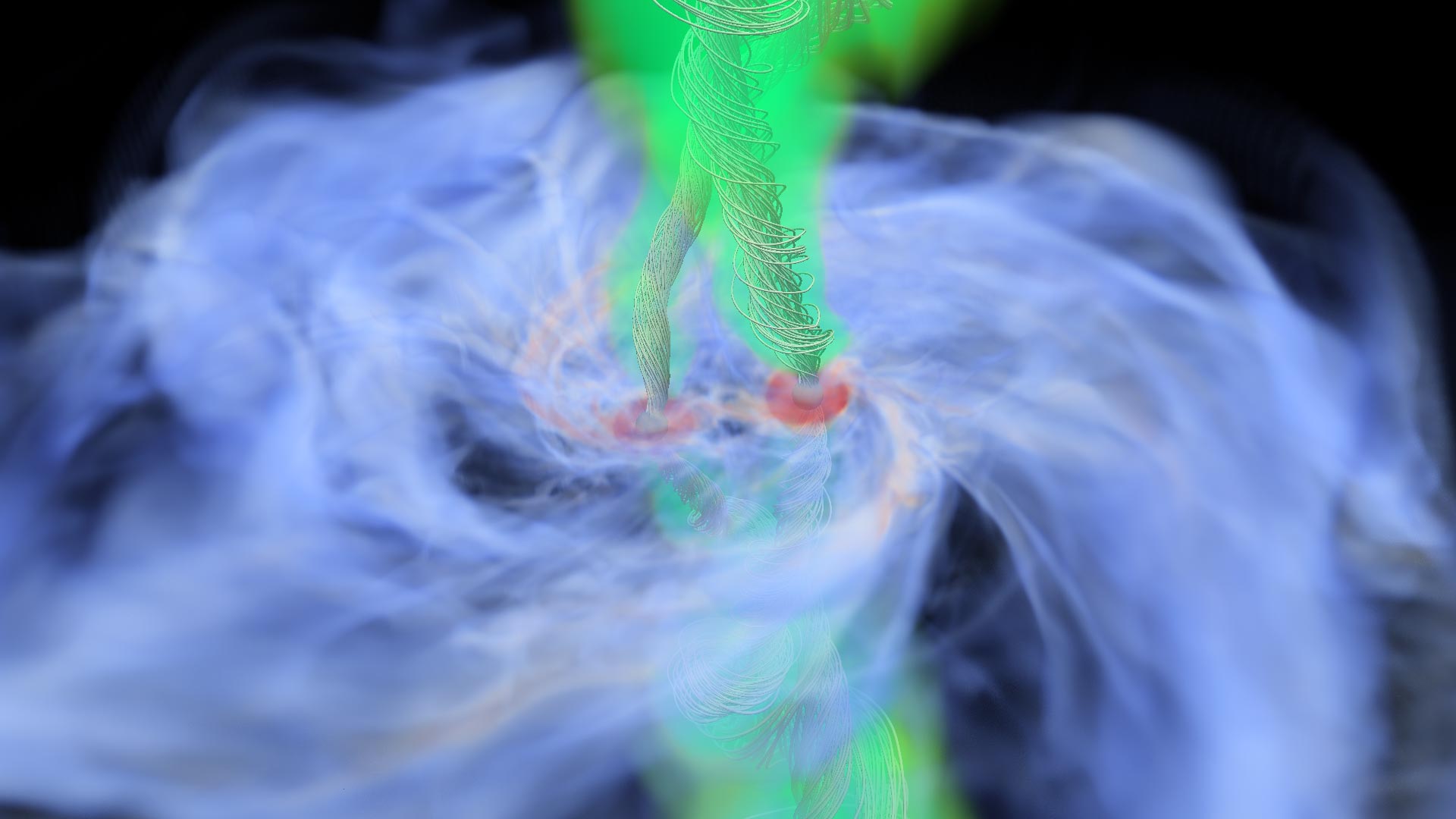
Magnetic fields may be the hidden force bringing both newborn stars and giant black holes together.
New computer simulations suggest that magnetic fields play a crucial role in helping pairs of young stars form. The findings could explain why binary star systems are so common throughout the Milky Way and may even offer clues about how supermassive black holes grow.
Stars are born when vast clouds of gas in space collapse under gravity, creating dense regions known as molecular cloud cores. Because multiple stars often form within the same cloud, some end up becoming gravitationally linked, creating binary star systems in which two stars orbit one another.
Astronomers have long suspected that many binary systems begin taking shape very early in the star formation process, before the stars themselves are fully developed. However, explaining how these young protostars move close enough together to become a stable pair has remained a challenge.
Magnetic Fields Bring Protostars Closer Together
To investigate the problem, researchers carried out advanced simulations using several supercomputers, including the National Astronomical Observatory of Japan’s ATERUI III system and its predecessor, ATERUI II.
The simulations revealed that interactions between magnetic fields in interstellar space and the gas surrounding young protostars can remove angular momentum from the pair. As angular momentum is reduced, the protostars are able to move closer together, allowing a binary system to form within a realistic timescale.
The importance of magnetic fields became especially clear when researchers ran a comparison simulation with no magnetic field at all. In that scenario, the two protostars moved farther apart rather than closer together, highlighting magnetism’s key role in the formation process.
Implications for Binary Black Holes
The researchers also found evidence that a similar mechanism could operate on pairs of massive black holes.
In the gas-rich central regions of a newly formed galaxy created when two smaller galaxies merge, magnetic fields may help massive binary black holes lose angular momentum and move closer together. Such a process could help explain how black holes eventually approach one another closely enough to merge, ultimately producing a supermassive black hole.
Directly simulating massive binary black holes over the enormous timescales required for them to spiral inward remains computationally difficult. As a result, researchers say that a detailed investigation into the influence of magnetic fields on binary black hole evolution will require future study.
Reference: “Magnetic-field-induced inspiral of binaries with circumbinary disc: black hole and protostellar systems” by Tomoaki Matsumoto, Kenta Hotokezaka and Kohei Inayoshi, 10 April 2026, Monthly Notices of the Royal Astronomical Society.
DOI: 10.1093/mnras/stag669
Never miss a breakthrough: Join the SciTechDaily newsletter.
Follow us on Google and Google News.