
Close Menu
    Facebook X (Twitter) Instagram
    SciTechDaily
    • Biology
    • Chemistry
    • Earth
    • Health
    • Physics
    • Science
    • Space
    • Technology
    Facebook X (Twitter) Pinterest YouTube RSS
    SciTechDaily
    Home»Space»Cosmic X-Rays Reveal a Distinctive Signature of Black Hole Event Horizons
    Space

    Cosmic X-Rays Reveal a Distinctive Signature of Black Hole Event Horizons

    By Tata Institute of Fundamental ResearchSeptember 21, 20206 Comments3 Mins Read
    Facebook Twitter Pinterest Telegram LinkedIn WhatsApp Email Reddit
    Share
    Facebook Twitter LinkedIn Pinterest Telegram Email Reddit
    Black Hole Event Horizon Concept
    Black Hole Event Horizon Concept. Astrophysicists discovered a clear signature that distinguishes black hole event horizons from neutron stars, providing the strongest steady signature of stellar-mass black holes observed so far.

    An international team of astrophysicists has found a distinctive signature of black hole event horizons, unmistakably separating them from neutron stars — objects, comparable to black holes in mass and size but confined within a hard surface. This is by far the strongest steady signature of stellar-mass black holes to date. The team consisting of Mr. Srimanta Banerjee and Professor Sudip Bhattacharyya from the Tata Institute of Fundamental Research, India, and Professor Marat Gilfanov and Professor Rashid Sunyaev from Max Planck Institute for Astrophysics, Germany, and Space Research Institute of Russian Academy of Sciences, Russia is publishing this research in a paper that has been accepted for publication in Monthly Notices of the Royal Astronomical Society.
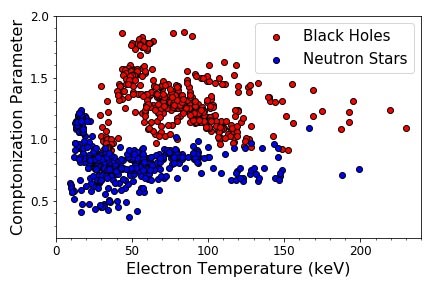
    Cosmic X-Rays Black Hole Signature
    The graph shows measured values of two source properties – electron temperature and Comptonization parameter – from many X-ray observations of about two dozens of black holes and neutron stars. It is clearly seen that the black hole (red symbols) and the neutron star (blue symbols) are almost entirely separated in an unprecedented manner, thus identifying the black holes indubitably. Credit: Srimanta Banerjee, Sudip Bhattacharyya, Marat Gilfanov

    A black hole is an exotic cosmic object without a hard surface predicted by Einstein’s theory of General Relativity. Although it does not have a surface, it is confined within an invisible boundary, called an event horizon, from within which nothing, not even light, can escape. Definitive proof of the existence of such objects is a holy grail of modern physics and astronomy.

    Only one supermassive black hole — with the mass more than 6 billion times the mass of the Sun — has so far been imaged using the surrounding radiation in radio wavelengths. But stellar-mass black holes — with masses of about ten times the mass of the Sun — should bend the spacetime around them at least ten thousand trillion times more than such a supermassive black hole does. Such smaller black holes are therefore indispensable to probe some extreme aspects of nature. When these smaller black holes merge with each other, they could be inferred from gravitational waves. Such waves are transient events, lasting for a fraction of a second and it is of immense interest to have a definitive proof of the existence of a stable stellar-mass black hole, which shines mainly in X-rays by devouring material from a companion star.

    A neutron star, the densest known object in the universe with a hard surface, can also shine in X-rays by accreting matter from a companion star in a similar way, characterized by extremely high efficiency of conversion of the rest-mass energy mc2 to radiation, of the order of 20%. In order to prove the existence of stellar-mass black holes, one needs to distinguish them from such neutron stars. The authors of this research have done exactly that. Using the archival X-ray data from the now decommissioned astronomy satellite Rossi X-Ray Timing Explorer, they have identified the effect of the lack of hard surface on the observed X-ray emission, and thus have found an extremely strong signature of accreting stellar-mass black holes.

    Reference: Reference: “Observing imprints of black hole event horizon on X-ray spectra ” by Srimanta Banerjee, Marat Gilfanov, Sudip Bhattacharyya and Rashid Sunyaev, 25 September 2020, Monthly Notices of the Royal Astronomical Society.
    DOI: 10.1093/mnras/staa2788

    Never miss a breakthrough: Join the SciTechDaily newsletter.
    Follow us on Google and Google News.

    Astronomy Astrophysics Black Hole Popular Tata Institute of Fundamental Research
    Share. Facebook Twitter Pinterest LinkedIn Email Reddit

    Related Articles

    Supermassive Black Hole Shreds a Huge Star in Record Flare

    “Cannibal Stars” and Black Holes May Have Formed in the Universe’s First Second

    Black Hole Shadows Could Reveal the Limits of Einstein’s Theory of Relativity

    “Truly Extraordinary” – Supermassive Black Hole Found in the Last Place Scientists Expected

    Scientists Just Solved a Black Hole Mystery 100 Years in the Making

    Einstein Was Right Again: Ripples in Space-Time Confirm Century-Old Theory

    Mysterious “Universe Breaker” Red Dots Could Be Black Holes in Disguise

    90% Chance: Physicists Predict a Black Hole Could Explode This Decade

    Webb Telescope Spots Oldest Black Hole, Shattering Cosmic Records

    6 Comments

    1. John Bayer on September 21, 2020 1:09 pm

      “Comptonization”: A concept I can’t recall ever being explained.

      Reply
      • Torbjörn Larsson on September 23, 2020 4:20 pm

        https://en.wikipedia.org/wiki/Compton_scattering

        Reply
      • Torbjörn Larsson on September 23, 2020 4:21 pm

        http://web.stanford.edu/~wilkinsd/docs/publications/comptonisation_paper.pdf

        Reply
    2. YaBoy the Nerd on September 22, 2020 12:05 pm

      A concept straight outta Compton

      Reply
    3. Torbjörn Larsson on September 23, 2020 4:20 pm

      Very interesting, but the paper was a bit technical. Not too much though, I think I grokked the essence of difference between black holes and neutron stars.

      Black holes have of course no surface and that translates to having less soft photon emissions from the surface of a neutron star. The decelerating accretion disk material (star surface rotating slower) supplies the seed photons for Compton X-ray emission for neutron stars – which seed is cooled by the soft emissions – while the black hole has no such luminous seed. Inverse Compton scattering in the object corona results in X-rays, and they are so much harder for black holes that lack the neutron star soft seed that the energy change of X-ray spectra of known lines (here the the iron K-α line emission) falls into two clusters.

      Reply
      • Torbjörn Larsson on September 23, 2020 4:22 pm

        “having less soft photon emissions from the surface of a neutron star” – having less soft photon emissions than from the surface of a neutron star.

        Reply
    Leave A Reply Cancel Reply

    • Facebook
    • Twitter
    • Pinterest
    • YouTube

    Don't Miss a Discovery

    Subscribe for the Latest in Science & Tech!

    Trending News

    Artificial Sweeteners May Harm Future Generations, Study Suggests

    Splashdown! NASA Artemis II Returns From Record-Breaking Moon Mission

    What If Consciousness Exists Beyond Your Brain

    Scientists Finally Crack the 100-Million-Year Evolutionary Mystery of Squid and Cuttlefish

    Beyond “Safe Levels”: Study Challenges What We Know About Pesticides and Cancer

    Researchers Have Found a Dietary Compound That Increases Longevity

    Scientists Baffled by Bizarre “Living Fossil” From 275 Million Years Ago

    Your IQ at 23 Could Predict Your Wealth at 27, Study Finds

    Follow SciTechDaily
    • Facebook
    • Twitter
    • YouTube
    • Pinterest
    • Newsletter
    • RSS
    SciTech News
    • Biology News
    • Chemistry News
    • Earth News
    • Health News
    • Physics News
    • Science News
    • Space News
    • Technology News
    Recent Posts
    • What if Dark Matter Has Two Forms? Bold New Hypothesis Could Explain a Cosmic Mystery
    • Researchers Expose Hidden Chemistry of “Ore-Forming” Elements in Biology
    • Geologists Reveal the Americas Collided Earlier Than We Thought
    • 20x Difference: Study Reveals True Source of Airborne Microplastics
    • Scientists Uncover Hidden Force Powering Yellowstone’s Supervolcano
    Copyright © 1998 - 2026 SciTechDaily. All Rights Reserved.
    • Science News
    • About
    • Contact
    • Editorial Board
    • Privacy Policy
    • Terms of Use

    Type above and press Enter to search. Press Esc to cancel.