
Close Menu
    Facebook X (Twitter) Instagram
    SciTechDaily
    • Biology
    • Chemistry
    • Earth
    • Health
    • Physics
    • Science
    • Space
    • Technology
    Facebook X (Twitter) Pinterest YouTube RSS
    SciTechDaily
    Home»Space»Second Alignment Plane of Solar System Discovered After Accounting for Galactic Gravity
    Space

    Second Alignment Plane of Solar System Discovered After Accounting for Galactic Gravity

    By National Institutes of Natural SciencesOctober 2, 2020No Comments3 Mins Read
    Facebook Twitter Pinterest Telegram LinkedIn WhatsApp Email Reddit
    Share
    Facebook Twitter LinkedIn Pinterest Telegram Email Reddit
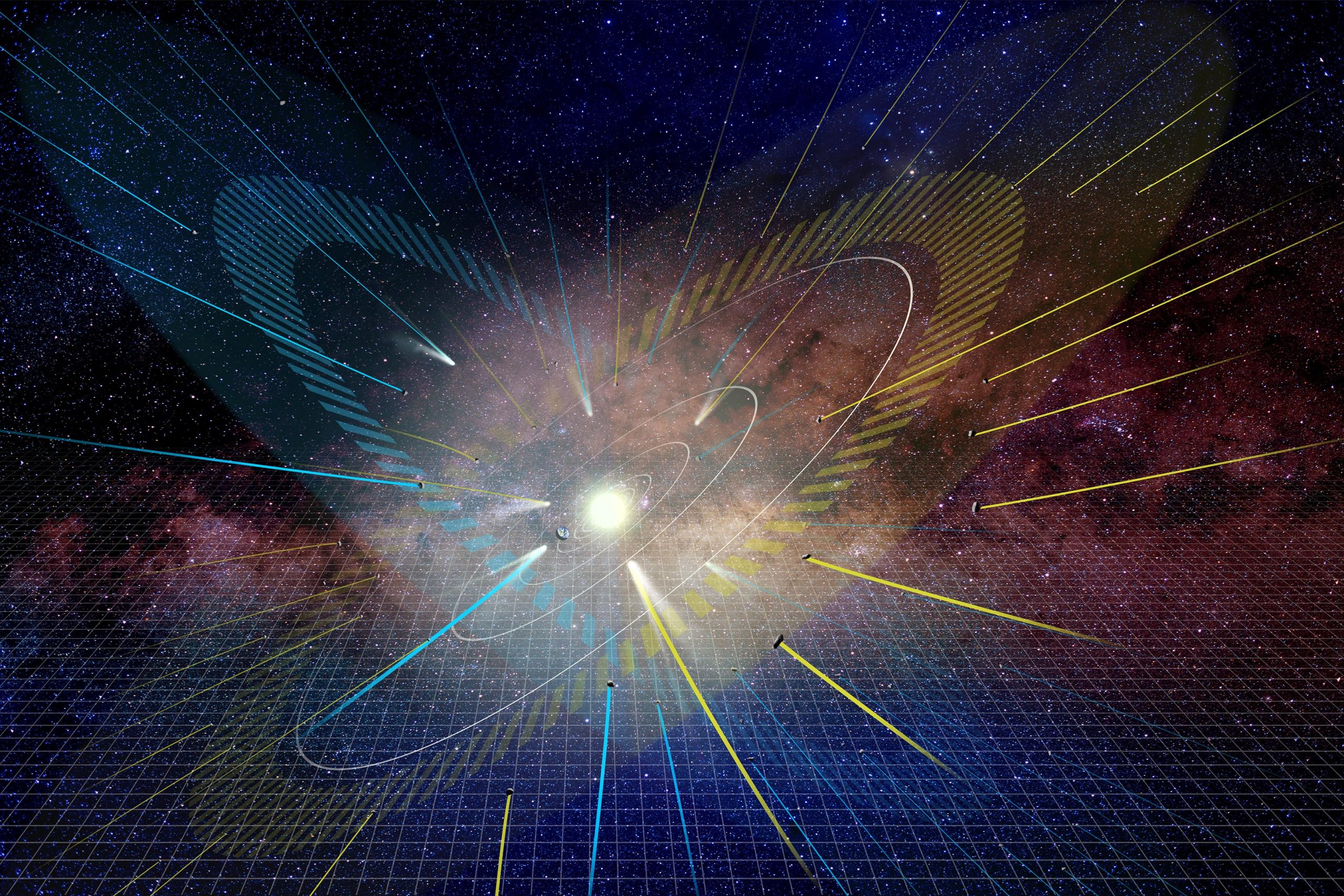
    Distribution of Long-Period Comets
    The converging lines represent the paths of the comets. The ecliptic plane is shown in yellow and the empty ecliptic is shown in blue. The background grid represents the plane of the Galactic disk. Credit: NAOJ

    A study of comet motions indicates that the Solar System has a second alignment plane.

    Analytical investigation of the orbits of long-period comets shows that the aphelia of the comets, the point where they are farthest from the Sun, tend to fall close to either the well-known ecliptic plane where the planets reside or a newly discovered “empty ecliptic.” This has important implications for models of how comets originally formed in the Solar System.

    In the Solar System, the planets and most other bodies move in roughly the same orbital plane, known as the ecliptic, but there are exceptions such as comets. Comets, especially long-period comets taking tens of thousands of years to complete each orbit, are not confined to the area near the ecliptic; they are seen coming and going in various directions.

    Models of Solar System formation suggest that even long-period comets originally formed near the ecliptic and were later scattered into the orbits observed today through gravitational interactions, most notably with the gas giant planets. But even with planetary scattering, the comet’s aphelion, the point where it is farthest from the Sun, should remain near the ecliptic. Other, external forces are needed to explain the observed distribution. The Solar System does not exist in isolation; the gravitational field of the Milky Way Galaxy in which the Solar System resides also exerts a small but non-negligible influence.

    Arika Higuchi, an assistant professor at the University of Occupational and Environmental Health in Japan and previously a member of the NAOJ RISE Project, studied the effects of the Galactic gravity on long-period comets through analytical investigation of the equations governing orbital motion. She showed that when the Galactic gravity is taken into account, the aphelia of long-period comets tend to collect around two planes.

    First the well-known ecliptic, but also a second “empty ecliptic.” The ecliptic is inclined with respect to the disk of the Milky Way by about 60 degrees. The empty ecliptic is also inclined by 60 degrees, but in the opposite direction. Higuchi calls this the “empty ecliptic” based on mathematical nomenclature because initially it contains no objects, only later being populated with scattered comets.

    Higuchi confirmed her predictions by cross-checking with numerical computations carried out in part on the PC Cluster at the Center for Computational Astrophysics of NAOJ. Comparing the analytical and computational results to the data for long-period comets listed in NASA’s JPL Small Body Database showed that the distribution has two peaks, near the ecliptic and empty ecliptic as predicted.

    This is a strong indication that the formation models are correct and long-period comets formed on the ecliptic. However, Higuchi cautions, “The sharp peaks are not exactly at the ecliptic or empty ecliptic planes, but near them. An investigation of the distribution of observed small bodies has to include many factors. Detailed examination of the distribution of long-period comets will be our future work. The all-sky survey project known as the Legacy Survey of Space and Time (LSST) will provide valuable information for this study.”

    Reference: “Anisotropy of Long-period Comets Explained by Their Formation Process” by Arika Higuchi, 26 August 2020, The Astronomical Journal.
    DOI: 10.3847/1538-3881/aba94d

    Never miss a breakthrough: Join the SciTechDaily newsletter.
    Follow us on Google and Google News.

    Astronomy Astrophysics Comet National Institutes of Natural Sciences Popular
    Share. Facebook Twitter Pinterest LinkedIn Email Reddit

    Related Articles

    ALMA Peers Back 12.4 Billion Years and Discovers the Most Ancient Galaxy of Its Kind Ever Observed

    Potentially Hazardous 4,000 Year Comets Can Cause Meteor Showers on Earth

    Unknown Physics on the Cosmic Scale? 1000 Supernova Explosions Chart the Expansion History of the Universe

    A New Window to See Unexplored Hidden Side of Magnetized Universe

    Exploring Comet Thermal History: Observing a Burnt-Out Comet Covered With Talcum Powder

    Natural Cosmic Telescope Helps ALMA Discover Rotating Infant Galaxy

    Mysterious Interstellar Visitor May Be the Most Pristine Comet Ever Found

    Supercomputer Turns Back Cosmic Clock for Insights Into One of the Most Important Mysteries in Modern Astronomy

    The Comet That Killed the Dinosaurs: New Theory on Origin of the Chicxulub Impactor

    Leave A Reply Cancel Reply

    • Facebook
    • Twitter
    • Pinterest
    • YouTube

    Don't Miss a Discovery

    Subscribe for the Latest in Science & Tech!

    Trending News

    Monster Storms on Jupiter Unleash Lightning Beyond Anything on Earth

    Scientists Create “Liquid Gears” That Spin Without Touching

    The Simple Habit That Could Help Prevent Cancer

    Millions Take These IBS Drugs, But a New Study Finds Serious Risks

    Scientists Unlock Hidden Secrets of 2,300-Year-Old Mummies Using Cutting-Edge CT Scanner

    Bread Might Be Making You Gain Weight Even Without Eating More Calories

    Scientists Discover Massive Magma Reservoir Beneath Tuscany

    Europe’s Most Active Volcano Just Got Stranger – Here’s Why Scientists Are Rethinking It

    Follow SciTechDaily
    • Facebook
    • Twitter
    • YouTube
    • Pinterest
    • Newsletter
    • RSS
    SciTech News
    • Biology News
    • Chemistry News
    • Earth News
    • Health News
    • Physics News
    • Science News
    • Space News
    • Technology News
    Recent Posts
    • Not Just Snoring – New Research Reveals Sleep Apnea May Be Damaging Your Muscles
    • Scientists Discover a Surprising Reason Intermittent Fasting Extends Life
    • Scientists Discover a New Meteor Shower From a Mysterious Crumbling Asteroid
    • This Simple Fruit Wash Could Make Produce Safer and Last Days Longer
    • These Tiny Robots 50x Smaller Than a Hair Can Hunt and Move Bacteria
    Copyright © 1998 - 2026 SciTechDaily. All Rights Reserved.
    • Science News
    • About
    • Contact
    • Editorial Board
    • Privacy Policy
    • Terms of Use

    Type above and press Enter to search. Press Esc to cancel.