
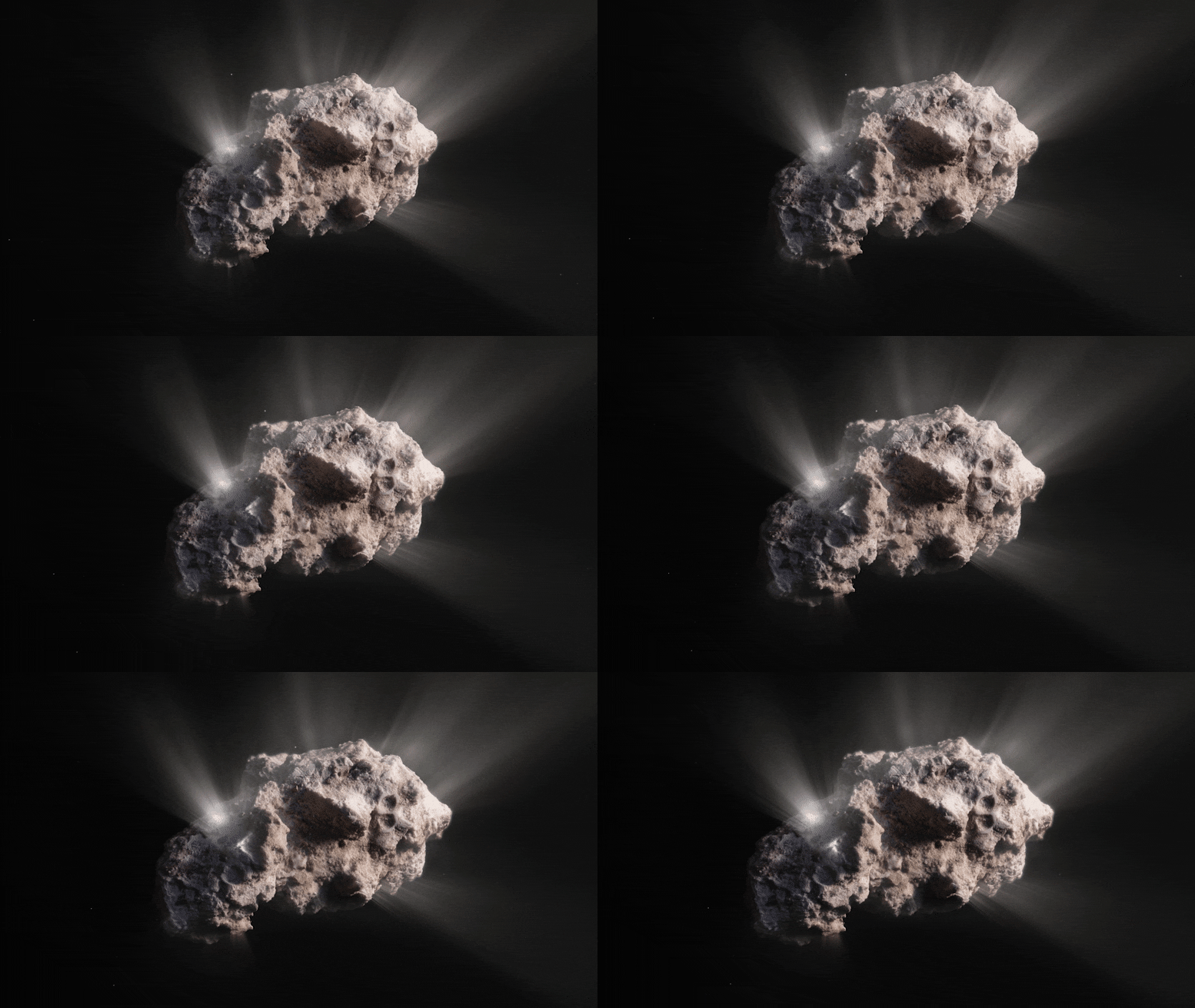
Interstellar comet 2I/Borisov is pristine and surprisingly similar to Solar System comets, offering clues to shared cosmic origins.
New observations with the European Southern Observatory’s Very Large Telescope (ESO’s VLT) indicate that the rogue comet 2I/Borisov, which is only the second and most recently detected interstellar visitor to our Solar System, is one of the most pristine ever observed. Astronomers suspect that the comet most likely never passed close to a star, making it an undisturbed relic of the cloud of gas and dust it formed from.
2I/Borisov was discovered by amateur astronomer Gennady Borisov in August 2019 and was confirmed to have come from beyond the Solar System a few weeks later. “2I/Borisov could represent the first truly pristine comet ever observed,” says Stefano Bagnulo of the Armagh Observatory and Planetarium, Northern Ireland, UK, who led the new study published today in Nature Communications. The team believes that the comet had never passed close to any star before it flew by the Sun in 2019.
New observations with the European Southern Observatory’s Very Large Telescope (ESO’s VLT) indicate that the rogue comet 2I/Borisov, which is only the second and most recently detected interstellar visitor to our Solar System, is one of the most pristine ever observed. This video summarizes new findings on this mysterious alien visitor. Credit: ESO
Bagnulo and his colleagues used the FORS2 instrument on ESO’s VLT, located in northern Chile, to study 2I/Borisov in detail using a technique called polarimetry.[1] Since this technique is regularly used to study comets and other small bodies of our Solar System, this allowed the team to compare the interstellar visitor with our local comets.
The team found that 2I/Borisov has polarimetric properties distinct from those of Solar System comets, with the exception of Hale–Bopp. Comet Hale–Bopp received much public interest in the late 1990s as a result of being easily visible to the naked eye, and also because it was one of the most pristine comets astronomers had ever seen. Prior to its most recent passage, Hale–Bopp is thought to have passed by our Sun only once and had therefore barely been affected by solar wind and radiation. This means it was pristine, having a composition very similar to that of the cloud of gas and dust it — and the rest of the Solar System — formed from some 4.5 billion years ago.
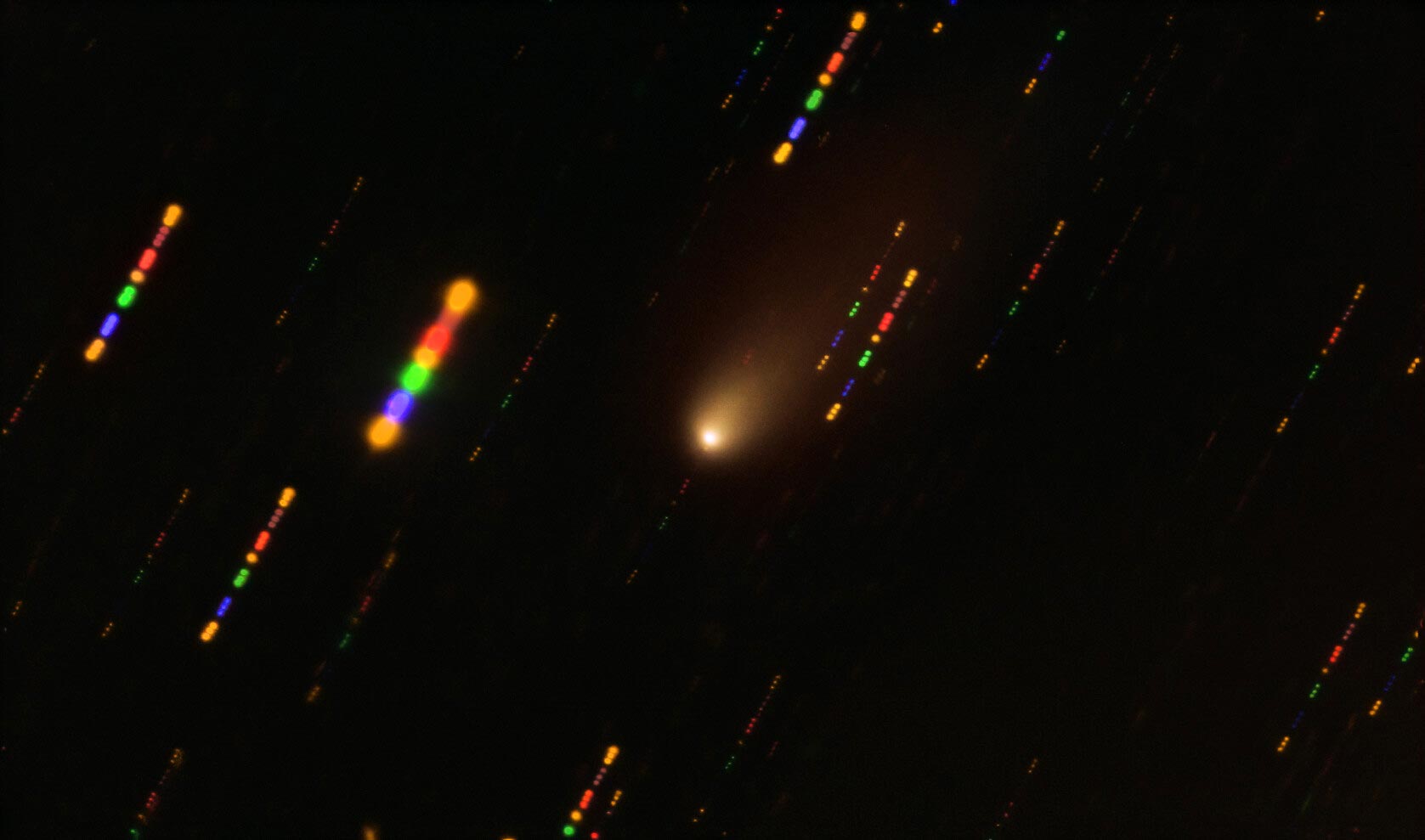
By analyzing the polarisation together with the color of the comet to gather clues on its composition, the team concluded that 2I/Borisov is in fact even more pristine than Hale–Bopp. This means it carries untarnished signatures of the cloud of gas and dust it formed from.
“The fact that the two comets are remarkably similar suggests that the environment in which 2I/Borisov originated is not so different in composition from the environment in the early Solar System,” says Alberto Cellino, a co-author of the study, from the Astrophysical Observatory of Torino, National Institute for Astrophysics (INAF), Italy.
Olivier Hainaut, an astronomer at ESO in Germany who studies comets and other near-Earth objects but was not involved in this new study, agrees. “The main result — that 2I/Borisov is not like any other comet except Hale–Bopp — is very strong,” he says, adding that “it is very plausible they formed in very similar conditions.”
“The arrival of 2I/Borisov from interstellar space represented the first opportunity to study the composition of a comet from another planetary system and check if the material that comes from this comet is somehow different from our native variety,” explains Ludmilla Kolokolova, of the University of Maryland in the US, who was involved in the Nature Communications research.
Bagnulo hopes astronomers will have another, even better, opportunity to study a rogue comet in detail before the end of the decade. “ESA is planning to launch Comet Interceptor in 2029, which will have the capability of reaching another visiting interstellar object, if one on a suitable trajectory is discovered,” he says, referring to an upcoming mission by the European Space Agency.
An Origin Story Hidden in the Dust
Even without a space mission, astronomers can use Earth’s many telescopes to gain insight into the different properties of rogue comets like 2I/Borisov. “Imagine how lucky we were that a comet from a system light-years away simply took a trip to our doorstep by chance,” says Bin Yang, an astronomer at ESO in Chile, who also took advantage of 2I/Borisov’s passage through our Solar System to study this mysterious comet. Her team’s results are published in Nature Astronomy.
Yang and her team used data from the Atacama Large Millimeter/submillimeter Array (ALMA), in which ESO is a partner, as well as from ESO’s VLT, to study 2I/Borisov’s dust grains to gather clues about the comet’s birth and conditions in its home system.
This animation shows the orbit (in red) of the interstellar comet 2I/Borisov, which was the second and most recently detected interstellar object to visit our Solar System. Credit: ESA/Space Engine (spaceengine.org)/L. Calçada. Music: Johan B. Monell
They discovered that 2I/Borisov’s coma — an envelope of dust surrounding the main body of the comet — contains compact pebbles, grains about one millimeter in size or larger. In addition, they found that the relative amounts of carbon monoxide and water in the comet changed drastically as it neared the Sun. The team, which also includes Olivier Hainaut, says this indicates that the comet is made up of materials that formed in different places in its planetary system.
The observations by Yang and her team suggest that matter in 2I/Borisov’s planetary home was mixed from near its star to further out, perhaps because of the existence of giant planets, whose strong gravity stirs material in the system. Astronomers believe that a similar process occurred early in the life of our Solar System.
While 2I/Borisov was the first rogue comet to pass by the Sun, it was not the first interstellar visitor. The first interstellar object to have been observed passing by our Solar System was ʻOumuamua, another object studied with ESO’s VLT back in 2017. Originally classified as a comet, ʻOumuamua was later reclassified as an asteroid as it lacked a coma.
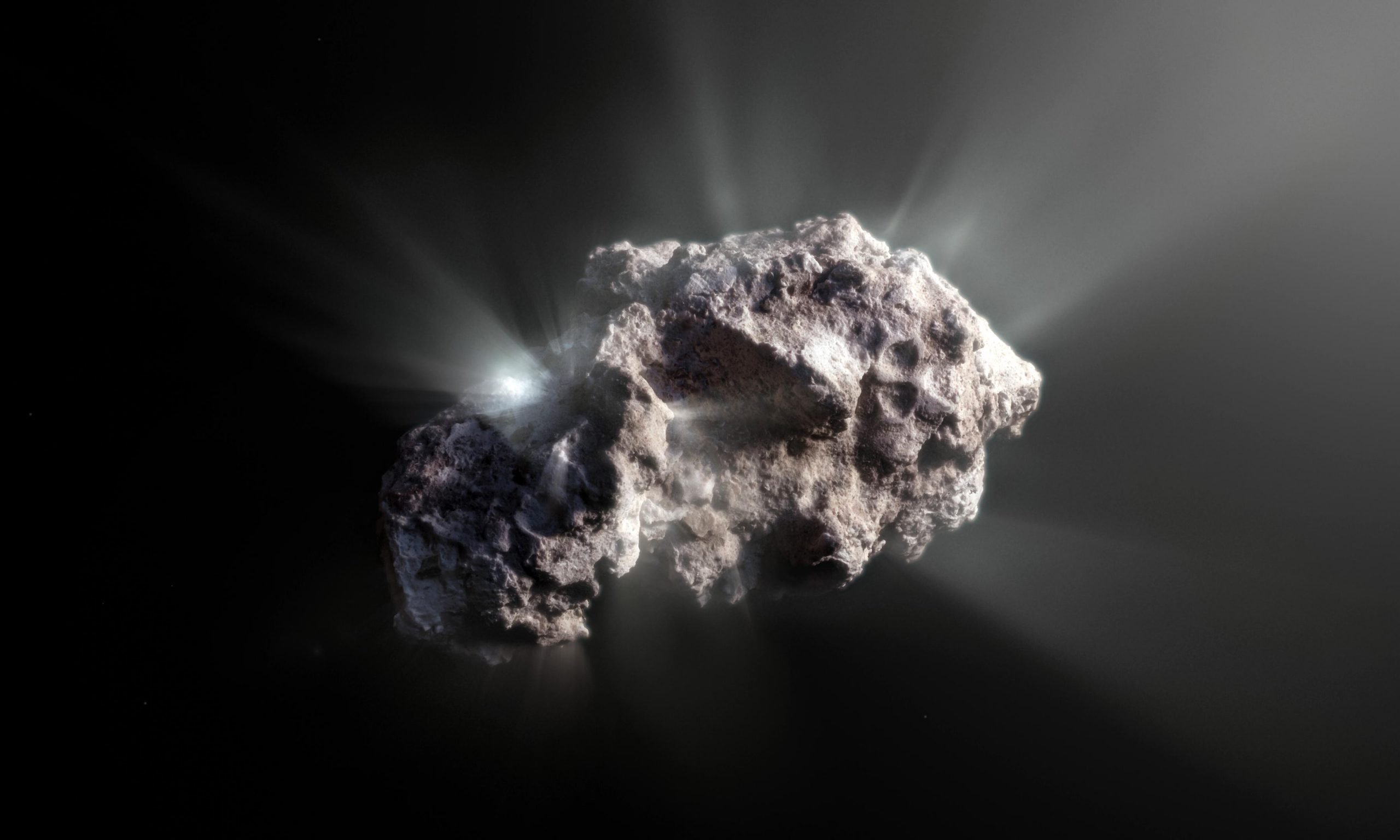
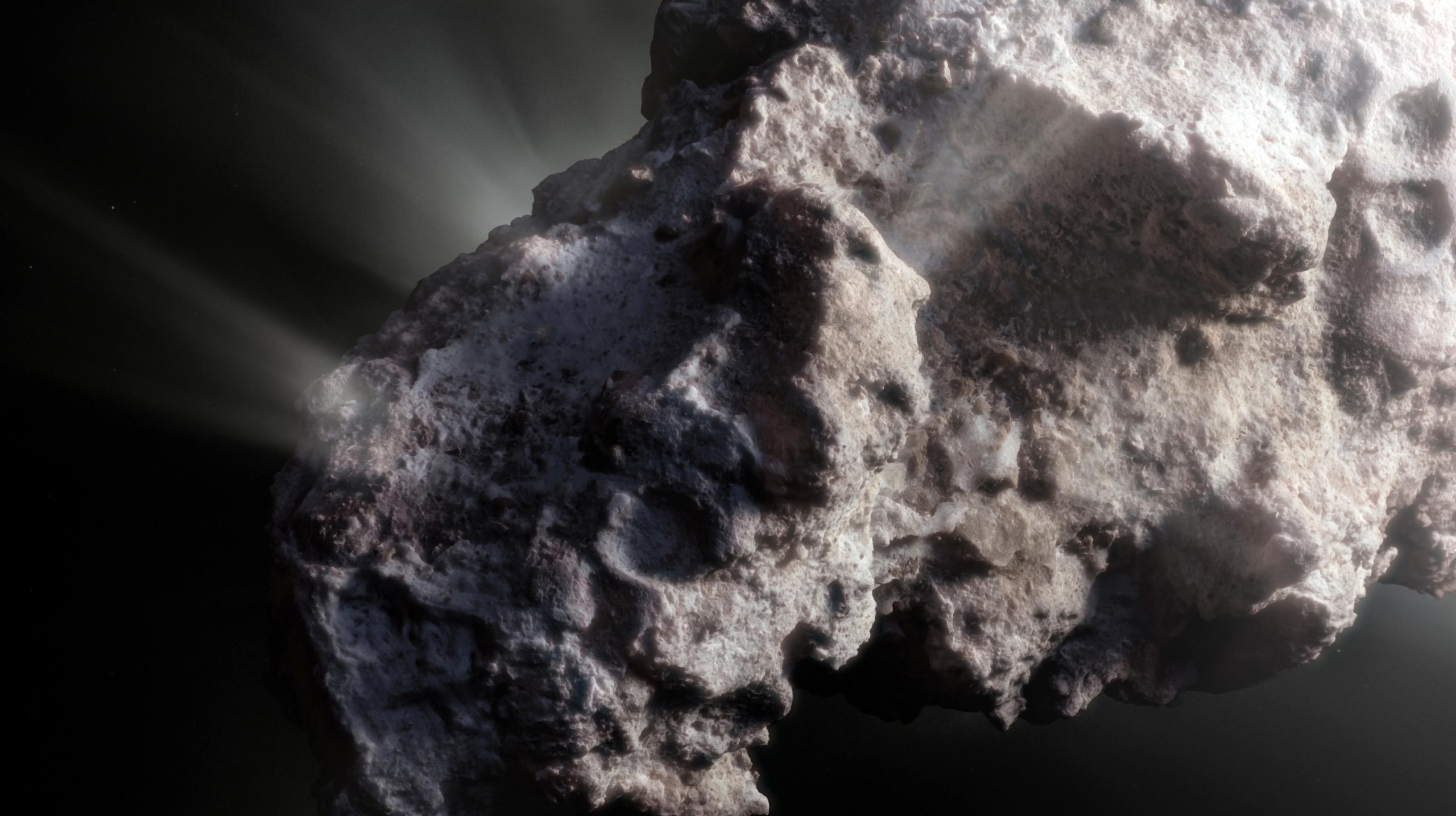
This video shows an artist’s view of what the surface of the comet might look like. 2I/Borisov was a visitor from another planetary system that passed by our Sun in 2019, allowing astronomers a unique view of an interstellar comet. While telescopes on Earth and in space captured images of this comet, we don’t have any close-up observations of 2I/Borisov. It is therefore up to artists to create their own ideas of what the comet’s surface might look like, based on the scientific information we have about it. Credit: ESO/M. Kormesser
Notes
- Polarimetry is a technique to measure the polarization of light. Light becomes polarized, for example, when it goes through certain filters, like the lenses of polarized sunglasses or cometary material. By studying the properties of sunlight polarized by a comet’s dust, researchers can gain insights into the physics and chemistry of comets.
More information
This research highlighted in the first part of this release was presented in the paper “Unusual polarimetric properties for interstellar comet 2I/Borisov” to appear in Nature Communications (doi: 10.1038/s41467-021-22000-x). The second part of the release highlights the study “Compact pebbles and the evolution of volatiles in the interstellar comet 2I/Borisov” to appear in Nature Astronomy (doi: 10.1038/s41550-021-01336-w).
The team who conducted the first study is composed of S. Bagnulo (Armagh Observatory & Planetarium, UK [Armagh]), A. Cellino (INAF – Osservatorio Astrofisico di Torino, Italy), L. Kolokolova (Department of Astronomy, University of Maryland, US), R. Nežic (Armagh; Mullard Space Science Laboratory, University College London, UK; Centre for Planetary Science, University College London/Birkbeck, UK), T. Santana-Ros (Departamento de Fisica, Ingeniería de Sistemas y Teoría de la Señal, Universidad de Alicante, Spain; Institut de Ciencies del Cosmos, Universitat de Barcelona, Spain), G. Borisov (Armagh; Institute of Astronomy and National Astronomical Observatory, Bulgarian Academy of Sciences, Bulgaria), A. A. Christou (Armagh), Ph. Bendjoya (Université Côte d’Azur, Observatoire de la Côte d’Azur, CNRS, Laboratoire Lagrange, Nice, France), and M. Devogele (Arecibo Observatory, University of Central Florida, US).
The team who conducted the second study is composed of Bin Yang (European Southern Observatory, Santiago, Chile [ESO Chile]), Aigen Li (Department of Physics and Astronomy, University of Missouri, Columbia, USA), Martin A. Cordiner (Astrochemistry Laboratory, NASA Goddard Space Flight Centre, USA and Department of Physics, Catholic University of America, Washington, DC, USA), Chin-Shin Chang (Joint ALMA Observatory, Santiago, Chile [JAO]), Olivier R. Hainaut (European Southern Observatory, Garching, Germany), Jonathan P. Williams (Institute for Astronomy, University of Hawai‘i, Honolulu, USA [IfA Hawai‘i]), Karen J. Meech (IfA Hawai‘i), Jacqueline V. Keane (IfA Hawai‘i), and Eric Villard (JAO and ESO Chile).
Never miss a breakthrough: Join the SciTechDaily newsletter.
Follow us on Google and Google News.
3 Comments
… and this unpredictable thingy can influence other paths in our system, and volla…
… I just wonder, what is with the Pluto and the Neptune, their paths intersect, and if the Pluto is not dominant in its path, then the Neptune is not dominant in that path too.
And there is very interesting possible thing…
… and we know that even more powerful earthquakes can change planets orbit, and now you tell me how the predicted path for our planet is so pin point accurate that we know it all in nex 100 years..
Hope it hits this damped planet judgement day is way over due