
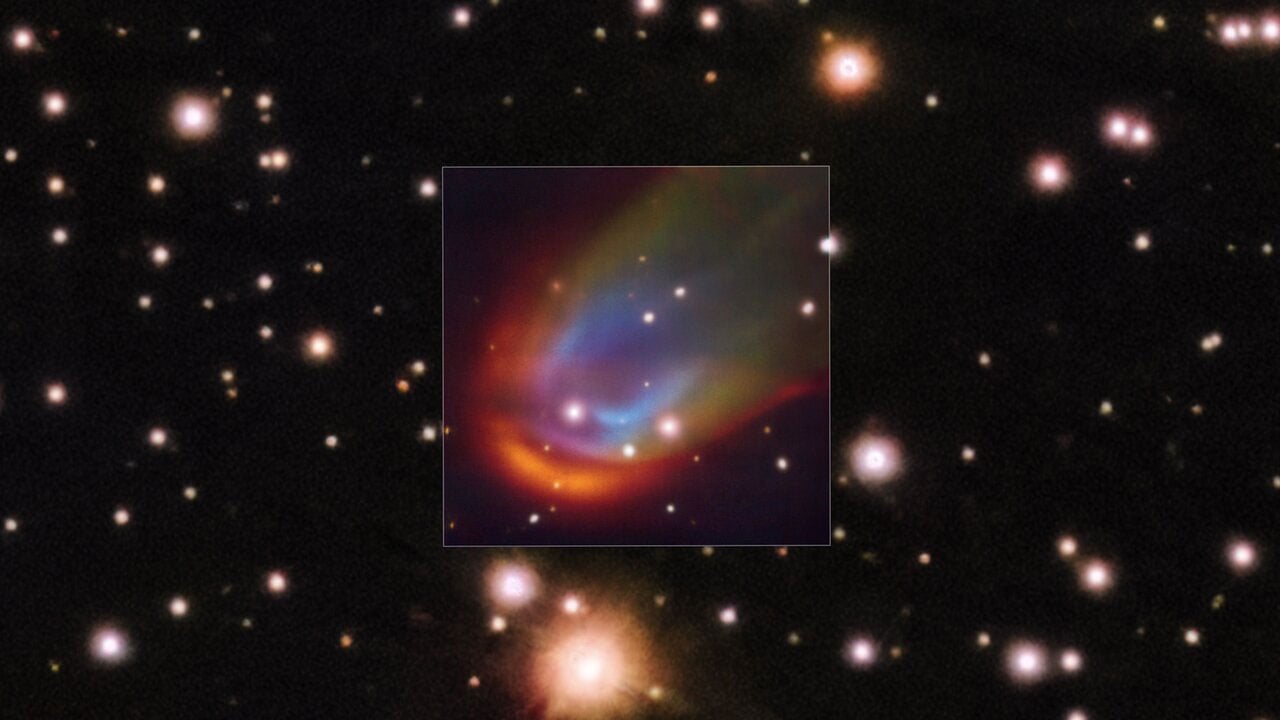
A mysterious bow shock around the white dwarf RXJ0528+2838 is challenging astronomers’ understanding of how dead stars interact with their surroundings.
Gas and dust streaming away from stars can sometimes collide with surrounding material and produce shock waves. Astronomers using the European Southern Observatory’s Very Large Telescope (ESO’s VLT) have now captured an especially striking example around a dead star. The discovery has left researchers puzzled because current theories cannot explain how such a structure formed.
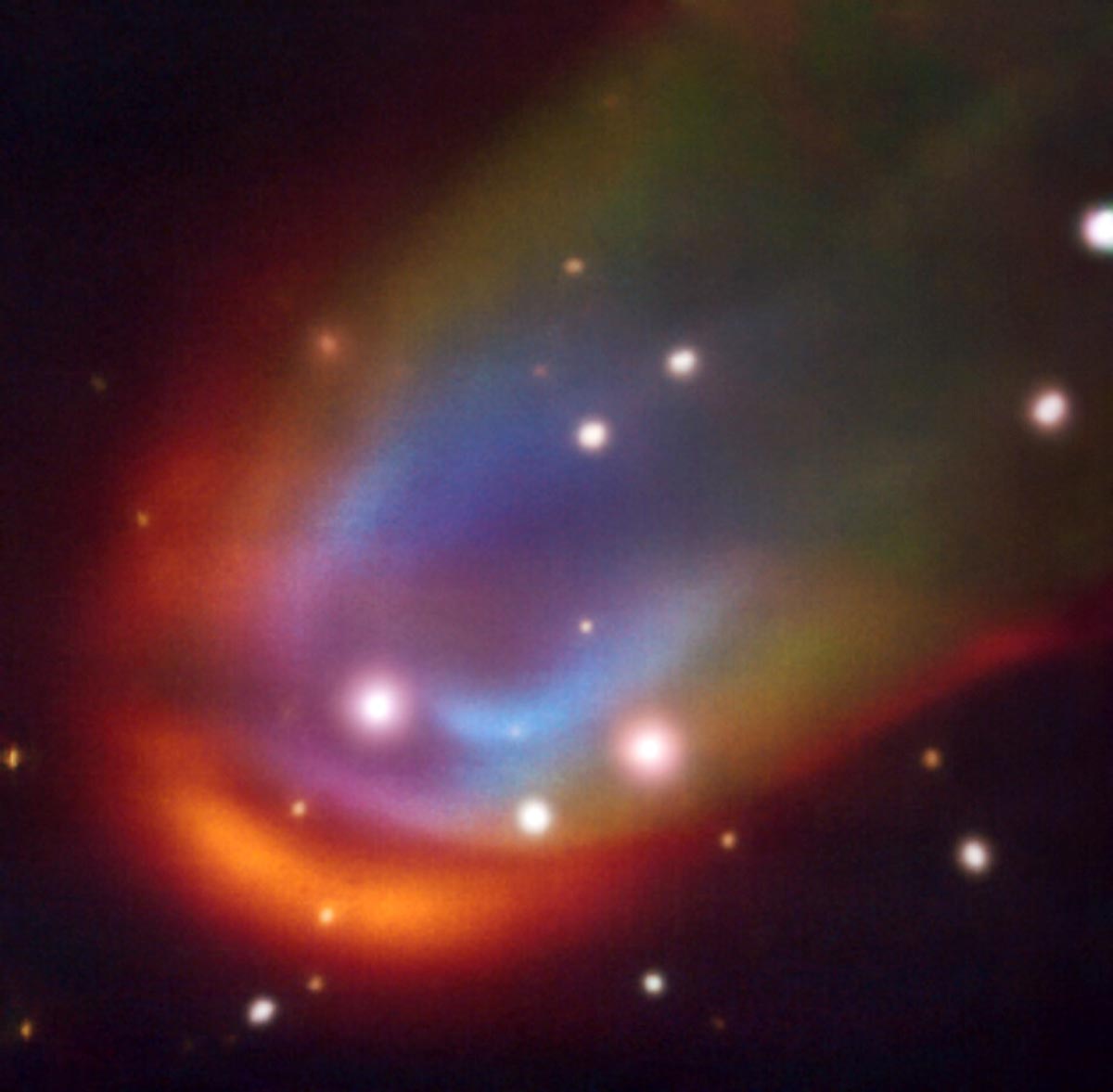
The object, known as RXJ0528+2838, is a small dead star that should not produce a shock wave as the one observed. Yet images reveal a dramatic arc of glowing gas surrounding the system. The unexpected finding challenges existing ideas about how dead stars interact with the material around them.
“We found something never seen before and, more importantly, entirely unexpected,” says Simone Scaringi, associate professor at Durham University, UK, and co-lead author of the study published in Nature Astronomy. “Our observations reveal a powerful outflow that, according to our current understanding, shouldn’t be there,” says Krystian Ilkiewicz, a postdoctoral researcher at the Nicolaus Copernicus Astronomical Center in Warsaw, Poland, and study co-lead. ‘Outflow’ is the term used by astronomers to describe the material that is ejected from celestial objects.
A Bow Shock in Interstellar Space
RXJ0528+2838 lies about 730 light-years (about 6.9 quadrillion kilometers or 4.3 quadrillion miles) from Earth. Like the Sun and other stars, it orbits the center of our galaxy. As the system moves through space, it interacts with the thin gas that fills the region between stars.
This motion creates a bow shock, a type of shock wave that forms when a fast-moving object pushes through surrounding gas. It appears as “a curved arc of material, similar to the wave that builds up in front of a ship,” explains Noel Castro Segura, research fellow at the University of Warwick in the UK and collaborator in this study.
Bow shocks typically form when a star releases material outward. However, the observations of RXJ0528+2838 do not match any known process that should produce such an outflow.
RXJ0528+2838 is a white dwarf, the leftover core of a dying low-mass star. It also has a Sun-like companion star orbiting nearby. In these binary systems, material from the companion often flows toward the white dwarf and forms a rotating disc around it.
That disc usually feeds gas onto the white dwarf while also ejecting some of the material back into space. These ejections can create powerful outflows that shape surrounding nebulae.
However, RXJ0528+2838 shows no evidence of such a disc. Without this structure, astronomers cannot easily explain the origin of the outflow or the nebula surrounding the system.
“The surprise that a supposedly quiet, discless system could drive such a spectacular nebula was one of those rare ‘wow’ moments,” says Scaringi.
Mapping the Mysterious Nebula
The team first noticed the unusual cloud of gas around RXJ0528+2838 in images taken with the Isaac Newton Telescope in Spain. Because the shape looked unusual, the researchers followed up with more detailed observations using the MUSE instrument on ESO’s VLT.
“Observations with the ESO MUSE instrument allowed us to map the bow shock in detail and analyze its composition. This was crucial to confirm that the structure really originates from the binary system and not from an unrelated nebula or interstellar cloud,” Ilkiewicz explains.
The size and shape of the bow shock indicate that the white dwarf has been producing a strong outflow for at least 1000 years.
Scientists do not yet know how a dead star without a disc could sustain such activity for so long. However, they have a possible explanation.
Searching for the Hidden Energy Source
The white dwarf in this system has a strong magnetic field, which the MUSE observations confirmed. This field channels material taken from the companion star directly onto the white dwarf, preventing a disc from forming.
“Our finding shows that even without a disc, these systems can drive powerful outflows, revealing a mechanism we do not yet understand. This discovery challenges the standard picture of how matter moves and interacts in these extreme binary systems,” Ilkiewicz explains.
The results suggest the presence of a hidden energy source, likely the strong magnetic field. Still, this ‘mystery engine’, as Scaringi puts it, requires further study.
Current measurements indicate that the magnetic field alone could only power a bow shock for a few hundred years. That means it explains only part of the phenomenon astronomers observe.
To understand how these discless outflows work, scientists will need to examine many more binary systems. ESO’s upcoming Extremely Large Telescope (ELT) will help astronomers “to map more of these systems as well as fainter ones and detect similar systems in detail, ultimately helping in understanding the mysterious energy source that remains unexplained,” as Scaringi foresees.
Reference: “A persistent bow shock in a diskless magnetized accreting white dwarf” by Krystian Iłkiewicz, Simone Scaringi, Domitilla de Martino, Christian Knigge, Sara E. Motta, Nanda Rea, David Buckley, Noel Castro Segura, Paul J. Groot, Anna F. McLeod, Luke T. Parker and Martina Veresvarska, 12 January 2026, Nature Astronomy.
DOI: 10.1038/s41550-025-02748-8
Never miss a breakthrough: Join the SciTechDaily newsletter.
Follow us on Google and Google News.