
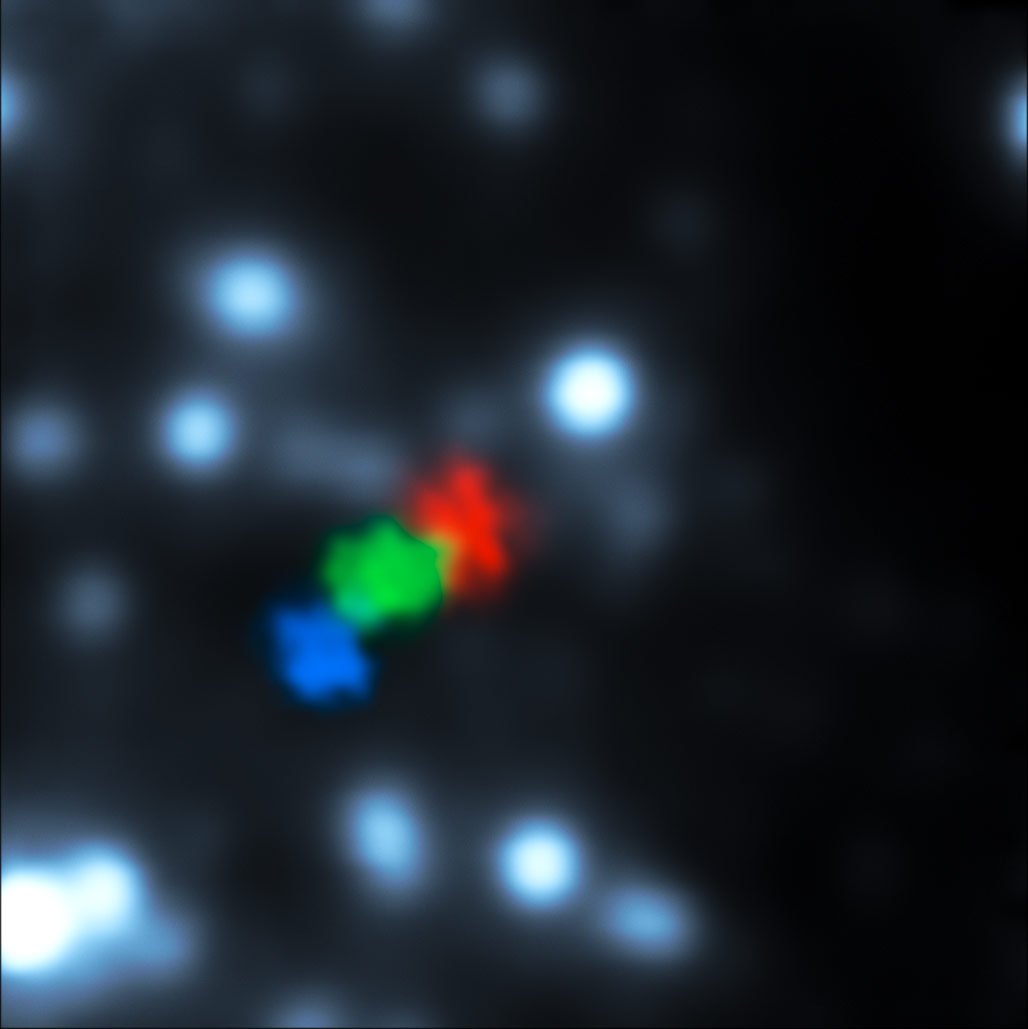
Due to its distance, and the fact that we see the orbit at a steep angle as the cloud falls towards the black hole, only the position, not the shape, of the cloud can be discerned in this image. The stretching of the cloud is seen in observations of its velocity, which allow astronomers to work out where on its orbit the different parts of the cloud are now located. Credit: ESO/S. Gillessen
Using the Very Large Telescope at the European Southern Observatory, astronomers watch in real time as a gas cloud is being ripped apart by the supermassive black hole at the center of the Milky Way.
New observations from ESO’s Very Large Telescope show for the first time a gas cloud being ripped apart by the supermassive black hole at the center of the galaxy. The cloud is now so stretched that its front part has passed the closest point and is traveling away from the black hole at more than 10 million km/h, whilst the tail is still falling towards it.
In 2011 ESO’s Very Large Telescope (VLT) discovered a gas cloud with several times the mass of the Earth accelerating towards the black hole at the center of the Milky Way [1]. This cloud is now making its closest approach and new VLT observations show that it is being grossly stretched by the black hole’s extreme gravitational field.
This simulation shows a gas cloud, discovered in 2011, as it passes close to the supermassive black hole at the center of the galaxy. Observations with ESO’s Very Large Telescope in 2013 show that the cloud is so stretched that the front part of it has passed the closest point and is travelling away from the black hole at more than 10 million km/h, whilst the tail is still falling towards it. Credit: ESO/S. Gillessen/MPE/Marc Schartmann
“The gas at the head of the cloud is now stretched over more than 160 billion kilometers around the closest point of the orbit to the black hole. And the closest approach is only a bit more than 25 billion kilometers from the black hole itself — barely escaping falling right in,” explains Stefan Gillessen (Max Planck Institute for Extraterrestrial Physics, Garching, Germany) who led the observing team [2]. “The cloud is so stretched that the close approach is not a single event but rather a process that extends over a period of at least one year.”
As the gas cloud is stretched its light gets harder to see. But by staring at the region close to the black hole for more than 20 hours of total exposure time with the SINFONI instrument on the VLT — the deepest exposure of this region ever with an integral field spectrometer [3] — the team was able to measure the velocities of different parts of the cloud as it streaks past the central black hole [4].
“The most exciting thing we now see in the new observations is the head of the cloud coming back towards us at more than 10 million km/h along the orbit — about 1% of the speed of light,” adds Reinhard Genzel, leader of the research group that has been studied this region for nearly twenty years. “This means that the front end of the cloud has already made its closest approach to the black hole.”
These observations from ESO’s Very Large Telescope, using the SINFONI instrument, show the behavior of a small gas cloud as it passes close to the supermassive black hole at the center of the galaxy. The horizontal axis shows the extent of the cloud along its orbit and the vertical axis shows the velocities of different parts of the cloud. As the cloud gets closer to the black hole it is dramatically stretched out and at the time when the cloud passes the closest point the velocity of the front is several million km/h different from that of the tail. Credit: ESO/S. Gillessen
The origin of the gas cloud remains mysterious, although there is no shortage of ideas [5]. The new observations narrow down the possibilities.
“Like an unfortunate astronaut in a science fiction film, we see that the cloud is now being stretched so much that it resembles spaghetti. This means that it probably doesn’t have a star in it,” concludes Gillessen. “At the moment we think that the gas probably came from the stars we see orbiting the black hole.”
The climax of this unique event at the center of the galaxy is now unfolding and being closely watched by astronomers around the world. This intense observing campaign will provide a wealth of data, not only revealing more about the gas cloud [6], but also probing the regions close to the black hole that have not been previously studied and the effects of super-strong gravity.
These observations from ESO’s Very Large Telescope show a small gas cloud as it falls towards the supermassive black hole at the center of the galaxy. The cloud appears in red and many of the bright blue stars orbiting the central black hole are also shown. Measurements made with ESO’s Very Large Telescope in 2013 show that the cloud is so stretched that the front part of it has passed the closest point and is traveling away from the black hole at more than 10 million km/h, whilst the tail is still falling towards it. Credit: ESO/S. Gillessen
Notes
[1] The black hole at the center of the Milky Way is estimated to have a mass of about four million times that of the Sun and is formally known as Sgr A* (pronounced Sagittarius A star). It is the closest supermassive black hole known by far and hence is the best place to study black holes in detail. The study of the supermassive black hole at the center of the galaxy and its environment is rated number one in the list of ESO’s top ten astronomical discoveries.
[2] The distance of closest approach is about five times the distance of the planet Neptune from the Sun. This is much too close for comfort to a black hole with a mass four million times that of the Sun!
[3] In an integral field spectrometer the light recorded in each pixel is separately spread out into its component colors and so spectra are recorded for each pixel. The spectra can then be analyzed individually and used to create maps of the velocities and the chemical properties of each part of the object, for example.
[4] The team is also hoping to see evidence of how the rapidly moving cloud interacts with any ambient gas around the black hole. So far nothing has been found, but further observations are planned to look for such effects.
[5] Astronomers thought that the gas cloud might have been created by stellar winds from the stars orbiting the black hole. Or possibly even be the result of a jet from the galactic center. Another option was that a star was at the center of the cloud. In this case, the gas would come either from a wind from the star, or from a planet-forming disc of gas and dust around the star.
[6] As this event at the center of the galaxy unfolds, astronomers expect to see the evolution of the cloud switches from purely gravitational and tidal to complex, turbulent hydrodynamics.
Reference: “Pericenter passage of the gas cloud G2 in the Galactic Center” by S. Gillessen, R. Genzel, T. K. Fritz, F. Eisenhauer, O. Pfuhl, T. Ott, M. Schartmann, A. Ballone and A. Burkert, 14 August 2013, The Astrophysical Journal.
DOI: 10.1088/0004-637X/774/1/44
arXiv:1306.1374
Never miss a breakthrough: Join the SciTechDaily newsletter.
Follow us on Google and Google News.