
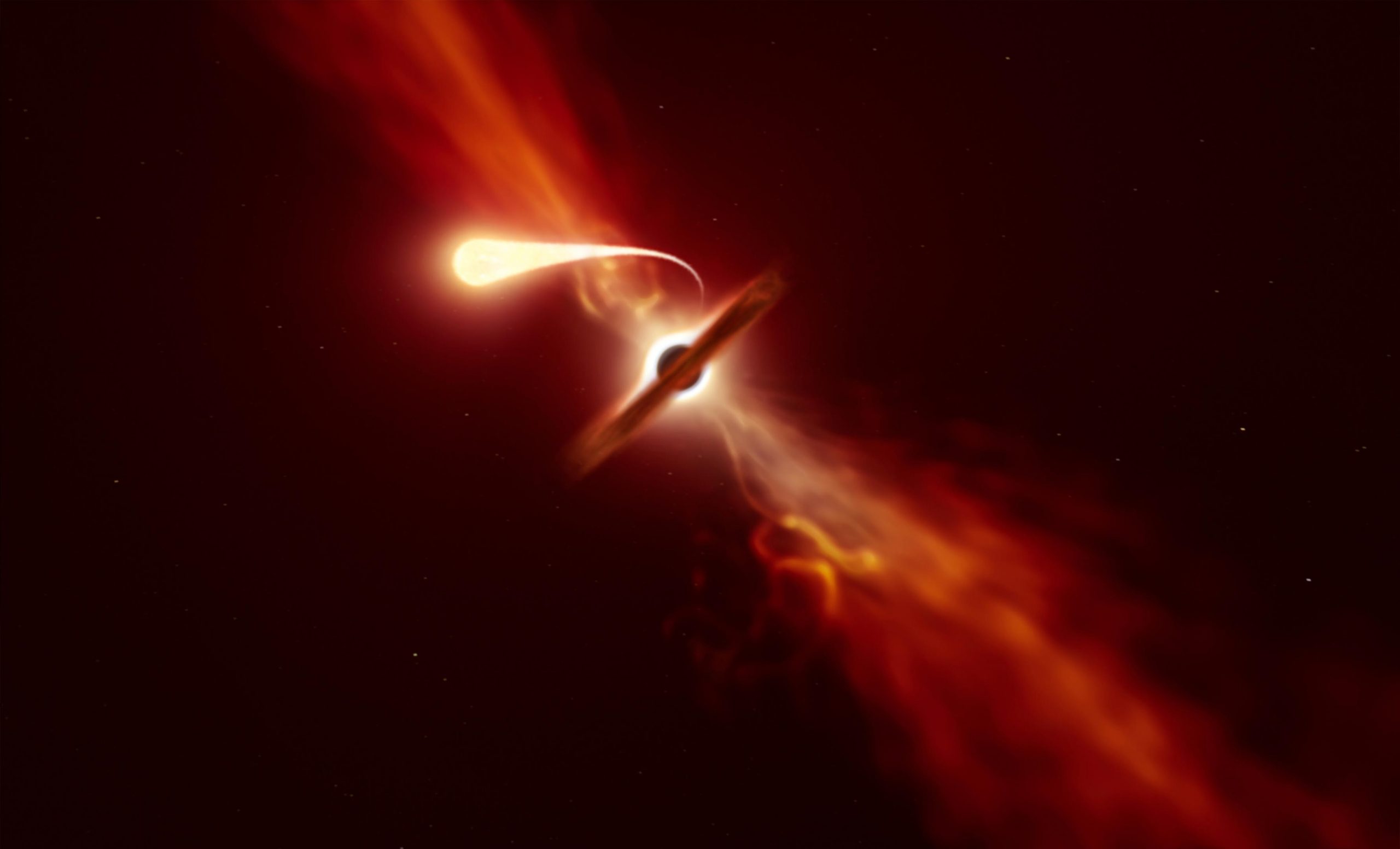
Astronomers have captured the last moments of a star just before it was ripped apart by a black hole. The violent occurrence—called a tidal disruption event—created a blast of light seen just 215 million light-years from Earth, the closest such flare recorded to date. The research is published in the Monthly Notices of the Royal Astronomical Society.
“The idea of a black hole ‘sucking in’ a nearby star sounds like science fiction. But this is exactly what happens in a tidal disruption event,” explained Matt Nicholl, a lecturer and Royal Astronomical Society research fellow at the University of Birmingham, UK, and the lead author on the new study.
To get a detailed look at just what happens when a star is devoured by a monstrous black hole, researchers pointed the European Southern Observatory’s Very Large Telescope (VLT) and New Technology Telescope (NTT) at a new flash of light that occurred close to a supermassive black hole last year. Followup observations occurred over a six-month period at multiple telescopes around the world, including the Center for Astrophysics | Harvard & Smithsonian’s MMT, located at the Fred Lawrence Whipple Observatory in Amado, Arizona.
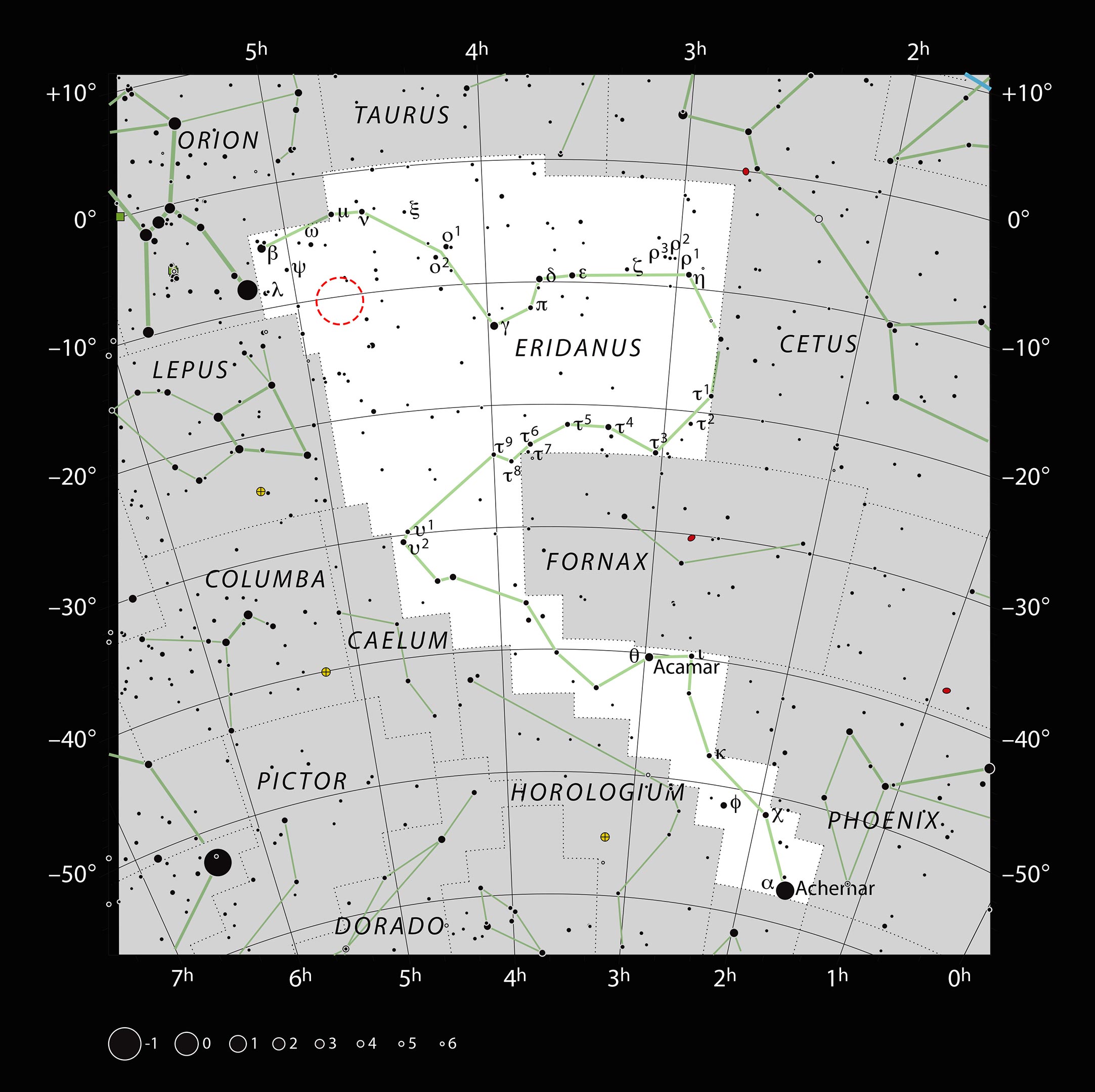
Tidal disruption events—in which stars experience spaghettification—are powerful and bright, which should make them easy to study. “A tidal disruption event results from the destruction of a star that strays too close to a supermassive black hole,” said Edo Berger, astronomer, CfA, and one of the authors on the study. “In this case the star was torn apart with about half of its mass feeding—or accreting—into a black hole of one million times the mass of the Sun, and the other half was ejected outward.”
These rare events are often obscured by a thick curtain of dust and debris, which has made it difficult for astronomers to see what’s happening, until now. AT2019qiz—the tidal disruption event the team was studying—was found shortly after the star was ripped apart, making it easier to analyze. “Because we caught it early, we could actually see the curtain of dust and debris being drawn up as the black hole launched a powerful outflow of material with velocities up to 10,000 km/s (22.4 million mph),” said Kate Alexander, NASA Einstein Fellow at Northwestern University. “This is a unique ‘peek behind the curtain’ that provided the first opportunity to pinpoint the origin of the obscuring material and follow in real time how it engulfs the black hole.”
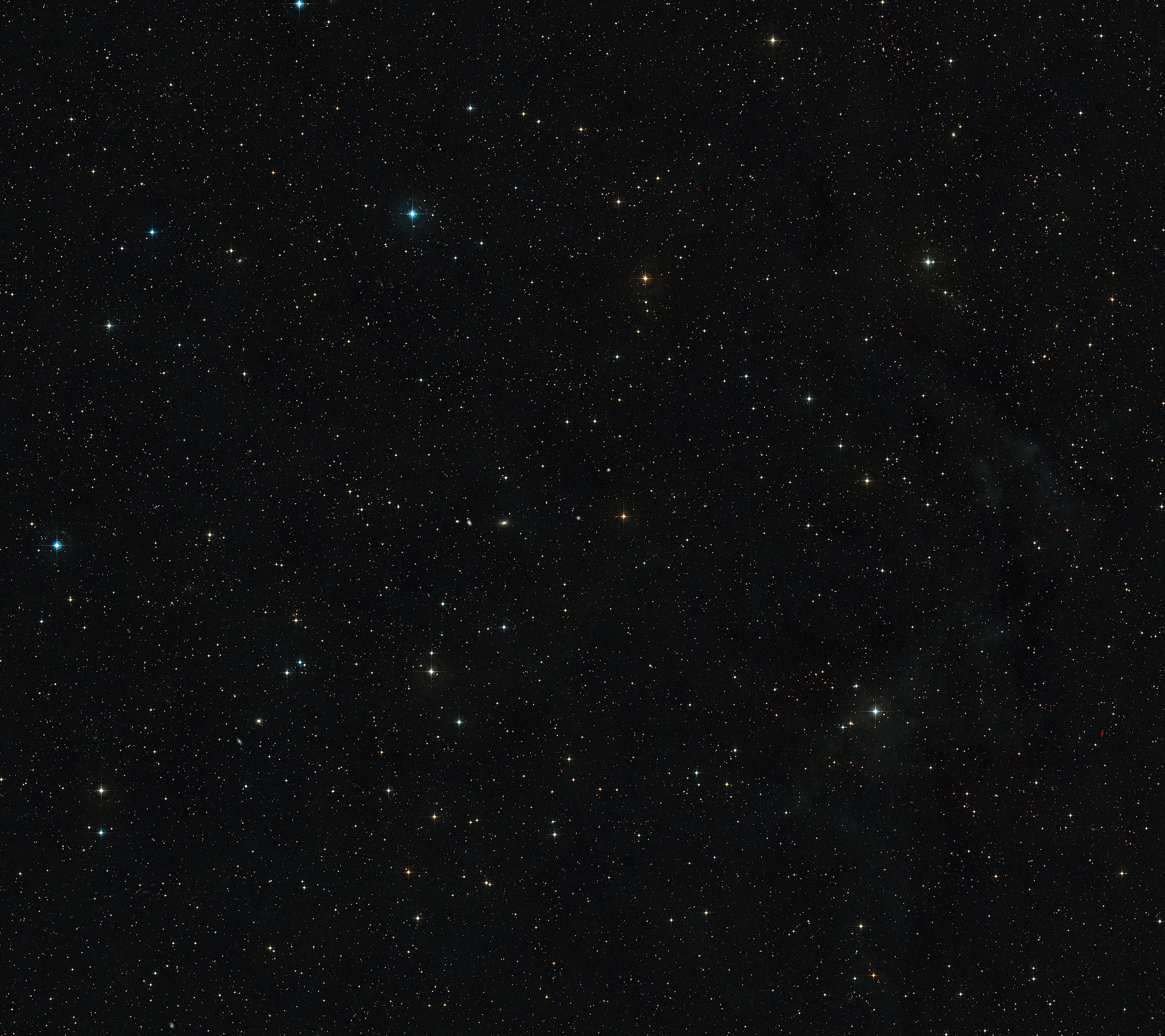
The newly discovered tidal disruption event will help scientists to better understand supermassive black holes and how matter behaves around them. “AT2019qiz is the nearest tidal disruption event discovered to date, and hence, incredibly well-observed across the electromagnetic spectrum. This is the first case in which we see direct evidence for outflowing gas during the disruption and accretion process that explains both the optical and radio emissions we’ve seen in the past,” said Berger. “Until now, the nature of these emissions has been heavily debated, but here we see that the two regimes are connected through a single process. This event is teaching us about the detailed physical processes of accretion and mass ejection from supermassive black holes.”
Read Telescopes Record Last Moments of Star Devoured by a Black Hole for more on this story.
Reference: “An outflow powers the optical rise of the nearby, fast-evolving tidal disruption event AT2019qiz” by M Nicholl, T Wevers, S R Oates, K D Alexander, G Leloudas, F Onori, A Jerkstrand, S Gomez, S Campana, I Arcavi, P Charalampopoulos, M Gromadzki, N Ihanec, P G Jonker, A Lawrence, I Mandel, S Schulze, P Short, J Burke, C McCully, D Hiramatsu, D A Howell, C Pellegrino, H Abbot, J P Anderson, E Berger, P K Blanchard, G Cannizzaro, T-W Chen, M Dennefeld, L Galbany, S González-Gaitán, G Hosseinzadeh, C Inserra, I Irani, P Kuin, T Müller-Bravo, J Pineda, N P Ross, R Roy, S J Smartt, K W Smith, B Tucker, Ł Wyrzykowski and D R Young, 12 October 2020, Monthly Notices of the Royal Astronomical Society.
DOI: 10.1093/mnras/staa2824
Spaghettification
In astrophysics, spaghettification (sometimes referred to as the noodle effect) is the vertical stretching and horizontal compression of objects into long thin shapes (rather like spaghetti) in a very strong non-homogeneous gravitational field; it is caused by extreme tidal forces. In the most extreme cases, near black holes, the stretching is so powerful that no object can withstand it, no matter how strong its components. Within a small region, the horizontal compression balances the vertical stretching so that small objects being spaghettified experience no net change in volume.
Stephen Hawking described the flight of a fictional astronaut who, passing within a black hole’s event horizon, is “stretched like spaghetti” by the gravitational gradient (difference in strength) from head to toe. The reason this happens would be that the gravity force exerted by the singularity would be much stronger at one end of the body than the other. If one were to fall into a black hole feet first, the gravity at their feet would be much stronger than at their head, causing the person to be vertically stretched. Along with that, the right side of the body will be pulled to the left, and the left side of the body will be pulled to the right, horizontally compressing the person. However, the term “spaghettification” was established well before this. Spaghettification of a star was imaged for the first time in 2018 by researchers observing a pair of colliding galaxies approximately 150 million light-years from Earth.
Never miss a breakthrough: Join the SciTechDaily newsletter.
Follow us on Google and Google News.