
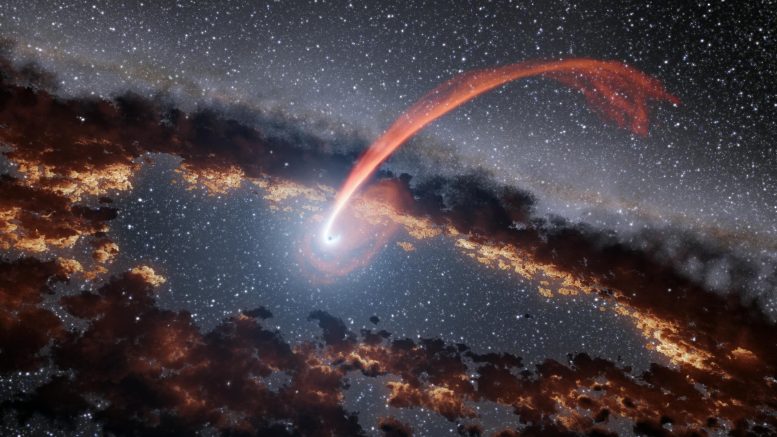
A group of physicists has developed a model that charts the unexpected orbit of a star around a supermassive black hole, uncovering new insights into one of the cosmos’ most extreme environments.
Millions of light-years away in a remote galaxy, a star is being torn apart by the immense gravitational pull of a supermassive black hole. The destruction of the star results in a stream of debris that falls back onto the black hole, forming an accretion disk – a bright and hot disk of material that swirls around the black hole.
The process of a star being destroyed by a supermassive black hole and fueling a bright accretion flare is known as a tidal disruption event (TDE). These events are believed to occur approximately once every 10,000 to 100,000 years in any given galaxy.
With luminosities exceeding entire galaxies (i.e., billions of times brighter than our Sun) for brief periods of time (months to years), accretion events enable astrophysicists to study supermassive black holes (SMBHs) from cosmological distances, providing a window into the central regions of otherwise-quiescent – or dormant – galaxies. By probing these “strong-gravity” events, where Einstein’s general theory of relativity is critical for determining how matter behaves, TDEs yield information about one of the most extreme environments in the universe: the event horizon – the point of no return – of a black hole.
TDEs are usually “once-and-done” because the extreme gravitational field of the SMBH destroys the star, meaning that the SMBH fades back into darkness following the accretion flare. In some instances, however, the high-density core of the star can survive the gravitational interaction with the SMBH, allowing it to orbit the black hole more than once. Researchers call this a repeating partial TDE.
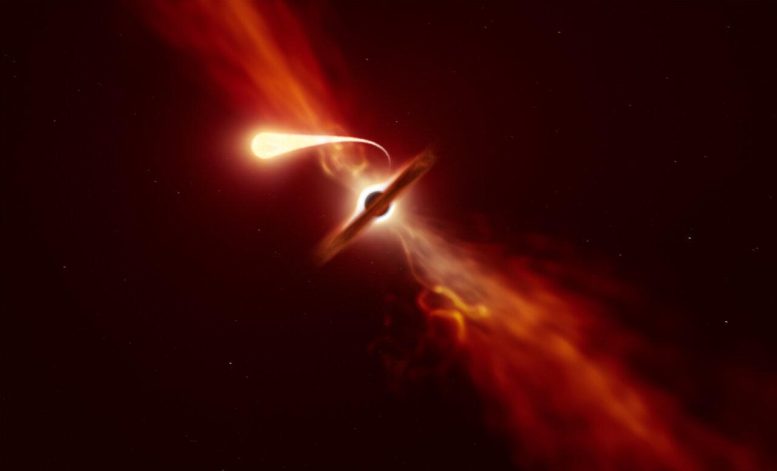
AT2018fyk: A Repeating Partial TDE
A team of physicists, including lead author Thomas Wevers, Fellow of the European Southern Observatory, and co-authors Eric Coughlin, assistant professor of physics at Syracuse University, and Dheeraj R. “DJ” Pasham, a research scientist at MIT’s Kavli Institute for Astrophysics and Space Research, have proposed a model for a repeating partial TDE.
Their findings, published in Astrophysical Journal Letters, describe the capture of the star by a SMBH, the stripping of the material each time the star comes close to the black hole, and the delay between when the material is stripped and when it feeds the black hole again. The team’s work is the first to develop and use a detailed model of a repeating partial TDE to explain the observations, make predictions about the orbital properties of a star in a distant galaxy, and understand the partial tidal disruption process.
The team is studying a TDE known as AT2018fyk (AT stands for “Astrophysical Transient”). The star was captured by a SMBH through an exchange process known as “Hills capture,” where the star was originally part of a binary system (two stars that orbit one another under their mutual gravitational attraction) that was ripped apart by the gravitational field of the black hole. The other (non-captured) star was ejected from the center of the galaxy at speeds comparable to ~ 1000 km/s, which is known as a hypervelocity star.
Once bound to the SMBH, the star powering the emission from AT2018fyk has been repeatedly stripped of its outer envelope each time it passes through its point of closest approach with the black hole. The stripped outer layers of the star form the bright accretion disk, which researchers can study using X-Ray and Ultraviolet /Optical telescopes that observe light from distant galaxies.
Animation describing a partial tidal disruption event – where a black hole repeatedly destroys a star. Credit: Syracuse University, Wevers, Coughlin, Pasham et al. (2022)
According to Wevers, having the opportunity to study a partial TDE gives unprecedented insight into the existence of supermassive black holes and the orbital dynamics of stars in the centers of galaxies.
“Until now, the assumption has been that when we see the aftermath of a close encounter between a star and a supermassive black hole, the outcome will be fatal for the star, that is, the star is completely destroyed,” he says. “But contrary to all other TDEs we know of, when we pointed our telescopes to the same location again several years later, we found that it had re-brightened again. This led us to propose that rather than being fatal, part of the star survived the initial encounter and returned to the same location to be stripped of material once more, explaining the re-brightening phase.”
First detected in 2018, AT2018fyk was initially perceived as an ordinary TDE. For approximately 600 days the source stayed bright in the X-ray, but then abruptly went dark and was undetectable – a result of the stellar remnant core returning to a black hole, explains MIT physicist Dheeraj R. Pasham.
“When the core returns to the black hole it essentially steals all the gas away from the black hole via gravity and as a result, there is no matter to accrete and hence the system goes dark,” Pasham says.
It wasn’t immediately clear what caused the precipitous decline in the luminosity of AT2018fyk, because TDEs normally decay smoothly and gradually – not abruptly – in their emission. But around 600 days after the drop, the source was again found to be X-ray bright. This led the researchers to propose that the star survived its close encounter with the SMBH the first time and was in orbit about the black hole.
Modeling the Survival of a Star Near a Black Hole
Using detailed modeling, the team’s findings suggest that the orbital period of the star about the black hole is roughly 1,200 days, and it takes approximately 600 days for the material that is shed from the star to return to the black hole and start accreting. Their model also constrained the size of the captured star, which they believe was about the size of the sun. As for the original binary, the team believes the two stars were extremely close to one another before being ripped apart by the black hole, likely orbiting each other every few days.
So how could a star survive its brush with death? It all comes down to a matter of proximity and trajectory. If the star collided head-on with the black hole and passed the event horizon – the threshold where the speed needed to escape the black hole surpasses the speed of light – the star would be consumed by the black hole. If the star passed very close to the black hole and crossed the so-called “tidal radius” – where the tidal force of the hole is stronger than the gravitational force that keeps the star together – it would be destroyed. In the model they have proposed, the star’s orbit reaches a point of closest approach that is just outside of the tidal radius, but doesn’t cross it completely: some of the material at the stellar surface is stripped by the black hole, but the material at its center remains intact.
Probing the Future of Star-Black Hole Interactions
How, or if, the process of the star orbiting the SMBH can occur over many repeated passages is a theoretical question that the team plans to investigate with future simulations. Syracuse physicist Eric Coughlin explains that they estimate between 1 to 10% of the mass of the star is lost each time it passes the black hole, with the large range due to uncertainty in modeling the emission from the TDE.
“If the mass loss is only at the 1% level, then we expect the star to survive for many more encounters, whereas if it is closer to 10%, the star may have already been destroyed,” notes Coughlin.
The team will keep their eyes to the sky in the coming years to test their predictions. Based on their model, they forecast that the source will abruptly disappear around August 2023 and brighten again when the freshly stripped material accretes onto the black hole in 2025.
The team says their study offers a new way forward for tracking and monitoring follow-up sources that have been detected in the past. The work also suggests a new paradigm for the origin of repeating flares from the centers of external galaxies.
“In the future, it is likely that more systems will be checked for late-time flares, especially now that this project puts forth a theoretical picture of the capture of the star through a dynamical exchange process and the ensuing repeated partial tidal disruption,” says Coughlin. “We’re hopeful this model can be used to infer the properties of distant supermassive black holes and gain an understanding of their “demographics,” being the number of black holes within a given mass range, which is otherwise difficult to achieve directly.”
The team says the model also makes several testable predictions about the tidal disruption process, and with more observations of systems like AT2018fyk, it should give insight into the physics of partial tidal disruption events and the extreme environments around supermassive black holes.
“This study outlines methodology to potentially predict the next snack times of supermassive black holes in external galaxies,” says Pasham. “If you think about it, it is pretty remarkable that we on Earth can align our telescopes to black holes millions of light years away to understand how they feed and grow.”
Reference: “Live to Die Another Day: The Rebrightening of AT 2018fyk as a Repeating Partial Tidal Disruption Event” by T. Wevers, E. R. Coughlin, D. R. Pasham, M. Guolo, Y. Sun, S. Wen, P. G. Jonker, A. Zabludoff, A. Malyali, R. Arcodia, Z. Liu, A. Merloni, A. Rau, I. Grotova, P. Short and Z. Cao, 12 January 2023, The Astrophysical Journal Letters.
DOI: 10.3847/2041-8213/ac9f36
Never miss a breakthrough: Join the SciTechDaily newsletter.
Follow us on Google and Google News.