
Close Menu
    Facebook X (Twitter) Instagram
    SciTechDaily
    • Biology
    • Chemistry
    • Earth
    • Health
    • Physics
    • Science
    • Space
    • Technology
    Facebook X (Twitter) Pinterest YouTube RSS
    SciTechDaily
    Home»Science»380-Million-Year-Old Fish Fossil Reveals Secrets of Life’s First Steps Onto Land
    Science

    380-Million-Year-Old Fish Fossil Reveals Secrets of Life’s First Steps Onto Land

    By Flinders UniversityMay 5, 2026No Comments4 Mins Read
    Facebook Twitter Pinterest Telegram LinkedIn WhatsApp Email Reddit
    Share
    Facebook Twitter LinkedIn Pinterest Telegram Email Reddit
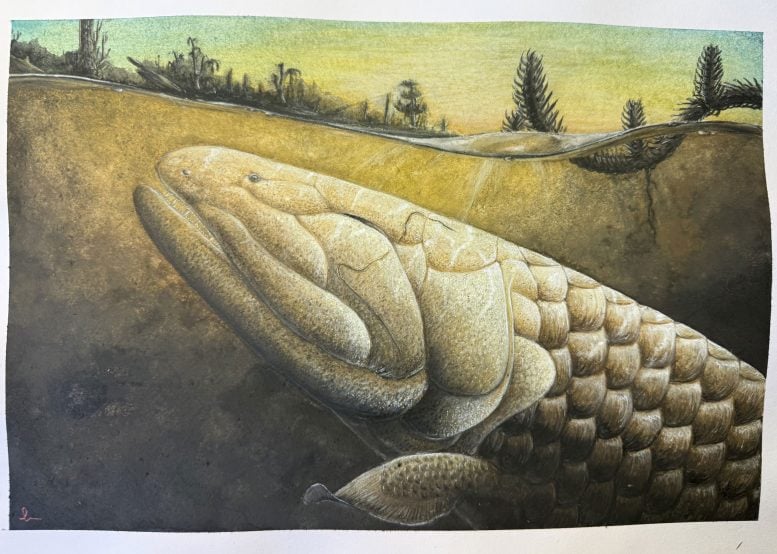
    Life Reconstruction of Devonian Tetrapodomorph Fish Koharalepis Jarviki
    Life reconstruction of Devonian tetrapodomorph fish Koharalepis jarviki. Original painting by honors student and paleoartist Thomas Turner. Credit: Flinders University

    A rare fossil fish scan reveals brain features and adaptations tied to the transition from aquatic to land animals.

    Researchers at Flinders University have taken a closer look inside the head of one of the earliest animals to move from water onto land more than 380 million years ago.

    Using advanced neutron imaging, the team examined the skull and braincase of the only known specimen of Koharalepis jarviki, a large fossil fish discovered in freshwater deposits in Antarctica’s Lashly Mountains. This species lived during the Devonian Period, often called the “Age of Fishes.”
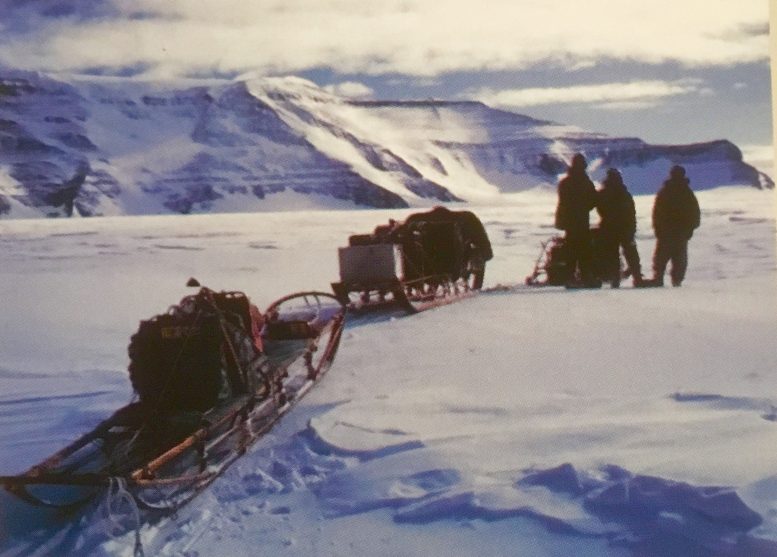
    Antarctic Field Trip 1991
    Professor John Long was part of the 1991 expedition to Antarctica when one of the first specimens was found. An earlier field trip in 1971 also found remains of the species. Credit: J Long (Flinders University)

    Canowindridae Fossil Links and Early Tetrapod Evolution

    “This precious fossil belongs to a group called the Canowindridae which highlights the ancient links between Australia and Antarctica,” says Flinders University Research Fellow Dr. Alice Clement, coauthor of a new article in Frontiers in Ecology and Evolution.

    “It is important to study such specimens from the Devonian Age of Fishes, when the waters teemed with predatory lobe-finned fish like this that are closely related to land animals (tetrapods),” says Dr. Clement, from the College of Science and Engineering.
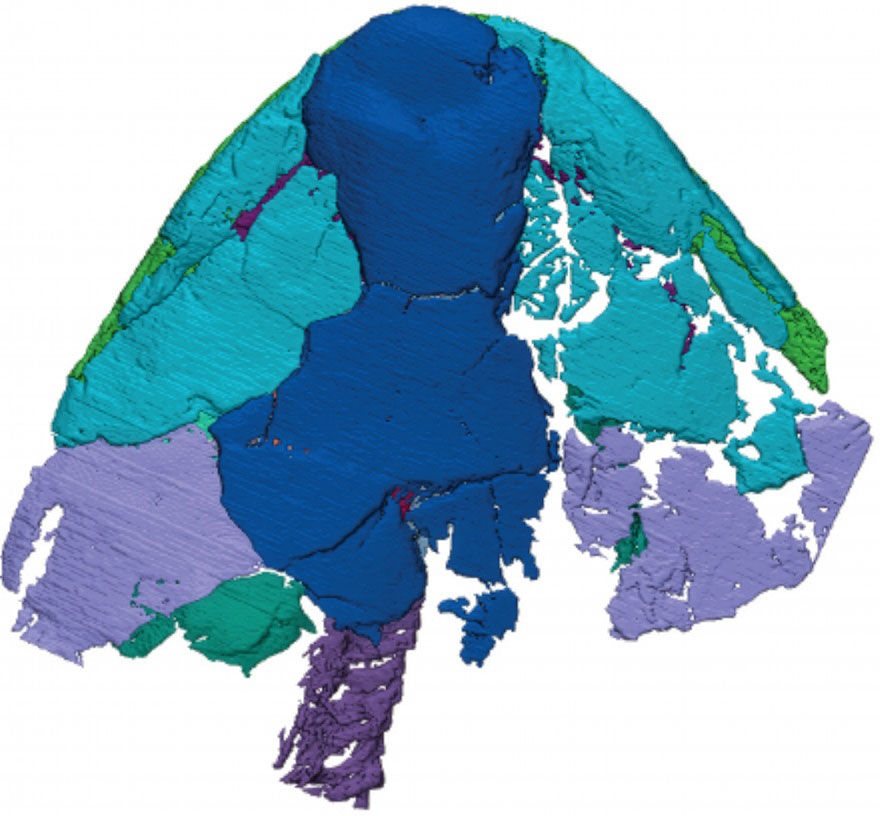
    3D Model of the Fossil Skull of Koharalepis jarviki
    3D model of the fossil skull of Koharalepis jarviki. The model is pictured from above, showing a roughly triangular-shaped skull with some vertebrae seen below. Credit: C Mensforth (Flinders University)

    Koharalepis belongs to the Canowindrid family, which lived across East Gondwana, with fossils now found in both Australia and Antarctica. It represents an early relative of the first land animals, the four-limbed vertebrates known as tetrapods.

    Braincase Insights, Surface Adaptations, and Predatory Behavior

    Lead author Corinne Mensforth, a PhD candidate from the Flinders Palaeontology Lab, explains, “We chose to focus on Koharalepis as it is the only fossil in the entire family to preserve the internal bones of the skull, which gives us valuable insights into its braincase and neuroanatomy.”

    “We found evidence that the brain of Koharalepis was similar to those of the fishes that straddle the vertebrate water-to-land transition.”

    She continues, “We also found adaptations to life near the surface of the water, including openings in the top of the skull for additional air intake and an organ within the brain that detects light and circadian rhythms.

    “Koharalepis, which grew to about 1 meter, was an ambush predator that preyed on other smaller animals in their environment, and with relatively small eyes, it must have relied heavily on its other senses to capture its prey.”
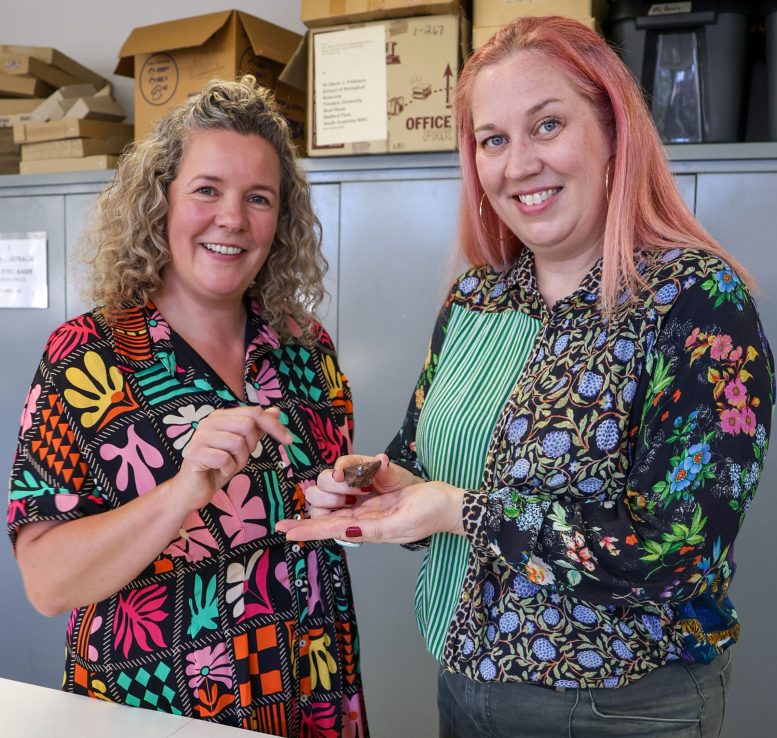
    Dr Alice Clement and PhD Candidate Corinne Mensforth
    Dr. Alice Clement and PhD candidate Corinne Mensforth in the Flinders Palaeontology Laboratory examining a small fossil fish. Credit: Flinders University

    Research History and Evolutionary Insights

    Another coauthor, Flinders University Emeritus Professor John Long, contributed to the original 1992 description of Koharalepis.

    Professor Long says modern non-destructive imaging methods have revealed details of the internal skeleton, including parts of the skull, shoulder girdle, and backbone.

    “This has enabled us to understand some of the behavior, adaptations, and relationships of Koharalepis to its environment and to the other tetrapod-like fishes—and how fish first left the water to live on land approximately 385 million years ago,” he says.

    Reference: “New data on the sarcopterygian Koharalepis jarviki (Tetrapodomorpha; Canowindridae) from the Late Devonian of Antarctica, revealed via synchrotron and neutron tomography” by Corinne L. Mensforth, John A. Long, Joseph J. Bevitt and Alice M. Clement, 27 March 2026, Frontiers in Ecology and Evolution.
    DOI: 10.3389/fevo.2026.1765271

    This work was supported by the Australian Research Council (DP 200103398), with thanks to Dr. Matthew McCurry (Australian Museum) for specimen loan and Anton Maksimenko for assistance with synchrotron scanning (Australian Nuclear Science and Technology Organisation).

    Never miss a breakthrough: Join the SciTechDaily newsletter.
    Follow us on Google and Google News.

    Evolutionary Biology Flinders University Fossils Paleontology Tetrapod
    Share. Facebook Twitter Pinterest LinkedIn Email Reddit

    Related Articles

    400-Million-Year-Old Fish Fossils Rewrite the Story of Life on Land

    Mysterious 380 Million-Year-Old Fish Reveals Secrets of Our Land-Walking Ancestors

    The Ancient Dietary Secrets of Elephants: A Tale of Evolution and Adaptation

    Bizarre: Scientists Discover New Species of Mosasaur With Strange “Screwdriver Teeth”

    Controversial Prehistoric Egg Identified To Be the Last of the “Demon Ducks of Doom”

    A Very Rare Discovery: 25-Million-Year-Old Ancient Eagle Ruled the Roost in Australia

    New Insight Into the Evolution of Sight From 54 Million Year-Old Fossil

    Turtles Share a Recent Common Ancestor with Birds and Crocodiles

    World’s Smallest Fossilized Footsteps Are From Diminutive Tetrapod

    Leave A Reply Cancel Reply

    • Facebook
    • Twitter
    • Pinterest
    • YouTube

    Don't Miss a Discovery

    Subscribe for the Latest in Science & Tech!

    Trending News

    First-of-Its-Kind Discovery: Homer’s Iliad Found Embedded in a 1,600-Year-Old Egyptian Mummy

    Beyond Inflammation: Scientists Uncover New Cause of Persistent Rheumatoid Arthritis

    A Simple Molecule Could Unlock Safer, Easier Weight Loss

    Scientists Just Built a Quantum Battery That Charges Almost Instantly

    Researchers Unveil Groundbreaking Sustainable Solution to Vitamin B12 Deficiency

    Millions of People Have Osteopenia Without Realizing It – Here’s What You Need To Know

    Researchers Discover Boosting a Single Protein Helps the Brain Fight Alzheimer’s

    World-First Study Reveals Human Hearts Can Regenerate After a Heart Attack

    Follow SciTechDaily
    • Facebook
    • Twitter
    • YouTube
    • Pinterest
    • Newsletter
    • RSS
    SciTech News
    • Biology News
    • Chemistry News
    • Earth News
    • Health News
    • Physics News
    • Science News
    • Space News
    • Technology News
    Recent Posts
    • 380-Million-Year-Old Fish Fossil Reveals Secrets of Life’s First Steps Onto Land
    • Mezcal “Worm” in a Bottle Mystery: DNA Testing Reveals a Surprise
    • Scientists Turn Red Lettuce Green, Unlocking Hidden Nutrients
    • Researchers Discover Natural Compound That Disarms Deadly Superbug
    • New Research Reveals That Your Morning Coffee Activates an Ancient Longevity Switch
    Copyright © 1998 - 2026 SciTechDaily. All Rights Reserved.
    • Science News
    • About
    • Contact
    • Editorial Board
    • Privacy Policy
    • Terms of Use

    Type above and press Enter to search. Press Esc to cancel.