
Close Menu
    Facebook X (Twitter) Instagram
    SciTechDaily
    • Biology
    • Chemistry
    • Earth
    • Health
    • Physics
    • Science
    • Space
    • Technology
    Facebook X (Twitter) Pinterest YouTube RSS
    SciTechDaily
    Home»Science»World’s Smallest Fossilized Footsteps Are From Diminutive Tetrapod
    Science

    World’s Smallest Fossilized Footsteps Are From Diminutive Tetrapod

    By SciTechDailySeptember 7, 2012No Comments2 Mins Read
    Facebook Twitter Pinterest Telegram LinkedIn WhatsApp Email Reddit
    Share
    Facebook Twitter LinkedIn Pinterest Telegram Email Reddit
    batrachichnus-salamandroides
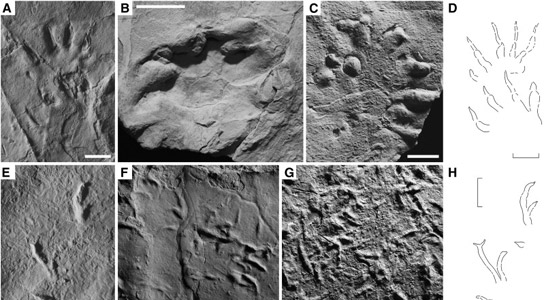
    (A-D) Amphisauropus (E-H) Dromopus lacertoides.

    Fossilized imprints and trackways record the movement and behavior of species long extinct. An amateur paleontologist discovered a fossil that has allowed others to follow the steps of a tiny 315-million-year-old tetrapod from the Carboniferous period.

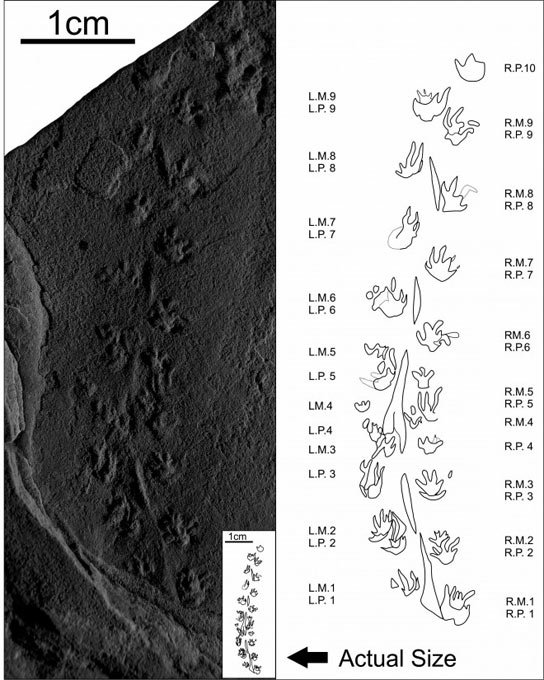
    The paleontologists published their findings in the journal Ichnos: An International Journal for Plant and Animal Traces. The tracks were discovered by Gloria Melanson, an amateur paleontologist, along Nova Scotia’s Joggins Cliffs. The tracks are the smallest fossil vertebrate footprints that have ever been found. The trackway contains about 30 footprints and is less than two inches in length.
    batrachichnus-salamandroides-nova-scotia

    The actual imprints range from 0.09 to 0.06 of an inch each. It seemed to have been walking at normal pace before speeding up at the end of the slab. Ichnologists are always faced with the problem of identifying the exact species that made the trace fossils they study.

    Stimson et al. attribute the tracks to the ichnospecies Batrachichnus salamandroides, the name of this type of particular track, but not of the animal itself. The tracks could have been made by a juvenile Dendrerpeton acadianum, a salamander-like amphibian whose articulated skeleton has been found in fossils inside the ancient lycopsid tree stumps.

    There are other candidates, including a microsaur, but without more information it’s hard to narrow it down to one exact species.
    more-batrachichnus-salamandroides
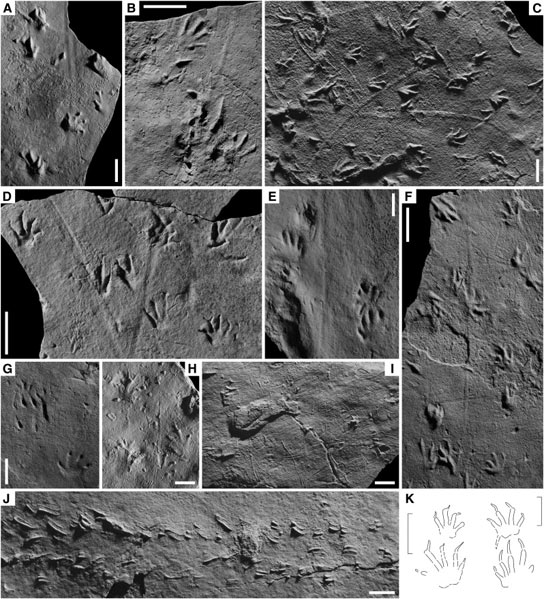
    Batrachichnus salamandroides imprints.

    Reference: “The Smallest Known Tetrapod Footprints: Batrachichnus Salamandroides from the Carboniferous of Joggins, Nova Scotia, Canada” by Matt Stimson, Spencer G. Lucas and Gloria Melanson, 29 August 2012, Ichnos: An International Journal for Plant and Animal Traces.
    DOI: 10.1080/10420940.2012.685206

    Never miss a breakthrough: Join the SciTechDaily newsletter.
    Follow us on Google and Google News.

    Fossils Paleontology Tetrapod
    Share. Facebook Twitter Pinterest LinkedIn Email Reddit

    Related Articles

    Prehistoric Fossilized Eocene Epoch Turtles Died Locked In Coitus

    27-Foot Long Crocodylus Thorbjarnarsoni Roamed Kenya

    Carbonemys Was a Giant Turtle From Late Paleocene

    Mysterious “Godzillus” Fossil Discovered by Amateur Paleontologist

    Cretaceous Period Sankofa Pyrenaica Fossilized Eggs Are Unusually Shaped

    Burtele Foot Points to Other Past Hominins

    Microraptor Feathers Were Black With Iridescent Sheen

    Jurassic Period Super-Sized Fleas Had Armored Mouthparts to Attack the Thick Hide of Dinosaurs

    Hundreds of Lost Fossils From the Darwin Collection Rediscovered by the British Geological Survey

    Leave A Reply Cancel Reply

    • Facebook
    • Twitter
    • Pinterest
    • YouTube

    Don't Miss a Discovery

    Subscribe for the Latest in Science & Tech!

    Trending News

    Scientists May Have Found the Key to Jupiter and Saturn’s Moon Mystery

    Scientists Uncover Brain Changes That Link Pain to Depression

    Saunas May Do More Than Raise Body Temperature – They Activate Your Immune System

    Exercise in a Pill? Metformin Shows Surprising Effects in Cancer Patients

    Hidden Oceans of Magma Could Be Protecting Alien Life

    New Study Challenges Alzheimer’s Theories: It’s Not Just About Plaques

    Artificial Sweeteners May Harm Future Generations, Study Suggests

    Splashdown! NASA Artemis II Returns From Record-Breaking Moon Mission

    Follow SciTechDaily
    • Facebook
    • Twitter
    • YouTube
    • Pinterest
    • Newsletter
    • RSS
    SciTech News
    • Biology News
    • Chemistry News
    • Earth News
    • Health News
    • Physics News
    • Science News
    • Space News
    • Technology News
    Recent Posts
    • Ancient DNA Reveals Irish Goats Have a 3,000-Year-Old Lineage Still Alive Today
    • Historians Reveal Secrets of the Strange Hat Wars That Shook Early Modern England
    • “A Plague Is Upon Us”: The Mass Death That Changed an Ancient City Forever
    • This Strange Material Can Turn Superconductivity on and off Like a Switch
    • Scientists Discover Game-Changing New Way To Treat High Cholesterol
    Copyright © 1998 - 2026 SciTechDaily. All Rights Reserved.
    • Science News
    • About
    • Contact
    • Editorial Board
    • Privacy Policy
    • Terms of Use

    Type above and press Enter to search. Press Esc to cancel.