
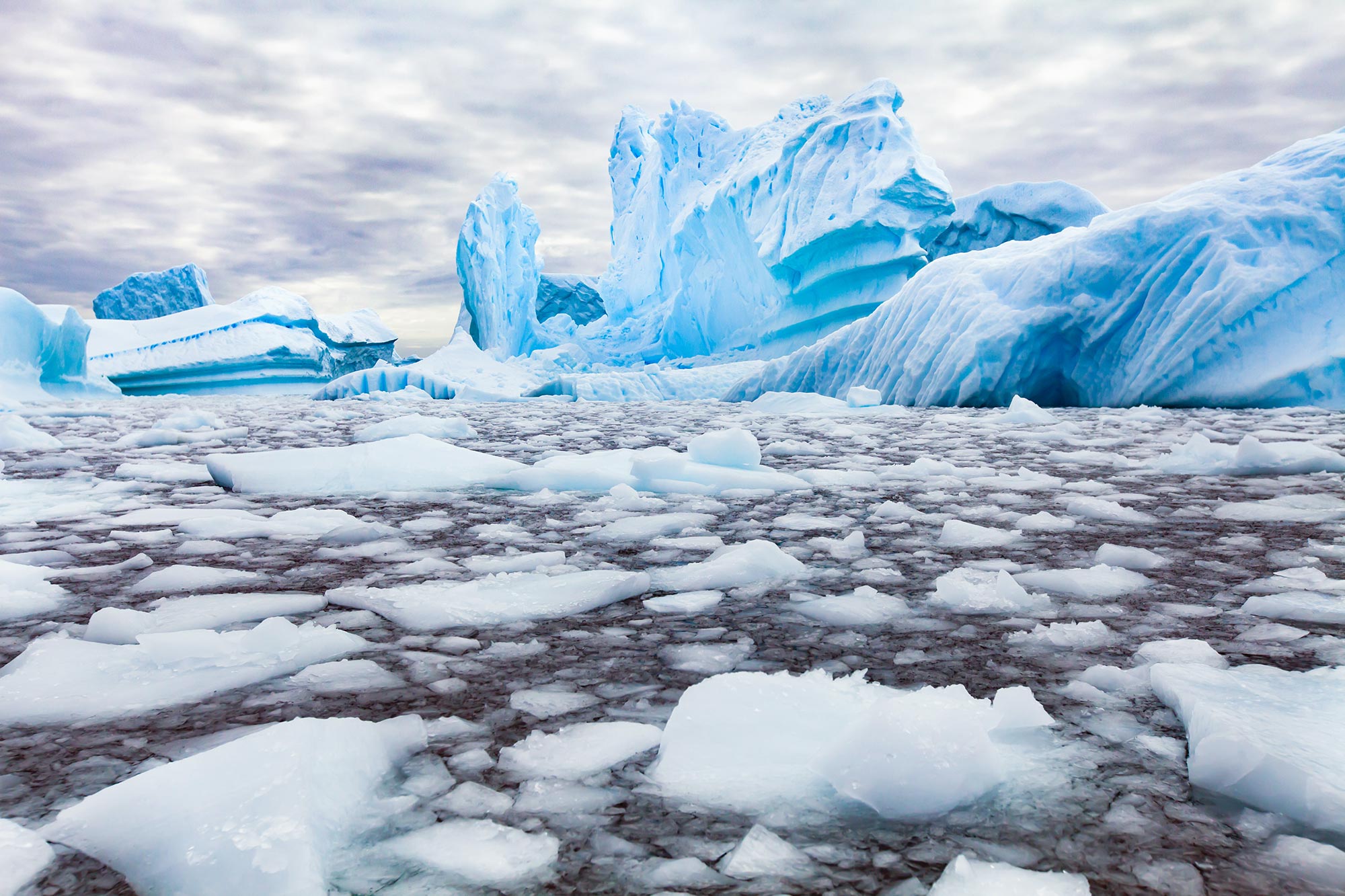
A new effort aims to more accurately measure the loss of ice shelves in Antarctica.
Global ice dams are weakening due to rising temperatures, leading to new insights about the mass of Antarctica’s floating ice shelves. A recent study in the Journal of Glaciology suggests that previous estimates of these ice shelves’ thickness might have been overestimated.
The study is the first large-scale comparison of ice shelf thickness. Researchers used ice-penetrating radar and contemporary surface elevation measurements to analyze 20 of the 300 separate ice shelf systems surrounding the Antarctic ice sheet.
Findings on Ice Shelf Thickness
By juxtaposing vast datasets of 20 of the 300 total separate ice shelf systems that surround about 75% of the Antarctic ice sheet, researchers from The Ohio State University found that on average, the Antarctic ice shelves are nearly 6% thinner than previous studies had assumed, a difference of about 17 meters. This may seem like a small shift in scale, but typical ice shelves can be anywhere from 50 to 600 meters thick.
The study concludes that while prior assumptions about the ice shelves’ thickness were correct on a large scale, their accuracy varied greatly on a small scale, such as for individual structures like valleys or crevasses that are either too narrow or too small to be measured accurately.
Impact on Global Sea Levels
Yet as ice shelves play a large role in stabilizing the Antarctic ice sheet as well as Earth’s complex climate system, getting an accurate estimation of their size is essential for calculating how their melt could contribute to sea level rise, said Allison Chartrand, lead author of the study and recent doctoral graduate of the Byrd Polar and Climate Research Center.
“Because the Antarctic ice sheet is so big, a 1% misestimation in how fast it’s melting could mean inches or feet of sea level rise that we’re not accounting for,” she said. “So it’s really important to be as accurate as we can.”
Even the most minute changes to Antarctica’s ice shelves could pose a significant threat to coastal communities, Chartrand said, as a few inches of significantly displaced ice shelf could cause thicker ice to flow into the ocean and potentially cause some coastlines to retreat several feet.
Study Approach and Discoveries
According to Chartrand, she and her co-author, Ian Howat, a glaciologist and a Distinguished University Scholar in earth sciences at Ohio State, first began to investigate ice shelf thickness when examining basal channels – channels in which warmer ocean water melts grooves into the bottom of the ice shelf, accelerating mass loss – during a previous study.
One of the largest discrepancies the study found was that the assumptions used to estimate ice shelf thickness in previous research sometimes exaggerated ice shelf thickness in some areas, and at other times understated it.
While many of these inconsistencies don’t take away much from the big picture, individually, these snapshots are vastly out of focus, said Chartrand. “In comparing the thickness estimate with the radar estimate, we saw that the numbers we had on basal channels and other features like them could be different by up to hundreds of meters, which meant that we could potentially be underestimating or overestimating rates of change,” she said.
The Need for Improved Data and Technology
Overall, the study concludes that more abundant and accurate data is needed to enable better predictions of ice shelf loss in Antarctica, as the ultimate goal of their work is to improve observations of the processes that contribute to sea level rise, said Chartrand.
“What this research really shows is that we need to be a lot more careful about the assumptions we make to estimate the ice shelf thickness, and about how we account for uncertainties and what they mean for the final result,” she said.
While their work also seeks to inspire others to probe into older datasets, Chartrand hopes that using the past to study the future changes in our environment spurs the development of more advanced technologies, ones that might be able to offer greater aid in the task of assessing the ups and downs of Antarctica’s ever-shifting landscape.
“There’s potential for new discoveries even with data collected anywhere from two to 15 years ago, so we know that a lot still hasn’t been fully explored,” said Chartrand.
Reference: “A comparison of contemporaneous airborne altimetry and ice-thickness measurements of Antarctic ice shelves” by Allison M. Chartrand and Ian M. Howat, 3 August 2023, Journal of Glaciology.
DOI: 10.1017/jog.2023.49
This study was supported by NASA and the National Science Foundation.
Never miss a breakthrough: Join the SciTechDaily newsletter.
Follow us on Google and Google News.
2 Comments
“What this research really shows is that we need to be a lot more careful about the assumptions we make to estimate the ice shelf thickness, and about how we account for uncertainties and what they mean for the final result,”
I applaud the authors for being concerned about the uncertainties. They actually include an estimates and their associated uncertainty. It is a welcome change for those researching the climate. However, the abstract states, “On average, the hydrostatic thickness differs from observed thickness by at least ~17 ± 98 m …” I interpret that to mean that the average absolute error is about 17m, with a standard deviation of ±98m. That is a little difficult to understand. A common assumption is that the uncertainty in a measurement, or calculations based on measurements, is going to be much smaller than the measurement itself. That obviously isn’t the case here. Perhaps it would be better to state the error as ranging from -81m to 115m. That is not a trivial error range. As the authors remark, the large uncertainty obtained is probably the result of spatial variability.
Why is there no one looking at what goes on UNDER the ice??? Antarctica has many underwater volcanoes plus the biggest volcano in the world under antarctic ice. I suppose that doesn’t fit the “global warming/climate change” narrative.