
Close Menu
    Facebook X (Twitter) Instagram
    SciTechDaily
    • Biology
    • Chemistry
    • Earth
    • Health
    • Physics
    • Science
    • Space
    • Technology
    Facebook X (Twitter) Pinterest YouTube RSS
    SciTechDaily
    Home»Physics»Evading Heisenberg’s Uncertainty Principle Isn’t Easy
    Physics

    Evading Heisenberg’s Uncertainty Principle Isn’t Easy

    By EPFLNovember 2, 2019No Comments3 Mins Read
    Facebook Twitter Pinterest Telegram LinkedIn WhatsApp Email Reddit
    Share
    Facebook Twitter LinkedIn Pinterest Telegram Email Reddit
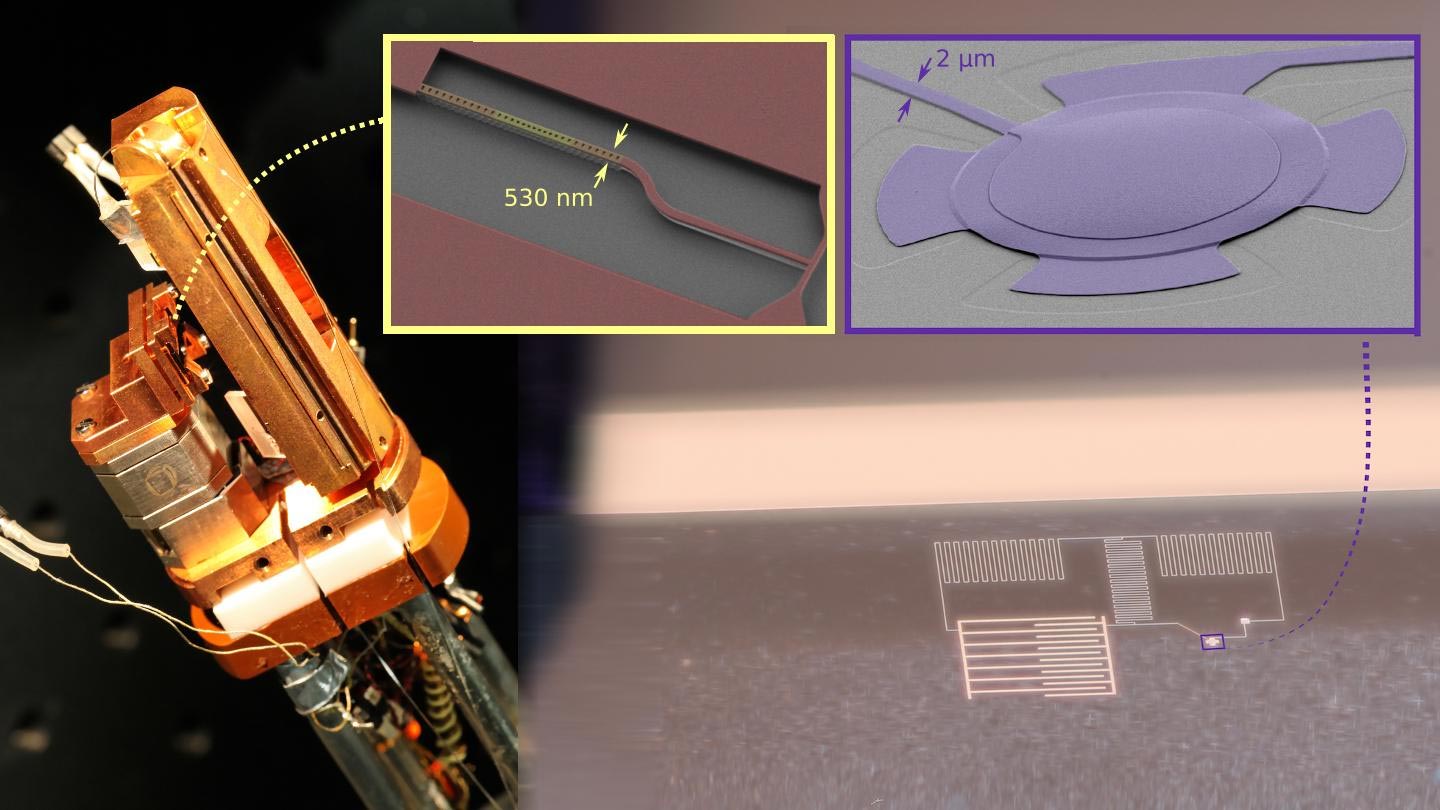
    Two Different Quantum Optomechanical Systems
    Two different quantum optomechanical systems used to demonstrate novel dynamics in backaction-evading measurements. Left (yellow): silicon nanobeam supporting both an optical and a 5 GHz mechanical mode, operated in a helium-3 cryostat at 4 Kelvin and probed using a laser sent in an optical fiber. Right (purple): microwave superconducting circuit coupled to a 6 MHz mechanically-compliant capacitor, operated in a dilution refrigerator at 15 milli-Kelvin. Credit: I. Shomroni, EPFL.

    EPFL researchers, with colleagues at the University of Cambridge and IBM Research–Zurich, unravel novel dynamics in the interaction between light and mechanical motion with significant implications for quantum measurements designed to evade the influence of the detector in the notorious “back action limit” problem.

    The limits of classical measurements of mechanical motion have been pushed beyond expectations in recent years, e.g. in the first direct observation- of gravitational waves, which were manifested as tiny displacements of mirrors in kilometer-scale optical interferometers. On the microscopic scale, atomic- and magnetic-resonance force microscopes can now reveal the atomic structure of materials and even sense the spins of single atoms.

    But the sensitivity that we can achieve using purely conventional means is limited. For example, Heisenberg’s uncertainty principle in quantum mechanics implies the presence of “measurement backaction”: the exact knowledge of the location of a particle invariably destroys any knowledge of its momentum, and thus of predicting any of its future locations.

    Backaction-evading techniques are designed specifically to ‘sidestep’ Heisenberg’s uncertainty principle by carefully controlling what information is gained and what isn’t in a measurement, e.g. by measuring only the amplitude of an oscillator and ignoring its phase.

    In principle, such methods have unlimited sensitivity but at the cost of learning half of the available information. But technical challenges aside, scientists have generally thought that any dynamical effects arising from this optomechanical interaction don’t carry any further complications.

    Now, in an effort to improve the sensitivity of such measurements, the lab of Tobias Kippenberg at EPFL, working with scientists at the University of Cambridge and IBM Research – Zurich, have discovered novel dynamics that place unexpected constraints on the achievable sensitivity. Published in Physical Review X on October 30, 2019, the work shows that tiny deviations in the optical frequency together with deviations in the mechanical frequency can have grave results — even in the absence of extraneous effects — as the mechanical oscillations begin to amplify out of control, mimicking the physics of what is called a “degenerate parametric oscillator.”

    The same behavior was found in two profoundly different optomechanical systems, one operating with optical and the other with microwave radiation, confirming that the dynamics were not unique to any particular system. The EPFL researchers charted the landscape of these dynamics by tuning the frequencies, demonstrating a perfect match with the theory.

    “Other dynamical instabilities have been known for decades and shown to plague gravitational wave sensors,” says EPFL scientist Itay Shomroni, the paper’s first author. “Now, these new results will have to be taken into account in the design of future quantum sensors and in related applications such as backaction-free quantum amplification.”

    Reference: “Two-Tone Optomechanical Instability and Its Fundamental Implications for Backaction-Evading Measurements” by Itay Shomroni, Amir Youssefi, Nick Sauerwein, Liu Qiu, Paul Seidler, Daniel Malz, Andreas Nunnenkamp and Tobias J. Kippenberg, 30 October 2019, Physical Review X.
    DOI: 10.1103/PhysRevX.9.041022

    Never miss a breakthrough: Join the SciTechDaily newsletter.
    Follow us on Google and Google News.

    Electricity EPFL Optics Quantum Mechanics Quantum Optics
    Share. Facebook Twitter Pinterest LinkedIn Email Reddit

    Related Articles

    Quantum Squeezing Unlocks Lightning-Fast Gas Sensors

    How Terahertz Pulses Are Unraveling the Mysteries of Superconductors

    Electrons Stand Still As Scientists Rewrite Molecular Rules

    Counter-Intuitive Quantum Mechanics: State of Vibration That Exists Simultaneously at Two Different Times

    Scientists Generate the Fastest Electric Current Ever Measured Inside a Solid Material

    Researchers Develop A Universal Quantum Gate

    Physicists Test the Response Time of Electrons

    Physicists Measure Photons in an Entangled NOON State

    Researchers Demonstrate a Quantum Connection Between Light and Mechanics

    Leave A Reply Cancel Reply

    • Facebook
    • Twitter
    • Pinterest
    • YouTube

    Don't Miss a Discovery

    Subscribe for the Latest in Science & Tech!

    Trending News

    Even Occasional Binge Drinking May Triple Liver Damage Risk

    Liftoff! NASA’s Artemis II Launch Sends Astronauts Around the Moon for First Time in 50 Years

    Scientists Discover New Way To Eliminate “Zombie Cells” Driving Aging

    This New Quantum Theory Could Change Everything We Know About the Big Bang

    This One Vitamin May Help Protect Your Brain From Dementia Years Later

    Stopping Weight-Loss Drugs Like Ozempic Can Quickly Erase Heart Benefits

    A 500-Million-Year-Old Surprise Is Forcing Scientists to Rethink Spider Evolution

    Coffee and Blood Pressure: What You Need To Know Before Your Next Cup

    Follow SciTechDaily
    • Facebook
    • Twitter
    • YouTube
    • Pinterest
    • Newsletter
    • RSS
    SciTech News
    • Biology News
    • Chemistry News
    • Earth News
    • Health News
    • Physics News
    • Science News
    • Space News
    • Technology News
    Recent Posts
    • 1,800 Miles Down: Scientists Uncover Mysterious Movements at the Edge of Earth’s Core
    • Scientists Uncover Earth’s Hidden “Gold Kitchen” Beneath the Ocean Floor
    • You Don’t Need To Be Rich: New Study Reveals a Simple Life Is the Real Secret to Happiness
    • “Crazy Dice” Help Scientists Prove Only One 150-Year-Old Theory About Randomness Works
    • Scientists Discover Hidden “Good Fats” in Green Rice That Could Transform Nutrition
    Copyright © 1998 - 2026 SciTechDaily. All Rights Reserved.
    • Science News
    • About
    • Contact
    • Editorial Board
    • Privacy Policy
    • Terms of Use

    Type above and press Enter to search. Press Esc to cancel.