
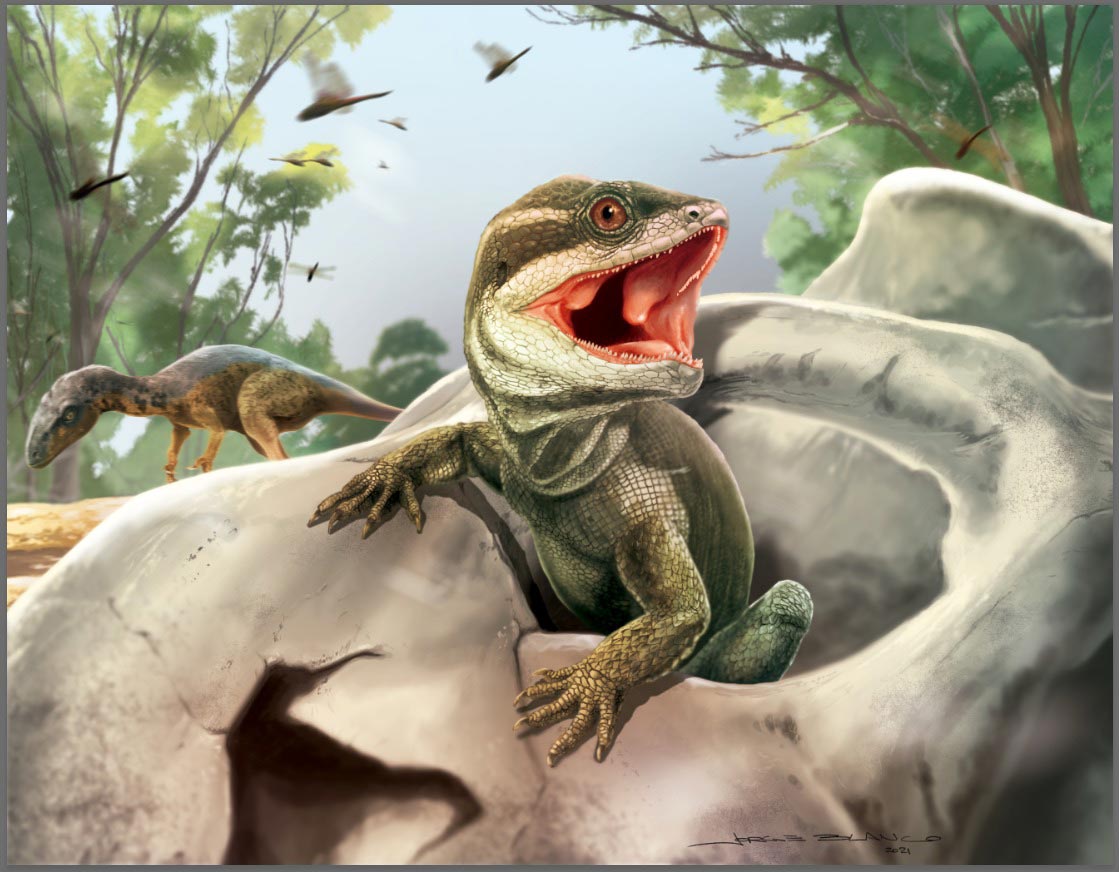
International team of researchers describe a new fossil species representing the ancient forerunner of most modern reptiles.
Lizards and snakes are a key component of most terrestrial ecosystems on Earth today. Along with the charismatic tuatara of New Zealand (a “living fossil” represented by a single living species), squamates (all lizards and snakes) make up the Lepidosauria—the largest group of terrestrial vertebrates in the planet today with approximately 11,000 species, and by far the largest modern group of reptiles. Both squamates and tuataras have an extremely long evolutionary history. Their lineages are older than dinosaurs having originated and diverged from each other at some point around 260 million years ago. However, the early phase of lepidosaur evolution 260-150 million years ago, is marked by very fragmented fossils that do not provide much useful data to understand their early evolution, leaving the origins of this vastly diverse group of animals embedded in mystery for decades.
In a study published today (August 25, 2021) in Nature an international team of researchers describe a new species that represents the most primitive member of lepidosaurs, Taytalura alcoberi, found in the Late Triassic deposits of Argentina. Discovered by lead author Dr. Ricardo N. Martínez, Universidad Nacional de San Juan, Argentina, and curator at the Instituto y Museo de Ciencias Naturales, Taytalura is the first three-dimensionally preserved early lepidosaur fossil. It allowed scientists to infer with great confidence it’s placement in the evolutionary tree of reptiles and aids in closing the gap of our knowledge of the origin and early evolution of lepidosaurs.
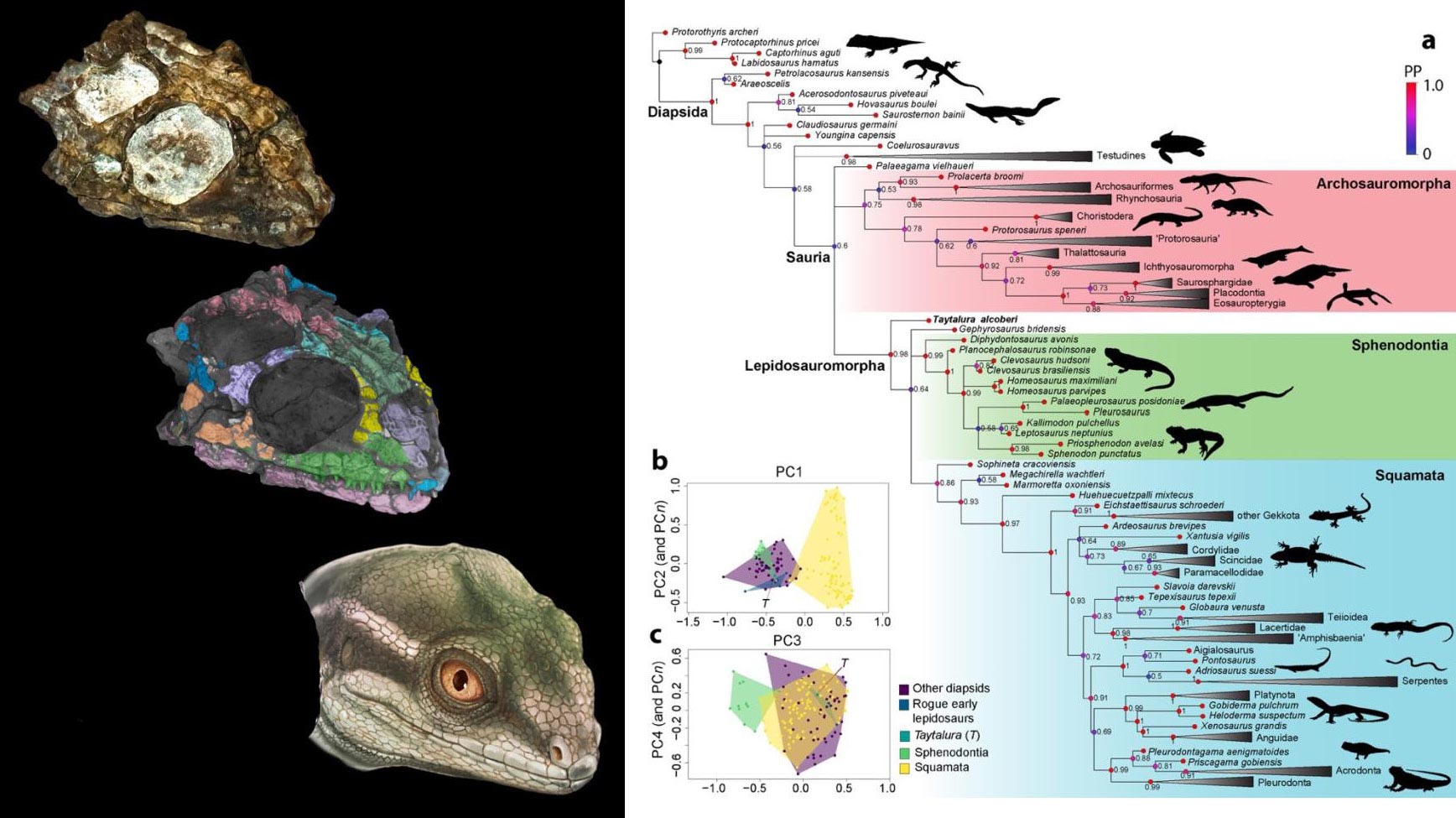
Martínez and co-author Dr. Sebastián Apesteguía, Universidad Maimónides, Buenos Aires, Argentina, conducted high-resolution CT scans of Taytalura which provided confirmation that it was something related to ancient lizards. They then contacted co-author Dr. Tiago R. Simões, postdoctoral fellow in The Department of Organismic and Evolutionary Biology, Harvard University, to help identify and analyze the fossil. Simões specializes in studying these creatures and in 2018 published the largest existing dataset to understand the evolution of the major groups of reptiles (living and extinct) in Nature.
“I knew the age and locality of the fossil and could tell by examining some of its external features that it was closely related to lizards, but it looked more primitive than a true lizard and that is something quite special,” said Simões.
The researchers then contacted co-author Dr. Gabriela Sobral, Department of Palaeontology, Staatliches Museum für Naturkunde Stuttgart, Germany, to process the CT scan data. Sobral, a specialist in processing CT data, created a mosaic of colors for each bone of the skull allowing the team to understand the fossil’s anatomy in high-detail resolution on a scale of only a few micrometers – about the same thickness as a human hair.
With Sobral’s data, Simões was able to apply a Bayesian evolutionary analysis to determine the proper placement of the fossil in the reptile dataset. Simões had recently applied the Bayesian method – which was adapted from methods originally developed in epidemiology to study how viruses like COVID-19 evolve – to precisely estimate the time and rates of anatomical evolution during the rise of tetrapods. The statistical analysis confirmed their suspicions that Taytalura was in fact the most primitive member of the lineage that eventually originated all lizards and snakes. “It’s not even a lizard in the evolutionary tree,” said Simões, “but it’s the very next thing there, between true lizards and tuataras, and all other reptiles.”
Rewriting the Ancestral Blueprint of Lizards
“This beautifully 3D preserved fossil is really an important finding. It is the most complete fossil representing the early stages of lepidosaur evolution that we have so far. All other known fossils are too incomplete, which makes it difficult to classify them for sure, but the complete and articulated nature of Taytalura makes its relationships much more certain,” said Sobral.
Simões agreed, “Taytalura is a major point in the reptile tree of life that was previously missing. Because these fossils are so small they are very difficult to preserve in the fossil record. And what candidate fossils we do have are very fragmented and poorly preserved, so they don’t provide as much useful data for analysis.”
Taytalura’s skull reveals that the first lepidosaurs looked substantially more like the tuataras than squamates, and therefore, that squamates represent a major deviation from this ancestral pattern. Further, it has a unique dentition, differing from the teeth found in any living or extinct group of lepidosaurs. “What our analyses tells us, besides some other anatomical traits that we could see on it, in the skull specifically, is that this sphenodontian body type, at least for the skull, is the ancestral pattern for lepidosaurs. The ancestral pattern seems to be more similar to tuataras,” said Simões.
“Taytalura preserves a composition of features that we were not expecting to find in such an early fossil. For instance, it shows some features that we thought were exclusive for the tuatara group. On the other hand, it made us question how truly “primitive” certain lizard features are, and it will make scientists reconsider several points in the evolution of this group,” said Sobral.
Global Implications for Reptile Evolution
“The almost perfectly preserved Taytalura skull shows us details of how a very successful group of animals, including more than 10,000 species of snakes, lizards, and tuataras, originated,” said Martínez. “But it also highlights the paleontological importance of the paleontological site of Ischigualasto Formation, known for preserving some of the most primitive dinosaurs known in the world. The extraordinary quality of preservation of the fossils at this site allowed something as fragile and tiny as this specimen to be preserved for 231 million years.”
“Contrary to almost all fossils of Triassic lepidosaurs found in Europe, this is the first early lepidosaur found in South America, suggesting lepidosaurs were able to migrate across vastly distant geographic regions early in their evolutionary history,” agreed Simões.
“We are accustomed to accept that the Mesozoic Era was an age of gigantic reptiles, enormous proto-mammals, and huge trees, and thus we commonly look for fossils that are visible at human height, just walking,” said Apesteguía. “However, the largest part of the ancient ecosystem components was small, as today. There was a universe of fauna sneaking among bigger, clawed, or hoofy paws. Taytalura teaches us that we were missing important information by looking not only for bigger animals, but also thinking that the origin of lizards occurred only in the Northern Hemisphere as evidence seemed to support until now.”
While Taytalura is primitive, it is not the oldest lepidosaur. The fossil is 231 million years old, but there are also fossils of true lizards from 11 million years earlier. The team plans to next explore older sites in hopes of finding similar or different species from the same lineage that branch just before the origin of true lizards.
Reference: “A Triassic stem lepidosaur illuminates the origin of lizard-like reptiles” by Ricardo N. Martínez, Tiago R. Simões, Gabriela Sobral and Sebastián Apesteguía, 25 August 2021, Nature.
DOI: 10.1038/s41586-021-03834-3
Never miss a breakthrough: Join the SciTechDaily newsletter.
Follow us on Google and Google News.