
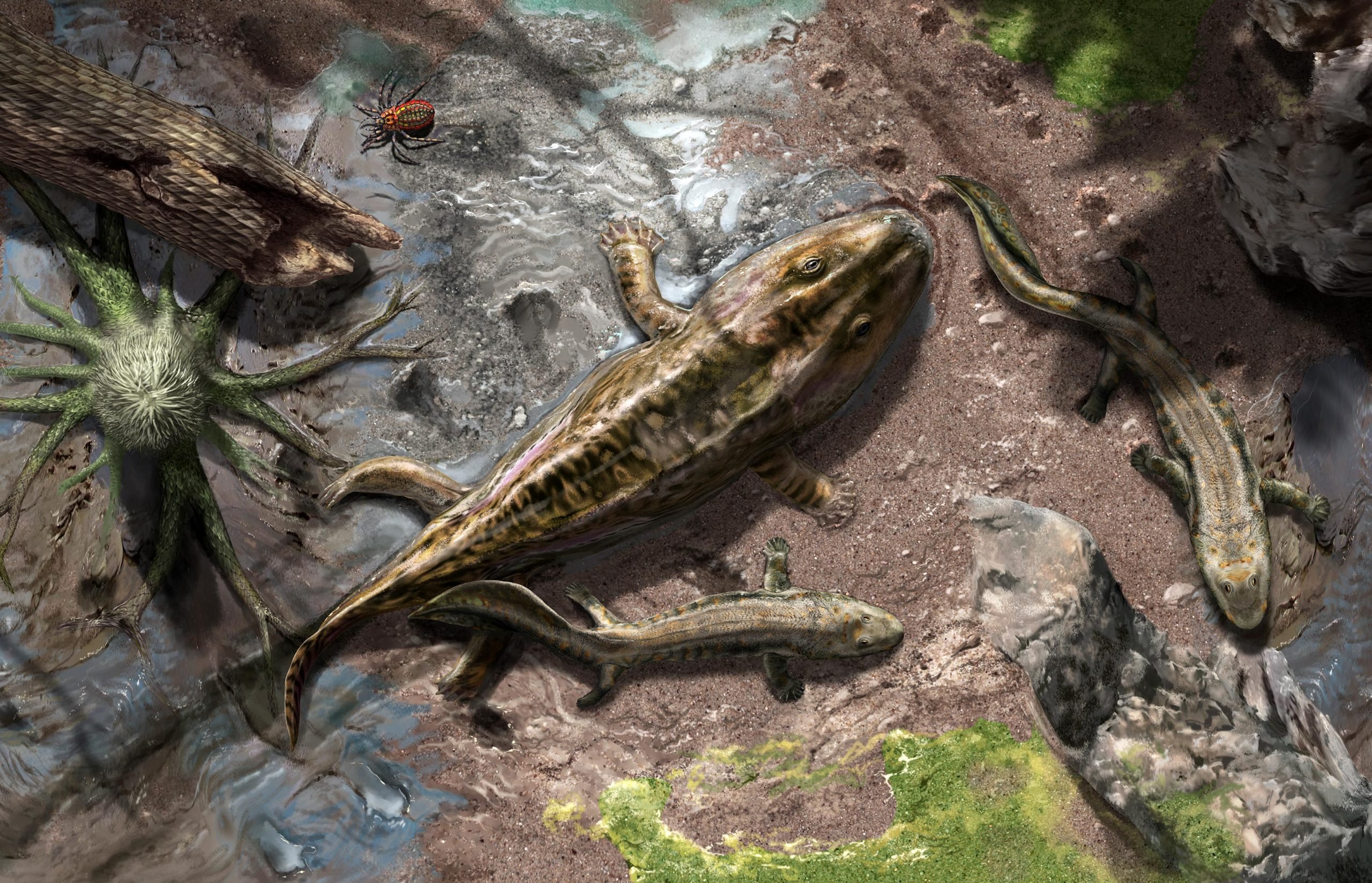
Harvard scientists used advanced statistical models and fossil evidence to pinpoint the origin of tetrapods at around 390 million years ago, with rapid skull evolution enabling land feeding, but species diversification came much later.
One of the biggest questions in evolution is when and how major groups of animals first evolved. The rise of tetrapods (all limbed vertebrates) from their fish relatives marks one of the most important evolutionary events in the history of life. This “fish-to-tetrapod” transition took place somewhere between the Middle and Late Devonian (~400-360 million years ago) and represents the onset of a major environmental shift, when vertebrates first walked onto land. Yet, some of the most fundamental questions regarding the dynamics of this transition have remained unresolved for decades.
In a study published on August 23, 2021, in Nature Ecology and Evolution Harvard researchers establish the origin date of the earliest tetrapods and discover they acquired several of the major new adaptive traits that enabled vertebrate life on land at accelerated evolutionary rates.
Bayesian Breakthroughs
The study, led by Dr. Tiago R. Simões, postdoctoral researcher, and senior author Professor Stephanie E. Pierce, both from the Department of Organismic and Evolutionary Biology, Harvard University, applied recently developed statistical methods (Bayesian evolutionary analysis) to precisely estimate the time and rates of anatomical evolution during the rise of tetrapods. The Bayesian method was adapted from methods originally developed in epidemiology to study how viruses like COVID-19 evolve and only recently became a tool in paleontology for the study of species evolution.
The study also innovates by combining data from fossil footprints and body fossils to pinpoint the time of origin of the tetrapods. “Normally footprint data shows up after body fossils of their track makers. In this case, we have tetrapod footprints much older than the first body fossils by several million years, which is extremely unusual. By combining both footprint and body fossils, we could search for a more precise age for the rise of tetrapods,” said Pierce.
“We were able to provide a very precise age for the origin of tetrapods at approximately 390 million years ago, 15 million years older than the oldest tetrapod body fossil,” said Simões.
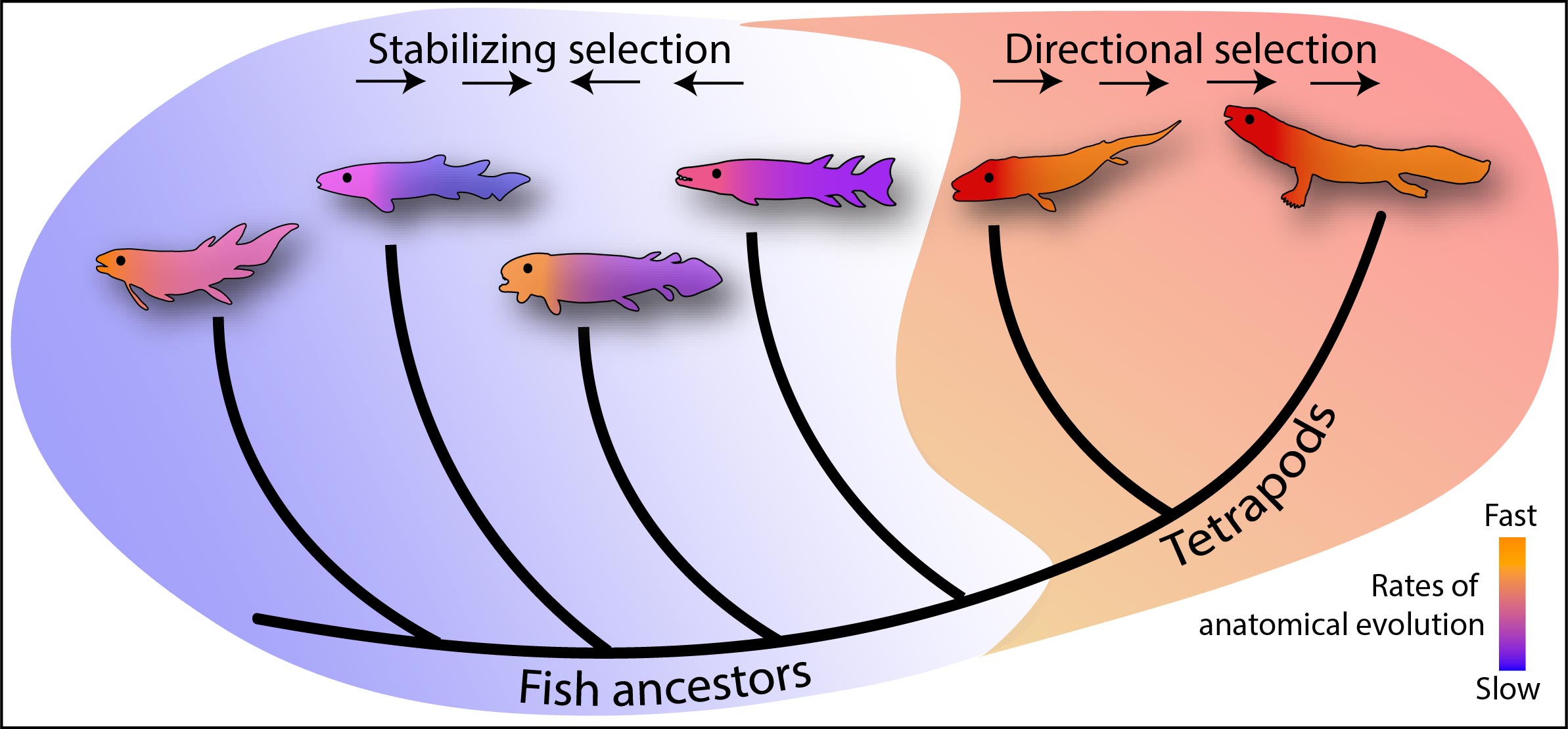
The researchers also found that most of the close relatives to tetrapods had exceptionally slow rates of anatomical evolution, suggesting the fish relatives to tetrapods were quite well adapted to their aquatic lifestyle.
Fast-Track Evolution in a Stable World
“On the other hand, we discovered the evolutionary lineages leading to the first tetrapods broke away from that stable pattern, acquiring several of the major new adaptive traits at incredibly fast rates that were sustained for approximately 30 million years,” said Simões.
Simões and Pierce also extended molecular approaches to study how fast different parts of the early tetrapod body plan evolved—such as the skull, jaws, and limbs—and the strength of natural selection acting on each of them. They found that all parts of the tetrapod skeleton were under strong directional selection to evolve new adaptive features, but that the skull and jaws were evolving faster than the rest of the body, including the limbs.
“This suggests that changes in the skull had a stronger role in the initial stages of the fish-to-tetrapod transition than changes in the rest of the skeleton. The evolution of limbs to life on land was important, but mostly at a later stage in tetrapod evolution, when they became more terrestrial,” said Pierce.
“We see several anatomical innovations in their skull related to feeding and food procurement, enabling a transition from a fish-like suction-based mode of prey capture to tetrapod-like biting, and an increase in orbit size and location,” said Simões. “These changes prepared tetrapods to look for food on land and to explore new food resources not available to their fish relatives.”
The researchers also found that the fast rates of anatomical evolution in the tetrapod lineage were not associated with fast rates of species diversification. In fact, there were very few species around, so few they had a very low probability of being preserved in the fossil record.
A New Hypothesis in Evolutionary Dynamics
This finding helps to answer an ongoing debate in evolution of whether new major animal groups originated under fast rates of anatomical change and species diversification (the classical hypothesis). Or, if there were high rates of anatomical evolution first, with increased rates of species diversification occurring only several million years later (a new hypothesis).
“What we’ve been finding in the last couple of years is that you have lots of anatomical changes during the construction of new animal body plans at short periods of geological time, generating high rates of anatomical evolution, like we’re seeing with the first tetrapods. But in terms of number of species, they remained constrained and at really low numbers for a really long time, and only after tens of millions of years do they actually diversify and become higher in number of species. There’s definitely a decoupling there,” said Simões.
Pierce agreed, “It takes time to get a foothold in a new niche in order to take full advantage of it.”
“Our study starts at the very beginning of this evolutionary story. There are many, many more chapters to come,” said Pierce. “We want to next dig further in terms of what happened after the origin of tetrapods, when they started to colonize land and diversify into new niches. How does that impact their anatomical rates of evolution compared to their species diversification across the planet? This is just the very beginning. It’s the introductory chapter to the book.”
Reference: “Sustained high rates of morphological evolution during the rise of tetrapods” by Tiago R. Simões and Stephanie E. Pierce, 23 August 2021, Nature Ecology & Evolution.
DOI: 10.1038/s41559-021-01532-x
Never miss a breakthrough: Join the SciTechDaily newsletter.
Follow us on Google and Google News.
3 Comments
“The Bayesian method was adapted from methods originally developed in epidemiology to study how viruses like COVID-19 evolve …”
That isn’t a sterling recommendation considering the poor track record of epidemiologists predicting the spread and mutation of COVID!
Got anything better than what epidemiologists did? Their predictions weren’t bang on, but were consistently accurate to within a small margin of error.
Love your channel. Your stories are sometimes a bit long, and sentences or concepts are repeated.