

By combining neuroscience with molecular biology, scientists have discovered that a well-known gene works to withstand psychiatric stress.
- Researchers have found that Tob, a well-known gene, plays a significant role in reducing depression, fear, and anxiety.
- This conclusion was reached after several different experiments involving mice in both cell biology and neuroscience.
- They also discovered that the Tob gene within the hippocampus was important for reducing fear and depression, but not anxiety. That seemed to be controlled by another part of the brain.
- Furthermore, the experimental mice without the Tob gene didn’t seem to learn that a place wasn’t so bad—they continued to show increased levels of fear observed as freezing, even after several days.
- Uncovering this role of the Tob gene in depression, fear, and anxiety could have vast implications for developing therapeutics for psychiatric stress, according to the researchers.
Prof. Tadashi Yamamoto’s former lab in Japan first characterized the gene Tob in 1996. Now it is well known for the role it plays in cancer. Previous research has also suggested that it has a role in regulating the cell cycle and the body’s immune response. In a new multidisciplinary study that combines molecular biology with neuroscience, researchers from the Okinawa Institute of Science and Technology (OIST) have discovered that this gene also plays an important role in reducing depression, fear, and anxiety. Their work was published recently in the journal Translational Psychiatry.
Tob Gene’s Link to Depression, Fear, and Anxiety
“This research is about understanding stress-resilience,” explained Dr. Mohieldin Youssef, lead author of the study. He is a former PhD student in OIST’s Cell Signal Unit, which is led by Prof. Yamamoto. “The presence of the gene helps with stress-resilience and if it’s removed, there’s an increase in depression, fear, and anxiety.”
Tob is named for the Japanese verb “tobu,” which means to fly or to jump. This is because when the cell is exposed to a stimulus, its protein levels jump in activity. As it has such a fast response, Dr. Youssef said that this has resulted in the gene being classed as an immediate-early gene.
“The Tob gene is related to many different phenomena but working on the brain system is particularly challenging,” said Prof. Yamamoto. “Although it was previously suspected, this research is the first work that clarifies that Tob has a function in the brain against stress.”
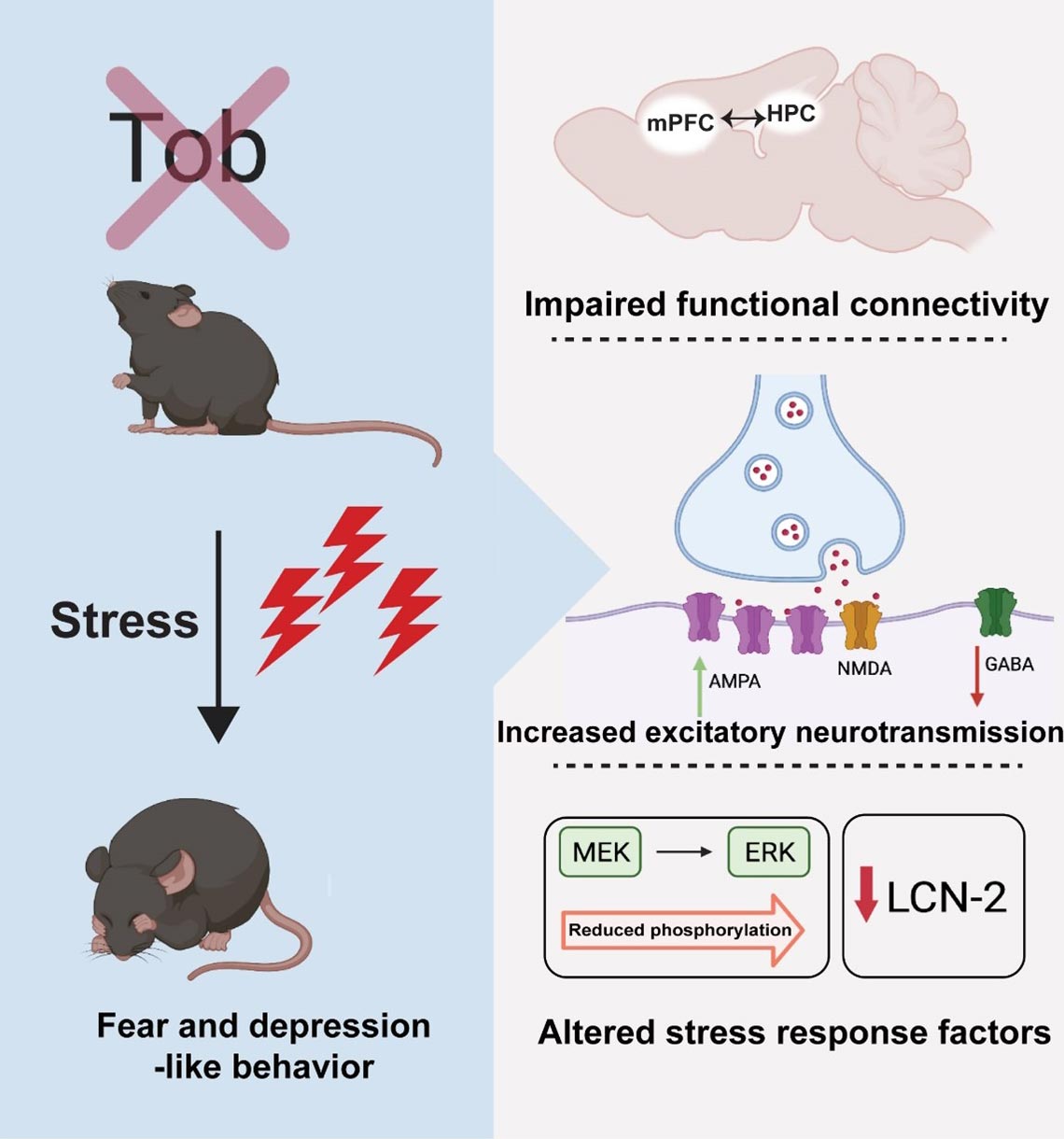
The results from several different experiments led to their conclusion that this gene is linked to anxiety, fear, and depression. First, the investigators exposed mice to stress and, as expected, saw the Tob protein levels increase. Next, they used mice that had been born without a Tob gene and observed an increase in depression, fear, and anxiety. For example, when a mouse with the Tob gene was placed in a bucket of water, it would swim and try to escape. However, a mouse without the Tob gene simply floated. This lack of will to fight a difficult situation is one way that researchers determine that an animal is depressed.
Furthermore, the mice without the Tob gene didn’t seem to learn. Dr. Youssef explained that when mice are put day after day in a place that evokes fear memory, they normally learn that it isn’t so bad and stop being as frightened. However, those without the Tob gene still showed increased levels of fear observed as freezing, even after several days.
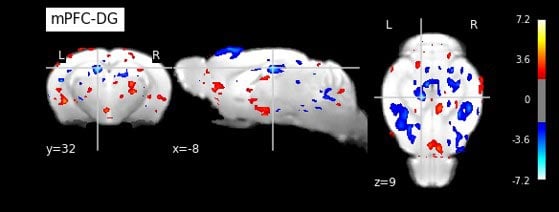
The scientists then teamed up with OIST’s former PhD student Dr. Hiroaki Hamada from the Neural Computational Unit. Through an MRI, they found that the connectivity between two key places regulating the brain’s stress resilience was altered when the Tob gene was removed—the hippocampus and the pre-frontal cortex.
Based on that revelation, the researchers decided to look at the specific role that the gene plays within the hippocampus. They took mice without the Tob gene and injected this gene directly into the hippocampus, while leaving it nonexistent in other parts of the body. The level of fear and depression returned to normal, but the mice still had increased anxiety. The scientists then explored the opposite situation—they created a mouse that had no Tob gene in the cells in the hippocampus but had it in the cells in the rest of the body. In this case, they found that the mice had normal levels of anxiety but increased fear and depression.
“We’ve concluded that the Tob gene within the hippocampus suppresses fear and depression,” explained Dr. Youssef. “But the suppression of anxiety must be regulated by another part of the brain.”
Neuronal Function and the Impact of Tob Deletion
Next, scientists from OIST’s former Brain Mechanisms for Behavior Unit measured the function of the neurons within the hippocampus of the mice without the Tob gene. They found that excitation was increased, while inhibition was decreased, suggesting that the overall balance was impacted, which would impact the behavior of the mice.
Finally, the researchers conducted molecular analyses after exposing the mice to stress. Interestingly, they found that expression didn’t immediately change with stress. However, 15 minutes after exposing the mice to stress, there were changes. Other genes and proteins were impacted if the Tob gene was deleted. This indicates that the Tob gene likely has multiple direct and indirect impacts.
“Uncovering this role of the Tob gene in fear, depression, and anxiety could have vast implications for developing therapeutics for psychiatric stress,” said Dr. Youssef.
Reference: “TOB is an effector of the hippocampus-mediated acute stress response” by Mohieldin M. M. Youssef, Hiro Taiyo Hamada, Esther Suk King Lai, Yuji Kiyama, Mohamed El-Tabbal, Hiroshi Kiyonari, Kohei Nakano, Bernd Kuhn and Tadashi Yamamoto, 29 July 2022, Translational Psychiatry.
DOI: 10.1038/s41398-022-02078-7
Never miss a breakthrough: Join the SciTechDaily newsletter.
Follow us on Google and Google News.