
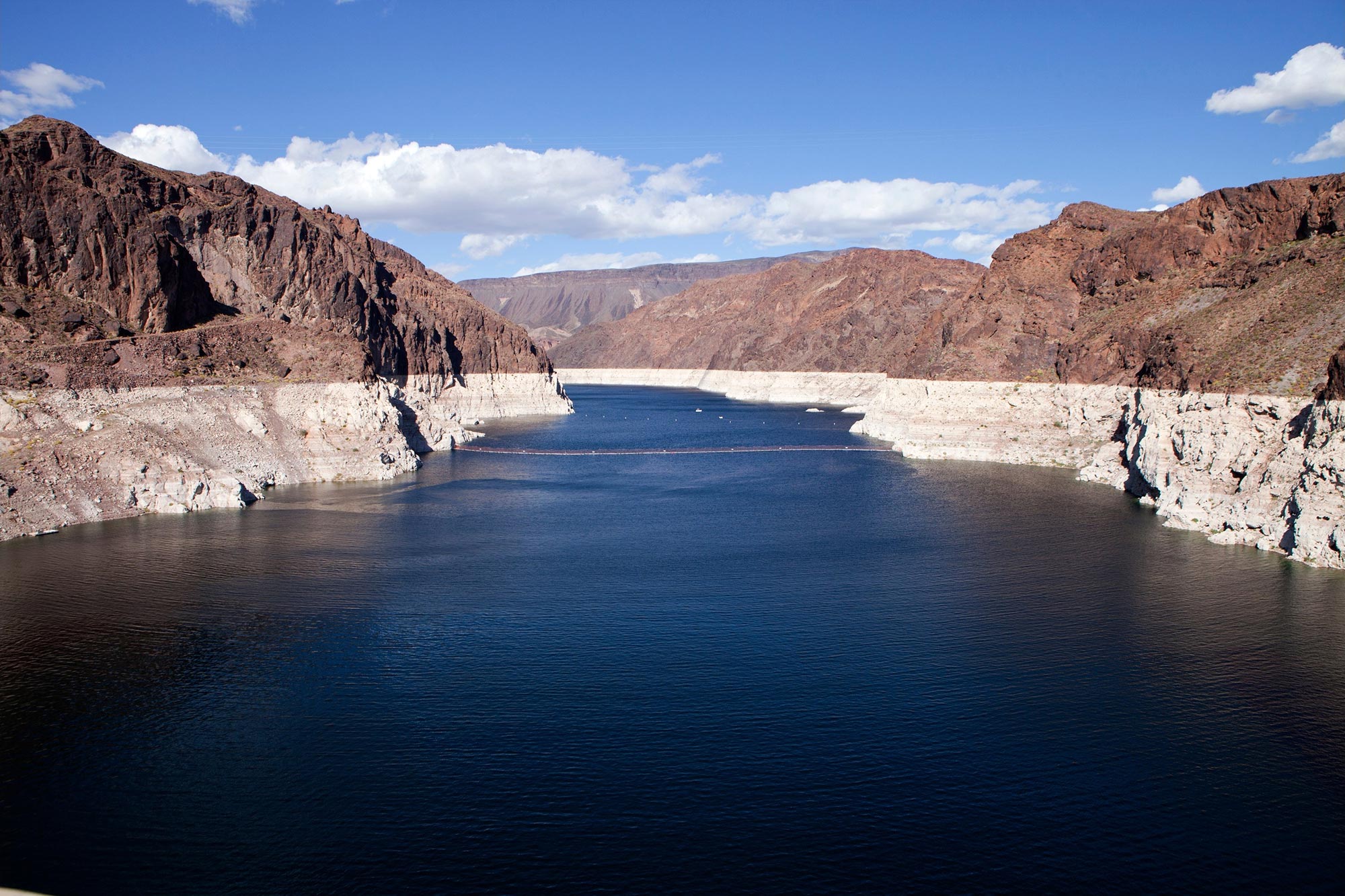
As water levels in Lake Powell and Lake Mead continue to fall due to drought and climate change, the term “dead pool” looms, referring to when water can no longer flow downstream.
Journalists reporting on the status and future of the Colorado River are increasingly using the phrase “dead pool.” It sounds ominous. And it is.
Dead pool occurs when water in a reservoir drops so low that it can’t flow downstream from the dam. The biggest concerns right now in the United States are Lake Powell, behind Glen Canyon Dam on the Utah-Arizona border, and Lake Mead, behind Hoover Dam on the Nevada-Arizona border. These two reservoirs, the largest in the U.S., provide water for drinking and irrigation and hydroelectricity to millions of people in Nevada, Arizona, and California.
Some media reports have incorrectly defined dead pool as the point at which a dam no longer has enough water to generate hydroelectricity. The more accurate term for that situation is the minimum power pool elevation.
As a 22-year drought in the Colorado River basin lingers, reaching minimum power pool elevation is the first problem. Lakes Powell and Mead have turbines at the bases of their dams, well below the surface of the reservoirs. Water flows through valves in intake towers in the reservoirs and is channeled through the turbines, making them spin to generate electricity.
Water levels in the Colorado River’s major reservoirs are falling to levels not seen since the reservoirs were created.
This system relies on what hydrologists call hydraulic head – the amount of liquid pressure above a given point. The higher the level of water above the turbines in Lake Powell and Lake Mead, the more hydraulic head they have and the more power they will generate.
When the level in a reservoir approaches minimum power pool elevation, the turbines lose capacity to produce power as they start to take in air along with water and must be shut down before they are damaged. A reservoir that reaches this point usually has quite a bit of water left before it drops to dead pool and water stops flowing from the dam.
The U.S. Bureau of Reclamation recently announced unprecedented changes in its regulation of the water in Lake Mead and Lake Powell. First, the bureau will retain in Lake Powell 480,000 acre-feet of water that was scheduled to flow down the Colorado River through the Grand Canyon and into Lake Mead for use by California, Nevada, and Arizona. One acre-foot is about 325,000 gallons.
Second, the bureau will release an additional 500,000 acre-feet from Flaming Gorge Dam on the Wyoming-Utah border. Water from Flaming Gorge flows into the Green River and eventually into Lake Powell. The water level in Lake Powell was 3,522 feet (1,074 meters) on April 30, 2022 – just 32 feet (9.8 meters) above the minimum power pool elevation of 3,490 feet (1,064 meters). Dead pool is 120 feet (37 meters) lower, at 3,370 feet (1,027 meters).
Critical points for Lake Powell and Lake Mead
These reservoirs, the two largest in the U.S., are at the lowest points since they were filled in 1934 (Lake Mead) and 1963 (Lake Powell).
| Reservoir | Water level on April 30, 2022 | Minimum power pool elevation | Dead pool elevation |
|---|---|---|---|
| Lake Powell | 3,522.77 feet | 3,490 feet | 3,370 feet |
| Lake Mead | 1,054.69 feet | 1,000 feet | 895 feet |
Table: The Conversation, CC BY-ND Source: U.S. Bureau of Reclamation
The bureau acted suddenly because the levels in both lakes have dropped far faster than anyone forecast. In the last year, Lake Mead dropped 22 feet (6.7 meters); Lake Powell, 40 feet (12 meters).
Extreme drought and climate change partly explain this rapid decline. Another factor is that Glen and Boulder Canyons are V-shaped, like martini glasses – wide at the rim and narrow at the bottom. As levels in the lakes decline, each foot of elevation holds less water.
For now, finding enough water to keep generating electricity is the focus. But unless California, Nevada, and Arizona make big cuts in the amount of water they use, dead pool in Lake Powell and Lake Mead can’t be ruled out.
Written by Robert Glennon, Regents Professor and Morris K. Udall Professor of Law & Public Policy, University of Arizona.
This article was first published in The Conversation.
Never miss a breakthrough: Join the SciTechDaily newsletter.
Follow us on Google and Google News.