
Close Menu
    Facebook X (Twitter) Instagram
    SciTechDaily
    • Biology
    • Chemistry
    • Earth
    • Health
    • Physics
    • Science
    • Space
    • Technology
    Facebook X (Twitter) Pinterest YouTube RSS
    SciTechDaily
    Home»Earth»Dwindling Water Levels of Lake Powell Seen From Space – Second-Largest Man-Made Reservoir in the US
    Earth

    Dwindling Water Levels of Lake Powell Seen From Space – Second-Largest Man-Made Reservoir in the US

    By European Space Agency (ESA)April 11, 20221 Comment4 Mins Read
    Facebook Twitter Pinterest Telegram LinkedIn WhatsApp Email Reddit
    Share
    Facebook Twitter LinkedIn Pinterest Telegram Email Reddit
    Dwindling Waters of Lake Powell
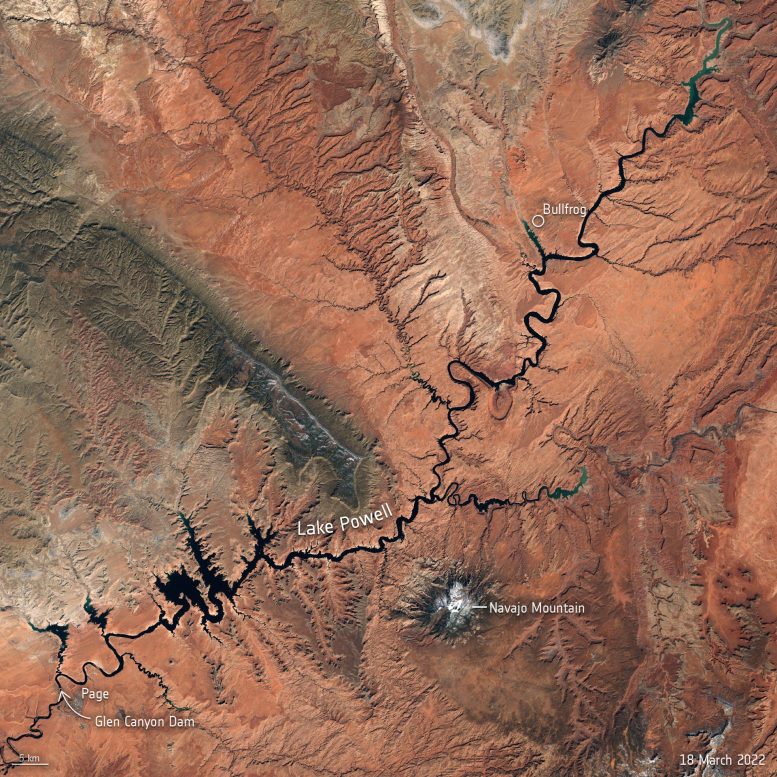
    This Copernicus Sentinel-2 image allows us a wider view of Lake Powell and its dwindling water levels amidst the climate crisis. After decades of drought, water levels in Lake Powell, the second-largest human-made reservoir in the United States, have shrunk to its lowest level since it was created more than 50 years ago, threatening millions of people who rely on its water supply. Credit: Contains modified Copernicus Sentinel data (2022), processed by ESA, CC BY-SA 3.0 IGO

    Drought and sediment buildup have pushed Lake Powell to dangerously low levels, jeopardizing water supply and power generation.

    After decades of drought, water levels in Lake Powell, the second-largest human-made reservoir in the United States, have shrunk to their lowest level since it was created more than 50 years ago, threatening millions of people who rely on its water supply. Satellite images allow us to take a closer look at the dwindling water levels of the lake amidst the climate crisis.

    Straddling the border of southeast Utah and northeast Arizona, Lake Powell is an important reservoir in the Colorado River Basin. The Colorado River, which Lake Powell flows through, was dammed at Glen Canyon in the early 1960s. The lake provides water to approximately 40 million people, irrigates over 2.2 million hectares (8,500 square miles) of land, and has the capacity to generate more than 4200 megawatts of hydropower electricity.

    In mid-March 2022, Lake Powell’s elevation dropped to an astonishing 1,074 m (3,523 ft) above sea level – the lowest the lake has been since it was filled in 1980. This drastic drop in water levels is documented in natural-color images captured by the Copernicus Sentinel-2 mission.

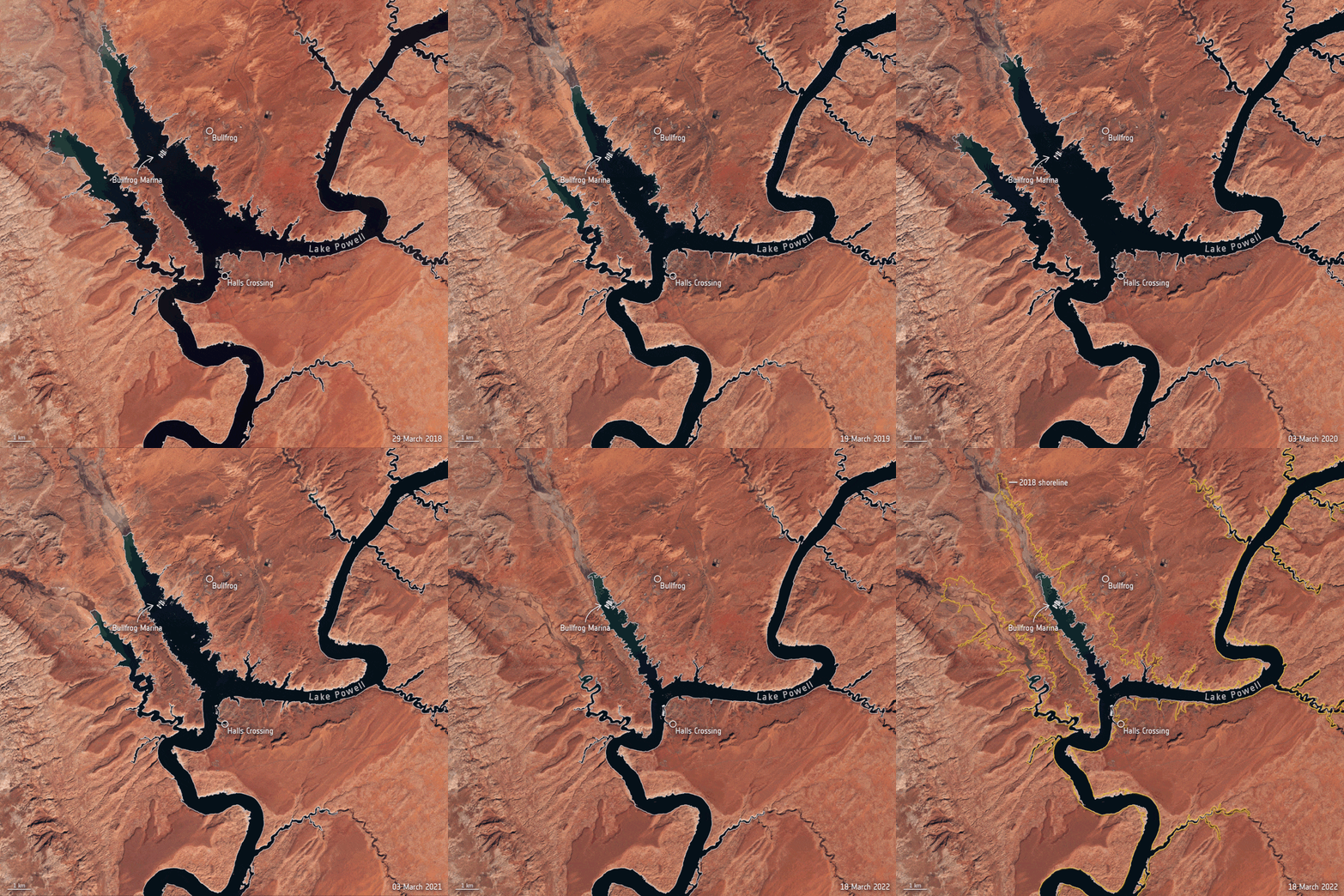
    The area pictured below shows the surface area changes of the reservoir near Bullfrog Marina, approximately 90 km (56 mi) north from Glen Canyon Dam, between March 2018 and March 2022. Dry conditions and falling water levels are unmistakable in the image captured on 18 March 2022, compared to the 2018 shoreline outlined in the image in yellow.
    Surface Area Changes of Lake Powell
    Surface area changes of Lake Powell. This animation shows the surface area changes of the reservoir near Bullfrog Marina, approximately 155 km north from Glen Canyon Dam, between March 2018 and March 2022. Dry conditions and falling water levels are unmistakable in the image captured on 18 March 2022, compared to the 2018 shoreline outlined in the image in yellow. Credit: Contains modified Copernicus Sentinel data (2018-22), processed by ESA, CC BY-SA 3.0 IGO

    The drop in water levels comes as hotter temperatures and falling water levels left a smaller amount of water flowing through the Colorado River. The peak inflow to Lake Powell occurs in mid-to-late spring, as the winter snow in the Rocky Mountains melts.

    The line graph shows the drastic drop in average water levels in March since 2000, when Lake Powell was at around 1,120 m (3,675 ft) elevation. The current elevation is just a few meters from what is considered the ‘minimum power pool’ – the level at which Glen Canyon Dam is able to generate hydroelectric power. If Lake Powell drops even more, it could soon hit a ‘deadpool’ where water will likely fail to flow through the dam and onto the nearby Lake Mead.

    According to a report compiled by the US Geological Survey in cooperation with the Bureau of Reclamation, Lake Powell’s storage capacity has lost nearly 7% of its potential storage capacity from 1963 to 2018, when the diversion tunnels of Glen Canyon Dam closed and the reservoir began to fill.

    The capacity of the reservoir is said to be shrinking because of sediments transported by the Colorado and San Juan Rivers. These sediments settle at the bottom of the reservoir and decrease the total amount of water the reservoir can hold.

    Climate change is expected to make droughts more severe in the future. According to the National Oceanic and Atmospheric Administration (NOAA) Spring Outlook for the US, nearly 60% of the continental US is experiencing drought.

    These conditions are likely to continue across more than half of the continental United States through at least June, straining water supplies and increasing the risk of wildfires. While these conditions are not new, the agency expects them to potentially worsen in the coming months.

    Never miss a breakthrough: Join the SciTechDaily newsletter.
    Follow us on Google and Google News.

    Drought European Space Agency Popular Water Weather
    Share. Facebook Twitter Pinterest LinkedIn Email Reddit

    Related Articles

    Unexpected Desolation: Largest Lake in the Middle East Shrivels Into Salt Flat

    Snowpack Melt Trend Signals Impending Summer Water Crisis in Western Regions

    Lake Powell Still Shrinking – The Second Largest Reservoir in the US at Lowest Level Ever

    Drought Causes Yangtze – China’s Most Important River – To Dry Up

    Lake Mead Keeps Dropping: Water Levels Are at Their Lowest Since 1937

    Lake Powell – The Second Largest Reservoir in the United States – Reaches New Low

    Lake Mead – The Largest Reservoir in the United States – Drops to a Record Low

    Severe Drought in the Czech Republic Visible From Space

    California Valley Land Continues to Sink

    1 Comment

    1. John Wellington Berryman on July 21, 2022 2:38 pm

      this is terrible

      Reply
    Leave A Reply Cancel Reply

    • Facebook
    • Twitter
    • Pinterest
    • YouTube

    Don't Miss a Discovery

    Subscribe for the Latest in Science & Tech!

    Trending News

    One of the Universe’s Largest Stars May Be Getting Ready To Explode

    Scientists Discover Enzyme That Could Supercharge Ozempic-Like Weight Loss Drugs

    Popular Sweetener Linked to DNA Damage – “It’s Something You Should Not Be Eating”

    Ancient “Rock” Microbes May Reveal How Complex Life Began

    Researchers Capture Quantum Interference in One of Nature’s Rarest Atoms

    “A Plague Is Upon Us”: The Mass Death That Changed an Ancient City Forever

    Scientists Discover Game-Changing New Way To Treat High Cholesterol

    This Small Change to Your Exercise Routine Could Be the Secret to Living Longer

    Follow SciTechDaily
    • Facebook
    • Twitter
    • YouTube
    • Pinterest
    • Newsletter
    • RSS
    SciTech News
    • Biology News
    • Chemistry News
    • Earth News
    • Health News
    • Physics News
    • Science News
    • Space News
    • Technology News
    Recent Posts
    • Scientists Rethink Extreme Warming After Surprising Ocean Discovery
    • The Surprising Role of Asteroids in the Origin of Life
    • Scientists Raise Concerns Over Newly Recognized Pollutant Found Everywhere in the Air
    • New Study Challenges 40-Year Puzzle About Childhood Body Fat
    • 20-Year Study Finds Daily Multivitamins Don’t Extend Lifespan
    Copyright © 1998 - 2026 SciTechDaily. All Rights Reserved.
    • Science News
    • About
    • Contact
    • Editorial Board
    • Privacy Policy
    • Terms of Use

    Type above and press Enter to search. Press Esc to cancel.