
The Reservoir Stands at Its Lowest Level Since the 1930s
Lake Mead is the largest reservoir in the United States and part of a system that supplies water to at least 40 million people across seven states and northern Mexico. It stands today at its lowest level since Franklin Delano Roosevelt was president. This means less water will be portioned out to some states in the 2022 water year.
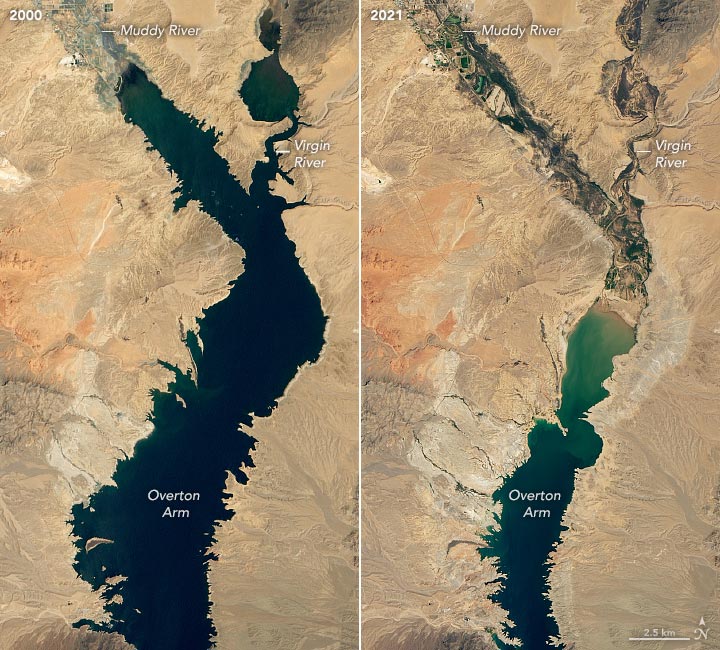
As of August 22, 2021, Lake Mead was filled to just 35 percent of its capacity. The low water level comes at a time when 95 percent of the land in nine Western states is affected by some level of drought (64 percent is extreme or worse). It continues a 22-year megadrought that may be the region’s worst dry spell in twelve centuries.
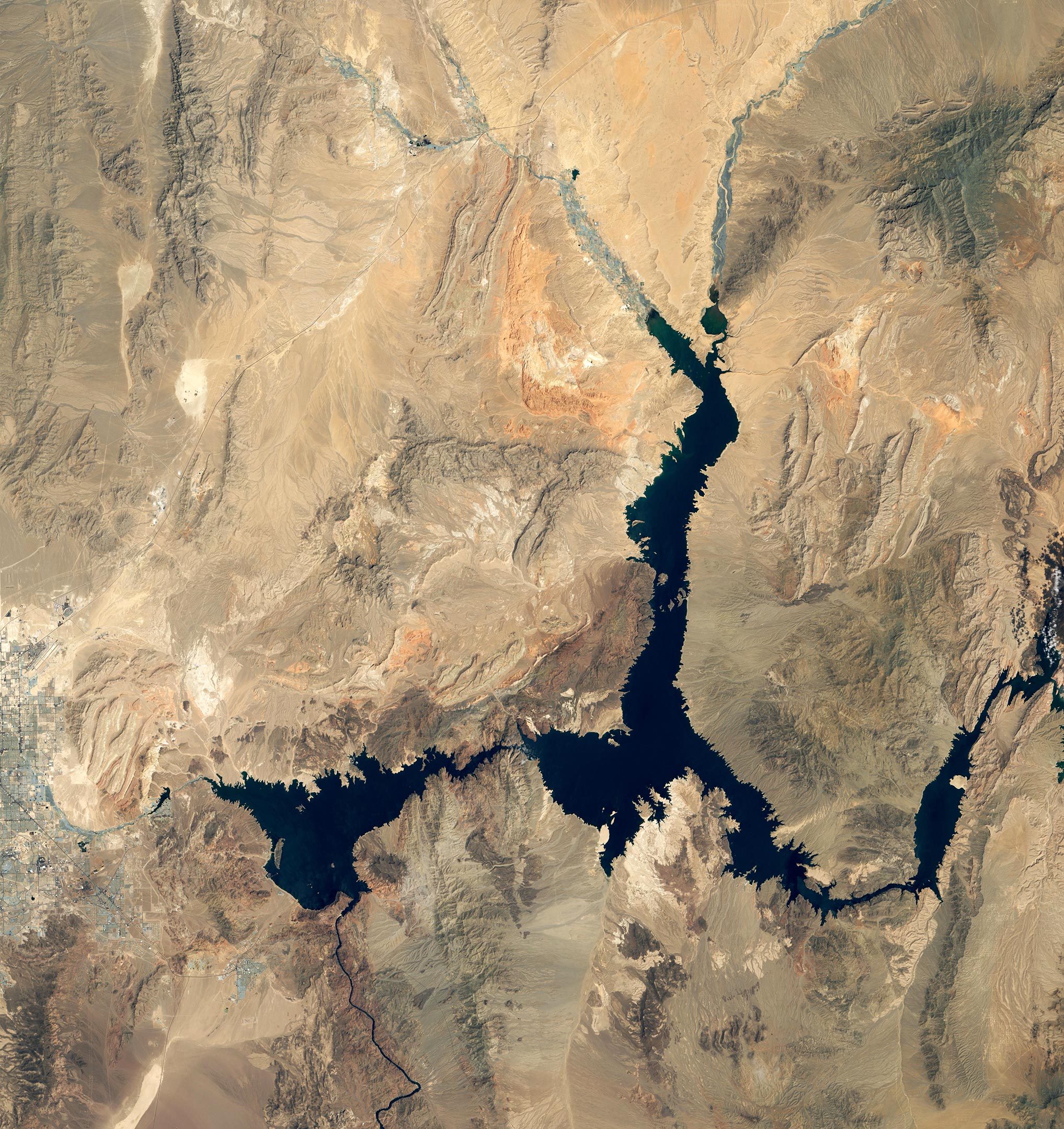
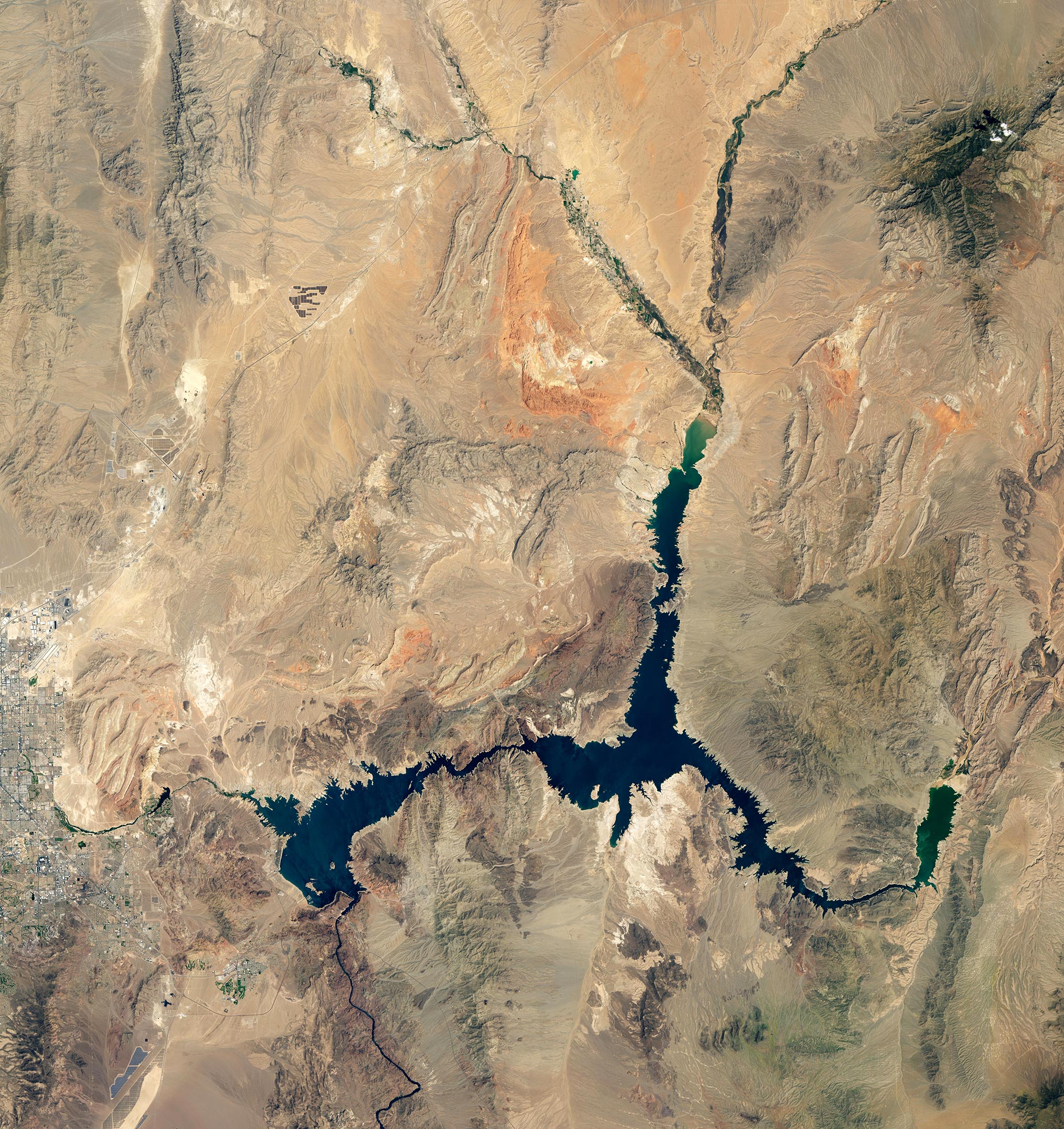
These natural-color images were acquired in August 2000 and August 2021 by Landsat 7 and Landsat 8. The tan fringes along the shoreline in 2021 are areas of the lakebed that would be underwater when the reservoir is filled closer to capacity. The phenomenon is often referred to as a “bathtub ring.”
The lake elevation data below come from the U.S. Bureau of Reclamation, which manages Lake Mead, Lake Powell, and other portions of the Colorado River watershed. At the end of July 2021, the water elevation at the Hoover Dam was 1067.65 feet (325 meters) above sea level, the lowest since April 1937, when the lake was still being filled. The elevation at the end of July 2000—around the time of the Landsat 7 images above and below—was 1199.97 feet (341 meters).
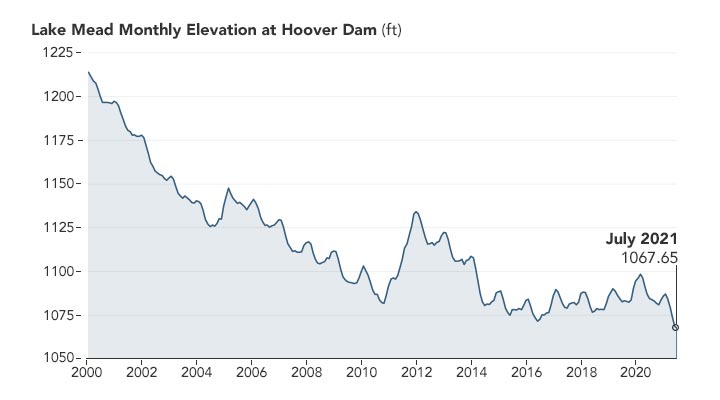
At maximum capacity, Lake Mead reaches an elevation 1,220 feet (372 meters) near the dam and would hold 9.3 trillion gallons (36 trillion liters) of water. The lake last approached full capacity in the summers of 1983 and 1999. It has been dropping ever since.
In most years, about 10 percent of the water in the lake comes from local precipitation and groundwater, with the rest coming from snowmelt in the Rocky Mountains that melts and flows down to rivers, traveling through Lake Powell, Glen Canyon, and the Grand Canyon on the way. The Colorado River basin is managed to provide water to millions of people—most notably the cities of San Diego, Las Vegas, Phoenix, and Los Angeles—and 4-5 million acres of farmland in the Southwest. The river is allotted to states and to Mexico through laws like the 1922 Colorado River Compact and by a recent drought contingency plan announced in 2019.
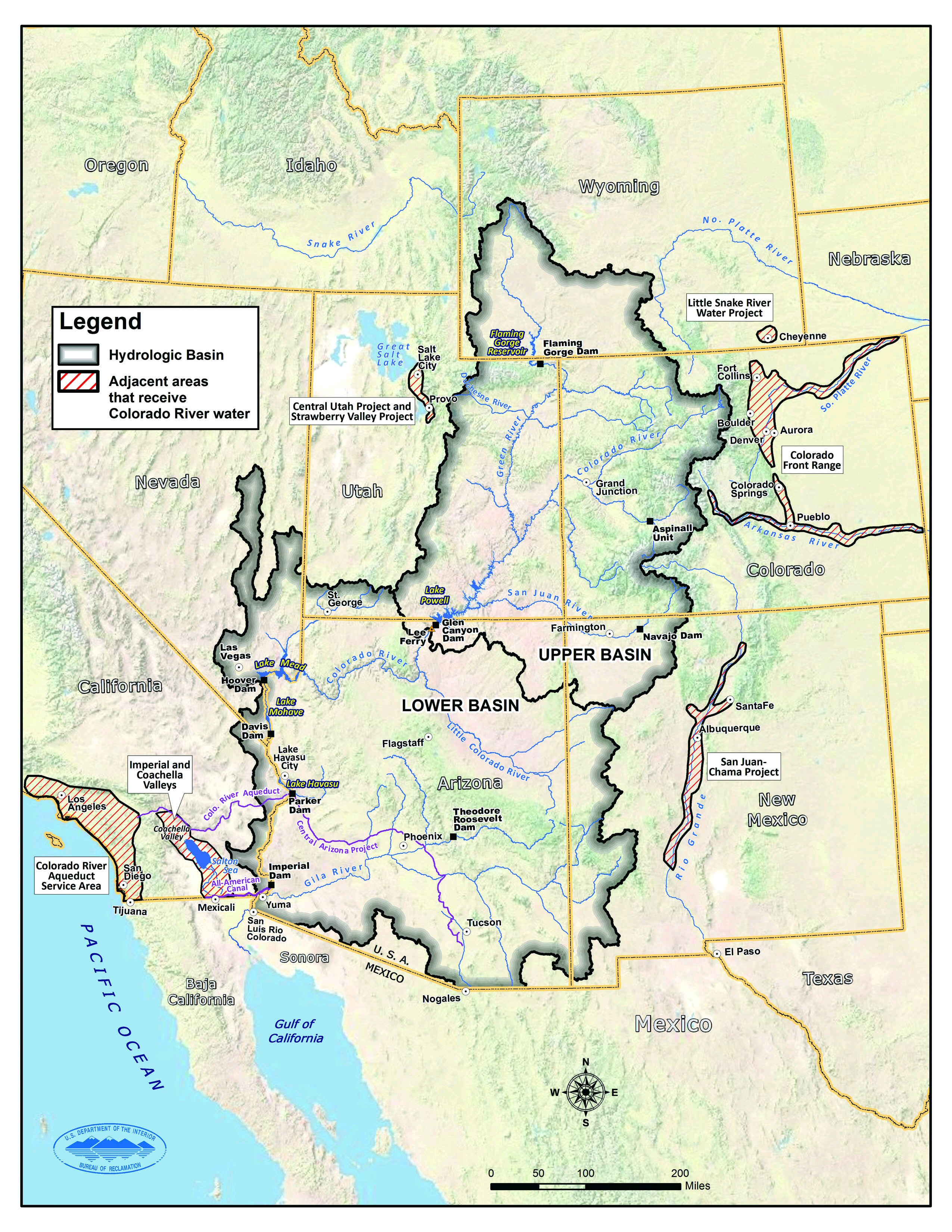
With the Lake Mead reservoir at 35 percent of capacity, Lake Powell at 31 percent, and the entire Lower Colorado system at 40 percent, the Bureau of Reclamation announced on August 16 that water allocations would be cut over the next year. “The Upper [Colorado] Basin experienced an exceptionally dry spring in 2021, with April to July runoff into Lake Powell totaling just 26 percent of average despite near-average snowfall last winter,” the USBR statement said. ”Given ongoing historic drought and low runoff conditions in the Colorado River Basin, downstream releases from Glen Canyon Dam and Hoover Dam will be reduced in 2022 due to declining reservoir levels. In the Lower Basin the reductions represent the first “shortage” declaration—demonstrating the severity of the drought and low reservoir conditions.”
For the 2022 water year, which begins October 1, Mexico will receive 80,000 fewer acre-feet, approximately 5 percent of the country’s annual allotment and Nevada’s take will be cut by: 21,000 acre-feet (about 7 percent of the state’s annual apportionment). The biggest cuts will come to Arizona, which will receive 512,000 fewer acre-feet, approximately 18 percent of the state’s annual apportionment and 8 percent of the state’s total water use (for agriculture and human consumption). An acre-foot is enough water to supply one to two households a year.
NASA Earth Observatory images by Lauren Dauphin, using Landsat data from the U.S. Geological Survey and lake elevation data from the Bureau of Reclamation. Story by Michael Carlowicz and Kathryn Hansen.
Never miss a breakthrough: Join the SciTechDaily newsletter.
Follow us on Google and Google News.
18 Comments
This of course is an object lesson in over-reliance on a limited natural resource. The article appears to be another Climate Change of Doom piece, but also states the lakes were this low when FDR was president; the 1930s comprised the warmest decade of the previous cycle. Obviously the main difference is not climate, it’s population: In 1930, Arizona had a half million residents, Nevada had 91,000, and California, about 6 million. By the year 2000, the states’ combined populations exceeded 42 million.
It’s not the drought-prone climate of the desert SW that’s the problem here. But since that area has had droughts lasting decades or even 100s of years, according to tree ring analysis, it’s a problem that has potential to get a LOT worse.
The dam was built in the 1930’s and filling with water, that is why it was low.
Phoenix and Vegas can’t be taken seriously unless they agree to include golf courses in non-functional turf criteria.
Richie, The water level was low in 1937 because the dam was finished in 1935, and the lake was being filled for the first time, not because of the 1930’s weather.
The reason the lake level was low in FDR’s time was because the dam was just completed and the reservoir was filling up FOR THE FIRST TIME
Time to run a pipeline with desalinated water from the Pacific Ocean? Why not use the same path as the high speed rail?
Let me see now … hmmm … you need power to run a desalination plant, and how much of that power would come from Hoover Dam (for which you need water to run it). Isn’t that kind of like a perpetual motion machine? Also, in order to permit a desalination plant, you probably need at least 10 years of environmental study and legal wrangling. I was in California during a power shortage where they planned at least a dozen new natural gas power plants (1996 ish). Not one was built after the tree huggers got wind of them. California STILL suffers from rotating black-outs.
Most of this is old data.
Could it be bad management of the resources we have, you can’t take out more than what’s comming into lake mead it has to be balanced properly
Interesting article. What level would Lake Mead have to drop too before power generation is stopped? First time I’ve seen acre, feet used, I normally work in cubic metres, but some of my US made equipment can use acre feet.
Lake Meade was pretty low in 1954 too. Obviously it’s poor management because we control how much comes out. I know California pumps all of their treated waste water into the ocean which is a total waste it could be used to irrigate crops instead of the water from lake Meade.
our idiot governor was asked and asked to build more dams, nothing was done,
When barry was installed as president like biden, all the fresh water was turned out and put right into the Pacific ocean to claim a drought to push climate control lie. Is that what’s happening here???
Desalinazation could be a solution, but I don’t think we should look at it until we figured out how to use our fresh water more efficiently.
Hoover Dam is unable to generate power below 950′ and rhe dead pool elevation is 895′ where no water will flow past the dam.
The answers lie in a combination of changes to the ways we use water, the way we develop land, and how we treat and use our wastewater. The last thing we should ever consider is to build more dams and drill more and deeper wells.
Dee Woodruff: “push climate control lie” Seriously? Did you actually read the article?
You are presented with incontrovertible evidence you can verify for yourself and you end up believing presidents (Democratic, funny enough) are responsible for diverting water into the Pacific with no one noticing. I not sure if it is mental health care or education that should be addressed more urgently in the USA.
we need a pipeline from the east coast to the west coast. The east coast is flooded badly every winter. we could pump the excess water from east to west and dump it in our reservoirs. it could actually flow either direction in an emergency. would solve U.S. water “shortage” permanently. this is just the rough idea. Engineers can figure it out very easily. The oil companies do it with oil. why not water? permanent solution
I’m not going to say anything smart but I will say this, when I was driving the family cross country ( a man never gets a vacation) we stopped at Hoover on that 2 lane rd with the Amoco on your left going east the last place to stop for miles so if you don’t have at least half l wouldn’t go road, we stopped and took some pictures and tou could see the difference in colors of the wall and it was about 50 ft if not more and this was summer time so tell me where has all the water gone? We have no more or less than we ever did don’t make sense but 1 thing we know is true, we have about 20 percent good water left
It is a dam. The reason it was that high after the same was built is I assume because the dam stopped the water and it backed up to that height. As of March 2025 it has raised 26 ft from the low in 2022 because of more rainfall and stricter water management. There obviously is a problem with fresh water but why have a 3 year old article in the “news” now? Who’s agenda does this help? Odd now that everyone has to argue / believe along party lines. Talking to all of you, unfortunately even myself.