
Study Tracks Foraging Behavior of 50 Bats in the Wild
Vampire bats that form bonds in captivity and continue those “friendships” in the wild also hunt together, meeting up over a meal after independent departures from the roost, according to a new study.
Researchers attached tiny “backpack” computers to 50 vampire bats – some that had previously been in captivity together and others that had lived only in the wild – to track their movement during their nightly foraging outings. By day, the bats shared a hollow tree in Panama, and at night they obtained their meals by drinking blood from wounds they made on cows in nearby pastures.
Tracking data showed that vampire bats set out to forage separately rather than as a group – and those that had established social relationships would reunite during the hunt for what the researchers speculated was some sort of coordination over food.
Social Bonds May Drive Mutual Success
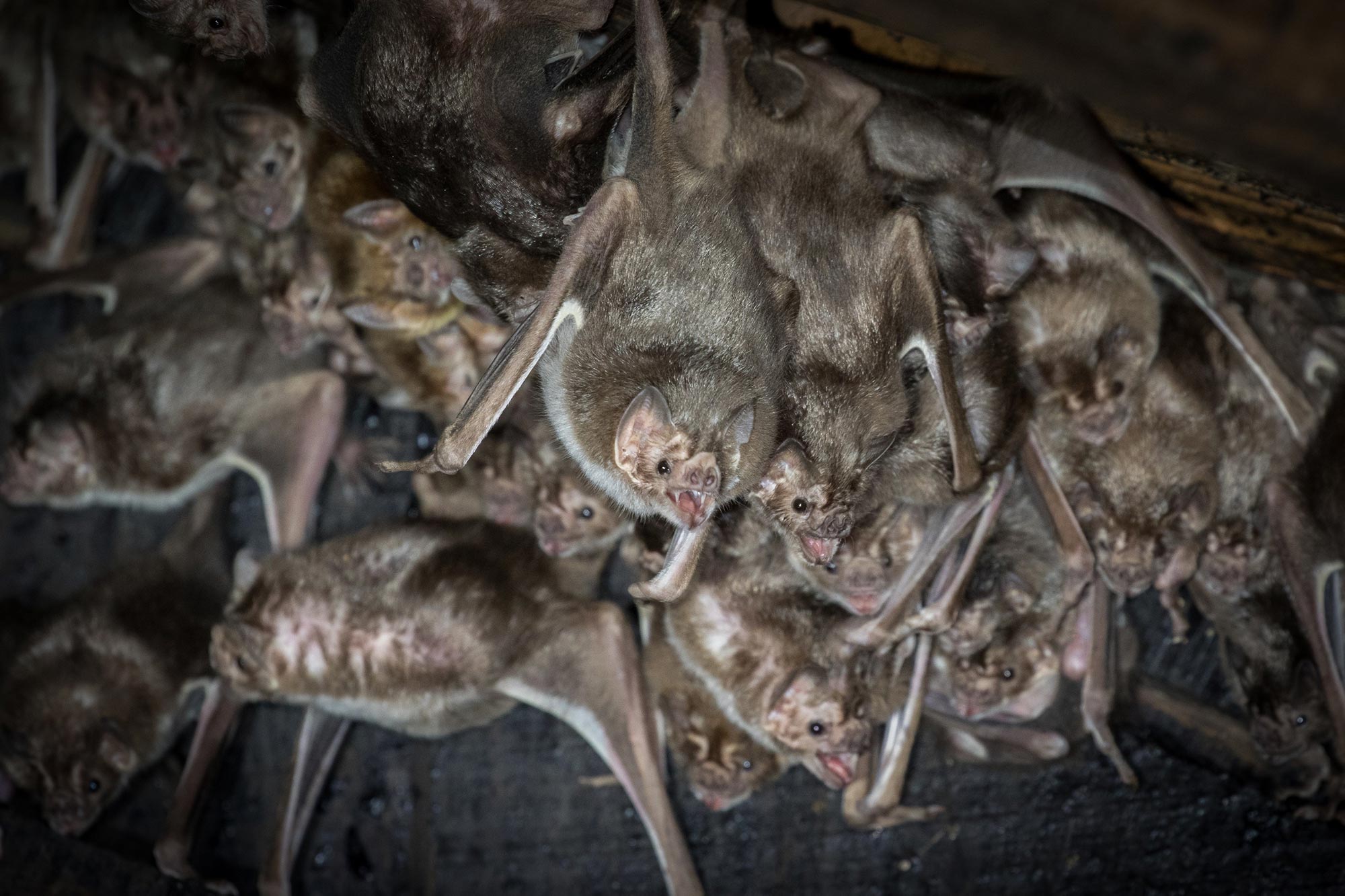
The findings suggest “making friends” in the roost could create more interdependence among socially bonded vampire bats – meaning they could benefit from each other’s success at obtaining blood meals and join forces when competing with other groups of bats for food resources.
“Everything we’ve been studying with vampire bats has looked at what they’re doing inside of a roost. What nobody has really known up until now is whether these social relationships serve any function outside the roost,” said study co-author Gerald Carter, assistant professor of evolution, ecology, and organismal biology at The Ohio State University.
“Understanding their interactions with a completely different group of bats out on the pasture can help us understand what’s going on inside the colony. If every time they leave the roost they’re getting into battles, that can increase the amount of cooperation within the colony.”
Co-author Simon Ripperger, a former postdoctoral researcher in Carter’s lab, later supplemented the tracking data by capturing video and audio of foraging vampire bats. He observed bats clustered together on one cow and others atop separate cows, some drinking from different wounds and some fighting over food access. He also made what are likely the first audio recordings of a specific type of vampire bat vocalization associated with foraging.
The research is published today (Sept. 23, 2021) in PLOS Biology.
The high-tech proximity sensors had already given the team a rare look at how vampire bats maintained friendships they formed in captivity when they returned to the wild. Over the course of two weeks, the backpack computers placed on the 50 wild and formerly captive female bats produced data on almost 400,000 individual meetings – the information analyzed for this new study.
By tracking the foraging behaviors of both groups of bats, the researchers were able to use the wild group as a control and simultaneously gauge whether the lengthy captivity interfered with bats’ ability to hunt – which was not the case.
Social Coordination During the Hunt
Carter and Ripperger considered a number of possible methods vampire bat “friends” would use to seek out food, ranging from not coordinating at all to leaving the roost together and foraging as a group. Though the proximity sensors couldn’t provide details of where exactly the bats were or what they were doing, the data on foraging encounters and previously published data on which bats groomed and shared food during captivity combined to tell a pretty convincing story.
“We looked at the possibility of different scenarios, and we found that they leave the roost to forage independently of each other, but then the ones that have a relationship are somehow finding each other and associating out on the cattle pasture – and we think they’re coordinating,” Carter said.
Bats that spent more time near each other in the roost during the day also spent more time together outside at night and encountered each other while foraging more frequently than bats not showing signs of social bonds. Foraging encounters between bats that had close relationships were, on average, longer in duration as well.
Cooperation or Competition?
“If you think about it, a longer interaction is more likely to be cooperative or affiliative than a short encounter, which could be neutral or aggressive,” Ripperger said.
The recorded vocalizations may eventually provide other insights into vampire bats’ social behaviors. Downward sweeping calls inside roosts and “buzz” calls during arguments had been documented before, but the calls recorded during the hunt, which increased and then decreased in frequency, were distinct from those.
“I could see them vocalize even if they were alone on a cow, and they vocalize back and forth, so we can tell that they interact while they’re feeding,” Ripperger said.
Reference: “Social foraging in vampire bats is predicted by long-term cooperative relationships” by Simon P. Ripperger and Gerald G. Carter, 23 September 2021, PLOS Biology.
DOI: 10.1371/journal.pbio.3001366
This work was conducted at and supported by the Smithsonian Tropical Research Institute in Panama.
The study was funded by the National Science Foundation, the German Research Foundation, a Smithsonian Scholarly Studies Awards grant and a National Geographic Society Research Grant.
Never miss a breakthrough: Join the SciTechDaily newsletter.
Follow us on Google and Google News.