
Close Menu
    Facebook X (Twitter) Instagram
    SciTechDaily
    • Biology
    • Chemistry
    • Earth
    • Health
    • Physics
    • Science
    • Space
    • Technology
    Facebook X (Twitter) Pinterest YouTube RSS
    SciTechDaily
    Home»Biology»Scientists Reconstruct Ancient Permian Ecosystem from Ash-Covered Plants
    Biology

    Scientists Reconstruct Ancient Permian Ecosystem from Ash-Covered Plants

    By SciTechDailyFebruary 21, 20121 Comment2 Mins Read
    Facebook Twitter Pinterest Telegram LinkedIn WhatsApp Email Reddit
    Share
    Facebook Twitter LinkedIn Pinterest Telegram Email Reddit
    permian-peat-forest
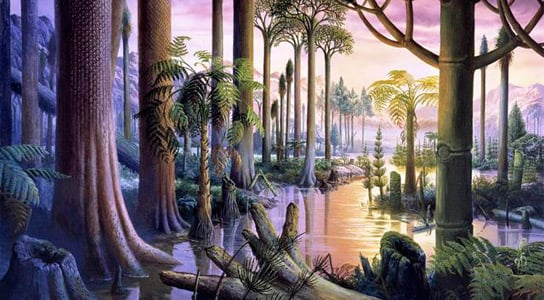
    Permian-era swampy forest illustration.

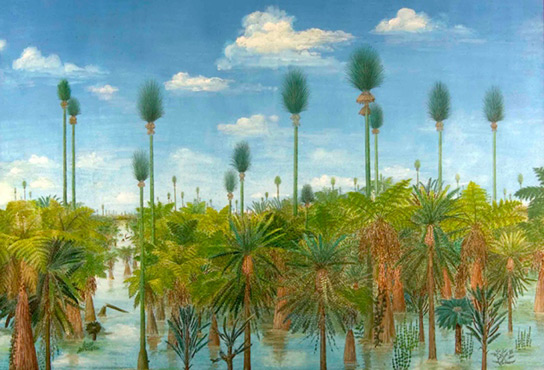
    Paleoecologists have reconstructed a Permian-era swampy forest, filled with long-extinct plant species, thanks to analyses of well-preserved fossils entombed in a layer of volcanic ash in northern China, under a coal mine. While many of the species are already known to science, the eruption that covered the tropical forest in ash created a sort of time capsule, preserving an unprecedented level of detail of the region’s flora.

    Whenever broad areas are preserved in a geological instant, researchers can get a true glimpse of the ecosystem and ecology of the forest. Hermann Pfefferkorn, a paleoecologist at the University of Pennsylvania, Philadelphia, states that the most reliable preservation comes from a layer of volcanic ash, which is even better for specimens that floods.
    ash-covered-permian-forest

    The forest dates from 298 million years ago, in the Permian, and researchers did the reconstruction by analyzing the positions of individual plants across three sites, which together cover more than 1,000 square meters. The scientists published their findings in the journal Proceedings of the National Academy of Sciences, and the peat forest contained trees that looked like feather dusters, with trunks twice the height of telephone poles.

    They found three species of Noeggerathiales, a small-spore-bearing type of tree that is supposed to be a close relative of the earliest ferns.

    298 million years ago, the forest sat on the northwestern tip of a large tropical island off the eastern shore of the supercontinent Pangea, while most forests like this one had died out elsewhere millions of years earlier.

    Reference: “Permian vegetational Pompeii from Inner Mongolia and its implications for landscape paleoecology and paleobiogeography of Cathaysia” by Jun Wang, Hermann W. Pfefferkorn, Yi Zhang and Zhuo Feng, 21 February 2012, Proceedings of the National Academy of Sciences.
    DOI: 10.1073/pnas.1115076109

    Never miss a breakthrough: Join the SciTechDaily newsletter.
    Follow us on Google and Google News.

    Botany Coal Ecology Palaeoecology Paleobotany Paleontology Pangea Permian Popular Prehistoric Supercontinent
    Share. Facebook Twitter Pinterest LinkedIn Email Reddit

    Related Articles

    North America’s Largest Native Fruit Shakes Up Local Ecosystems

    Identification of Mysterious Fossil Seed Solves 47,000-Year-Old Tar Pit Mystery

    Darwin’s Fear Was Unjustified: New Study Confirms Evolution Despite Fossil Gaps

    Ancient Kelp Forests Upend What We Knew About the Ocean

    100-Year-Old Paleontology Mystery Solved: Yale Scientists Uncover How Ancient Plants Adapted To Land

    Controversial Prehistoric Egg Identified To Be the Last of the “Demon Ducks of Doom”

    Ancient Horse DNA Reveals Gene Flow Between North American and Eurasian Horses

    Newly Discovered Dinosaur (Mansourasaurus shahinae) Links Africa and Europe

    Permian Ecosystems Tell Us A Lot About Modern Earth

    1 Comment

    1. Sidney Wagner on February 18, 2018 12:00 am

      The artist has illustrated blue skies with thin whispy clouds that allow heat to radiate into space. At this time, the sun was smaller and too weak to warm the earth. Also the plants would die if exposed to direct sunlight. There were no ice caps because these delicate plants covered the whole earth to produce the fossil fuels we use today. The earth was warmed by earth’s hot radioactive core and insulated by the thick clouds created by cosmic rays due to the weak solar wind of the smaller sun. The temperature would have been 55 degrees F over the whole earth. It was a peat bog for more than a billion years. As the sun grew in size and power, the insulating clouds got thinner allowed bees and flowering plants to evolve. Ice caps did not appear until 50 million years ago.

      Reply
    Leave A Reply Cancel Reply

    • Facebook
    • Twitter
    • Pinterest
    • YouTube

    Don't Miss a Discovery

    Subscribe for the Latest in Science & Tech!

    Trending News

    New Study Reveals Why Ozempic Works Better for Some People Than Others

    Climate Change Is Altering a Key Greenhouse Gas in a Way Scientists Didn’t Expect

    New Study Suggests Gravitational Waves May Have Created Dark Matter

    Scientists Discover Why the Brain Gets Stuck in Schizophrenia

    Scientists Engineer “Tumor-Eating” Bacteria That Devour Cancer From Within

    Even “Failed” Diets May Deliver Long-Term Health Gains, Study Finds

    NIH Scientists Discover Powerful New Opioid That Relieves Pain Without Dangerous Side Effects

    Collapsing Plasma May Hold the Key to Cosmic Magnetism

    Follow SciTechDaily
    • Facebook
    • Twitter
    • YouTube
    • Pinterest
    • Newsletter
    • RSS
    SciTech News
    • Biology News
    • Chemistry News
    • Earth News
    • Health News
    • Physics News
    • Science News
    • Space News
    • Technology News
    Recent Posts
    • JWST Reveals a “Forbidden” Planet With a Baffling Composition
    • New Research Challenges 30-Year-Old Theory of Eye Development
    • The Protein “Sabotaging” Aging Muscle Recovery Could Be Key to Surviving Aging
    • This Diet–Gut Interaction Could Transform Fat Into a Calorie-Burning Machine
    • Why Some People Reach 100: New Study Reveals Key Biological Differences
    Copyright © 1998 - 2026 SciTechDaily. All Rights Reserved.
    • Science News
    • About
    • Contact
    • Editorial Board
    • Privacy Policy
    • Terms of Use

    Type above and press Enter to search. Press Esc to cancel.