
Close Menu
    Facebook X (Twitter) Instagram
    SciTechDaily
    • Biology
    • Chemistry
    • Earth
    • Health
    • Physics
    • Science
    • Space
    • Technology
    Facebook X (Twitter) Pinterest YouTube RSS
    SciTechDaily
    Home»Space»Three Stunning New Views of Mars’ Moon Phobos Captured by NASA’s Odyssey Orbiter
    Space

    Three Stunning New Views of Mars’ Moon Phobos Captured by NASA’s Odyssey Orbiter

    By Jet Propulsion LaboratoryJune 9, 2020No Comments4 Mins Read
    Facebook Twitter Pinterest Telegram LinkedIn WhatsApp Email Reddit
    Share
    Facebook Twitter LinkedIn Pinterest Telegram Email Reddit
    Odyssey's Six Views of Phobos
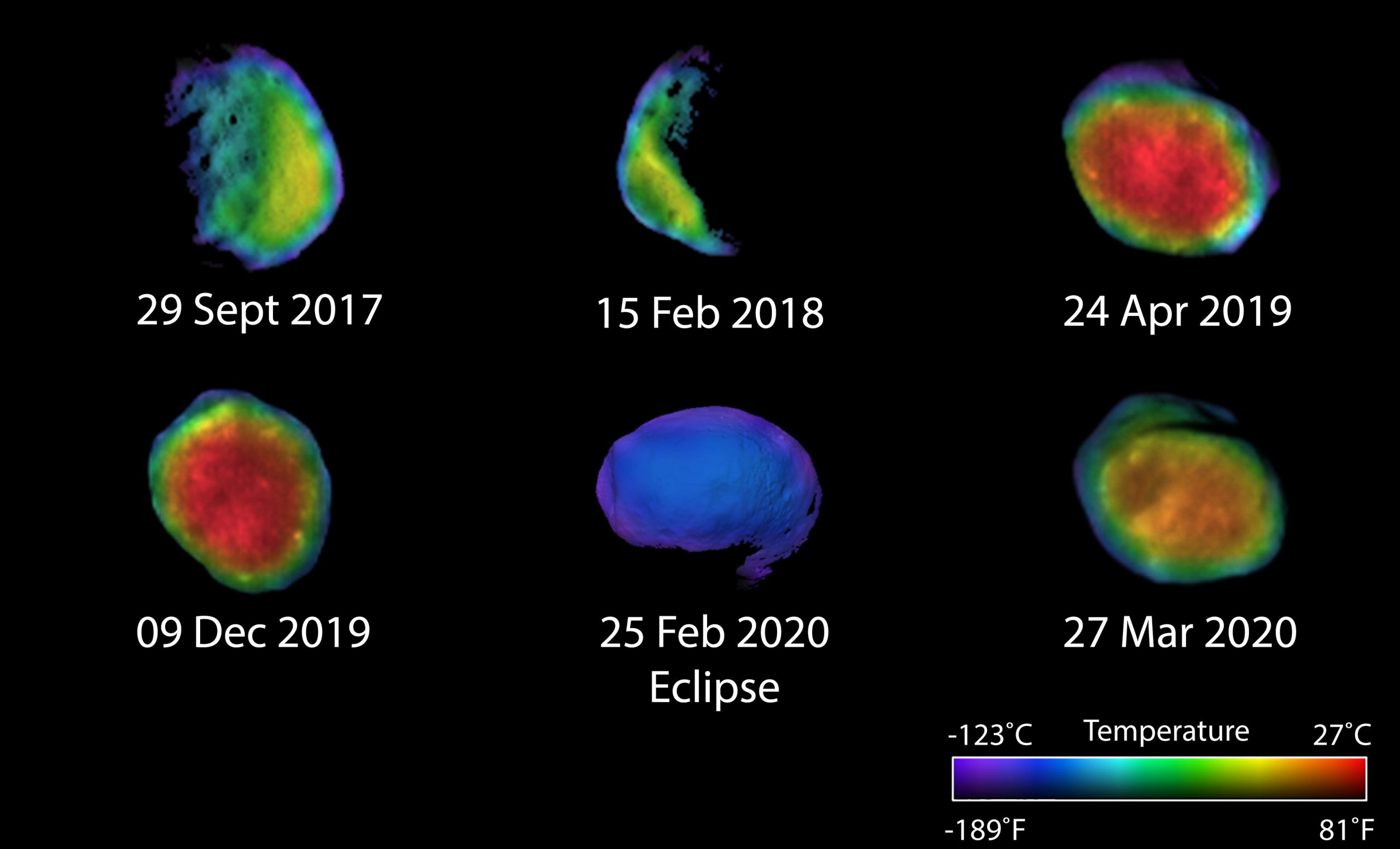
    Six views of the Martian moon Phobos captured by NASA’s Odyssey orbiter as of March 2020. The orbiter’s THEMIS camera is used to measure temperature variations that suggest what kind of material the moon is made of. Credit: NASA/JPL-Caltech/ASU/NAU

    Taken with the infrared camera on NASA’s Odyssey orbiter, the images reveal temperature variations aboard the small moon as it drifts into and out of Mars’ shadow.

    Three new views of the Martian moon Phobos have been captured by NASA’s Odyssey orbiter. Taken this past winter and this spring, they capture the moon as it drifts into and out of Mars’ shadow.

    The orbiter’s infrared camera, the Thermal Emission Imaging System (THEMIS), has been used to measure temperature variations across the surface of Phobos that provide insight into the composition and physical properties of the moon. Further study could help settle a debate over whether Phobos, which is about 16 miles (25 kilometers) across, is a captured asteroid or an ancient chunk of Mars that was blasted off the surface by an impact.

    Led by NASA’s Jet Propulsion Laboratory in Southern California, Odyssey’s mission is mostly dedicated to studying the Martian surface. But in recent years, a process has been developed to flip the spacecraft upside-down so it can point its camera at Phobos.


    View Phobos, one of Mars’ two moons, using NASA’s Eyes on the Solar System. View the full interactive experience at Eyes on the Solar System. Credit: NASA/JPL-Caltech

    Among the three new images, the one taken December 9, 2019, shows Phobos in full-moon phase, when more of the surface is exposed to sunlight, with a maximum temperature of 81 degrees Fahrenheit (27 degrees Celsius). An image taken February 25, 2020, shows Phobos while in eclipse, where Mars’ shadow completely blocked sunlight from reaching the moon’s surface. This provided some of the coldest temperatures measured on Phobos to date, with the lowest being about minus 189 degrees Fahrenheit (minus 123 degrees Celsius). On March 27, 2020, Phobos was observed exiting an eclipse, when the surface was still warming up.
    Odyssey's Six Views of Phobos Annotated
    These six views of the Martian moon Phobos were captured by NASA’s Odyssey orbiter as of March 2020. The orbiter’s infrared camera, the Thermal Emission Imaging System (THEMIS), is used to measure temperature variations that provide insight into the physical properties and composition of the moon. Credit: NASA/JPL-Caltech/ASU/NAU

    All of the THEMIS infrared images are colorized to show temperature variations and are overlain on THEMIS visible-light images taken at the same time to show the geology of the surface. The one exception is the eclipse image, which is computer-generated and shows what Phobos would have looked like if it wasn’t in complete shadow.

    Combined with three previous images, these observations represent waxing, waning, and full views of the moon. The Odyssey team plans to observe crescent phases in the coming months, providing a comprehensive view of how Phobos’ surface warms and cools as it rotates.

    “We’re seeing that the surface of Phobos is relatively uniform and made up of very fine-grained materials,” said Christopher Edwards of Northern Arizona University in Flagstaff, who leads the processing and analysis of the Phobos images. “These observations are also helping to characterize the composition of Phobos. Future observations will provide a more complete picture of the temperature extremes on the moon’s surface.”

    Odyssey has been orbiting Mars since 2001. It takes thousands of images of the Martian surface each month, many of which help scientists select landing sites for future missions. One of the sites Odyssey captured pictures of is Jezero Crater, the landing site for NASA’s Perseverance rover, which launches to Mars this summer. Odyssey also serves an important role in relaying commands and data for Mars’ newest inhabitant, NASA’s InSight lander.

    THEMIS was built and operated by Arizona State University in Tempe. The prime contractor for the Odyssey project, Lockheed Martin Space in Denver, developed and built the orbiter. Mission operations are conducted jointly by Lockheed Martin and JPL, a division of Caltech in Pasadena.

    Never miss a breakthrough: Join the SciTechDaily newsletter.
    Follow us on Google and Google News.

    JPL Mars Moons NASA Phobos Popular
    Share. Facebook Twitter Pinterest LinkedIn Email Reddit

    Related Articles

    Incredible Video of Solar Eclipse on Mars – Captured by NASA’s Perseverance Rover

    Could the Surface of the Martian Moon Phobos Reveal Secrets of Mars’ Past?

    New NASA InSight Mission Set to Explore the Depths of Mars

    Curiosity’s ChemCam Laser Analyzes Its First Martian Rock

    Color HiRISE Image of Curiosity Rover on Mars

    First Full-Resolution Images From Curiosity’s Navigation Cameras

    Curiosity’s First Color Image of Mars

    First Images From NASA’s Curiosity on Mars

    Mission Engineers Prepare for Curiosity’s Landing on Mars

    Leave A Reply Cancel Reply

    • Facebook
    • Twitter
    • Pinterest
    • YouTube

    Don't Miss a Discovery

    Subscribe for the Latest in Science & Tech!

    Trending News

    Massive Study Warns Marijuana Use in Teens Is Linked to Serious Mental Illness

    Scientists Discover a Completely Unexpected Way T Cells Kill Cancer

    Scientists Just Found the Solar System’s Original “Planet Factory”

    Study Warns Widely Used Food Preservatives Linked to High Blood Pressure and Heart Disease

    New Treatment Could Reverse Osteoarthritis Within Weeks

    Physicists Have Measured “Negative Time” in Bizarre Quantum Experiment

    The Deadly Tapeworm Spreading Across America Has Reached the Pacific Northwest

    Could Low Vitamin D Be Making Your Pain Worse?

    Follow SciTechDaily
    • Facebook
    • Twitter
    • YouTube
    • Pinterest
    • Newsletter
    • RSS
    SciTech News
    • Biology News
    • Chemistry News
    • Earth News
    • Health News
    • Physics News
    • Science News
    • Space News
    • Technology News
    Recent Posts
    • Scientists Discover Two Strange Dead Stars That Defy Astronomical Expectations
    • Scientists Find a Smarter Way To Measure the Universe Using Exploding Stars
    • Earth May Be Seeding Venus With Life, According to New Research
    • Streetlights Are Trapping Thousands of Isopods in Mysterious “Death Spirals”
    • Scientists Have Discovered These Deadly Parasites Are Secretly Swapping DNA
    Copyright © 1998 - 2026 SciTechDaily. All Rights Reserved.
    • Science News
    • About
    • Contact
    • Editorial Board
    • Privacy Policy
    • Terms of Use

    Type above and press Enter to search. Press Esc to cancel.