
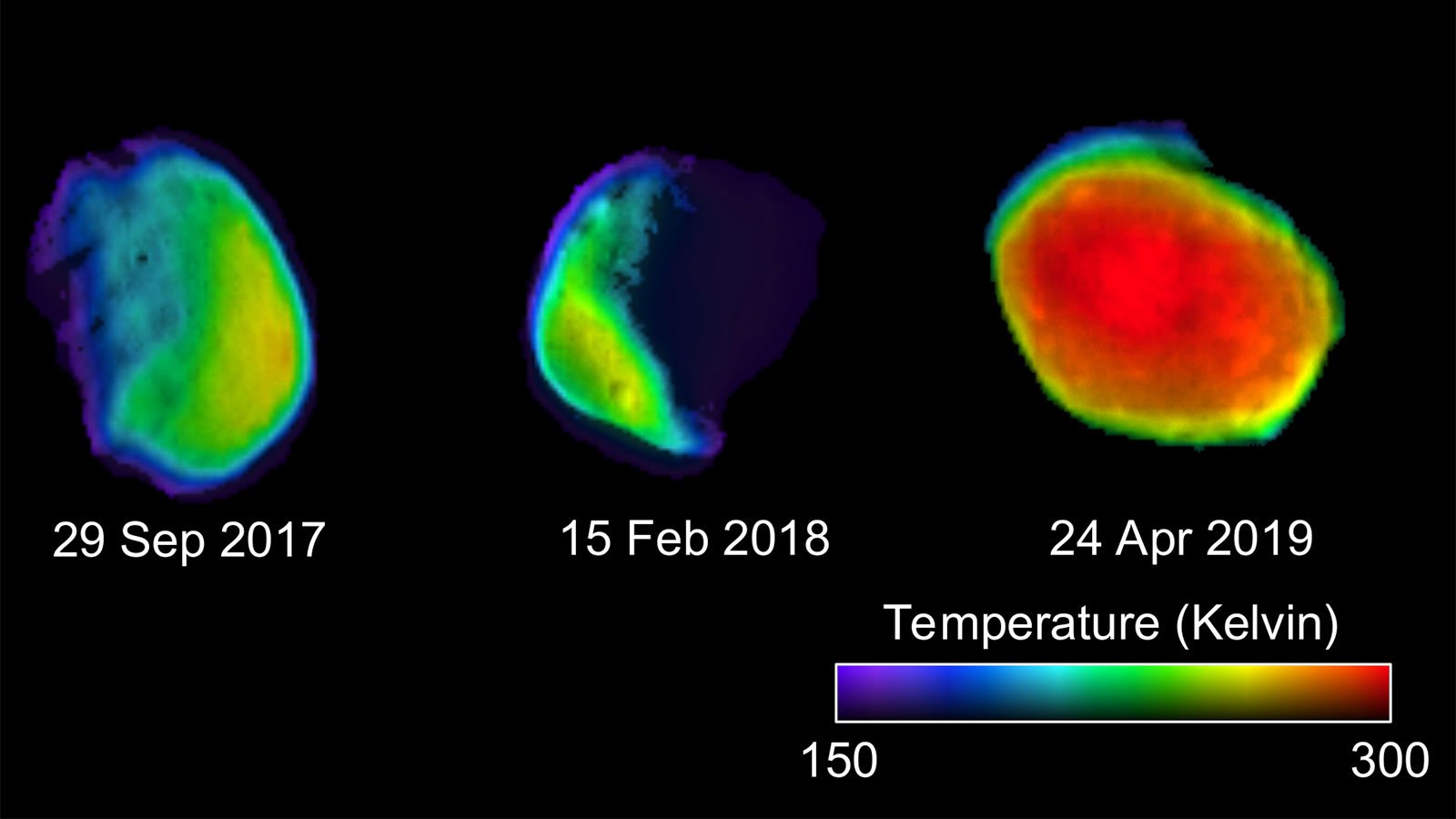
For the first time, NASA’s Mars Odyssey orbiter has caught the Martian moon Phobos during a full moon phase. Each color in this new image represents a temperature range detected by Odyssey’s infrared camera, which has been studying the Martian moon since September of 2017. Looking like a rainbow-colored jawbreaker, these latest observations could help scientists understand what materials make up Phobos, the larger of Mars’ two moons.
Odyssey is NASA’s longest-lived Mars mission. Its heat-vision camera, the Thermal Emission Imaging System (THEMIS), can detect changes in surface temperature as Phobos circles Mars every seven hours. Different textures and minerals determine how much heat THEMIS detects.
“This new image is a kind of temperature bullseye — warmest in the middle and gradually cooler moving out,” said Jeffrey Plaut, Odyssey project scientist at NASA’s Jet Propulsion Laboratory in Pasadena, California, which leads the mission. “Each Phobos observation is done from a slightly different angle or time of day, providing a new kind of data.”

On April 24, 2019, THEMIS looked at Phobos dead-on, with the Sun behind the spacecraft. This full-moon view is better for studying material composition, whereas half-moon views are better for looking at surface textures.
“With the half-moon views, we could see how rough or smooth the surface is and how it’s layered,” said Joshua Bandfield, a THEMIS co-investigator and senior research scientist at the Space Sciences Institute in Boulder, Colorado. “Now we’re gathering data on what minerals are in it, including metals.”
Iron and nickel are two such metals. Depending on how abundant the metals are, and how they’re mixed with other minerals, these data could help determine whether Phobos is a captured asteroid or a pile of Mars fragments, blasted into space by a giant impact long ago.
These recent observations won’t definitively explain Phobos’ origin, Bandfield added. But Odyssey is collecting vital data on a moon scientists still know little about — one that future missions might want to visit. Human exploration of Phobos has been discussed in the space community as a distant, future possibility, and a Japanese sample-return mission to the moon is scheduled for launch in the 2020s.
“By studying the surface features, we’re learning where the rockiest spots on Phobos are and where the fine, fluffy dust is,” Bandfield said. “Identifying landing hazards and understanding the space environment could help future missions to land on the surface.”
Odyssey has been orbiting Mars since 2001. It takes thousands of images of the Martian surface each month, many of which help scientists select landing sites for future missions. The spacecraft also serves an important role relaying data for Mars’ newest inhabitant, NASA’s InSight lander. But studying Phobos is a new chapter for the orbiter.
“I think it’s a great example of taking a spacecraft that’s been around a very long time and finding new things you can do with it,” Bandfield said. “It’s great that you can still use this tool to collect groundbreaking science.”
NASA’s Jet Propulsion Laboratory manages the 2001 Mars Odyssey mission for NASA’s Science Mission Directorate in Washington. THEMIS was developed by Arizona State University in Tempe in collaboration with Raytheon Santa Barbara Remote Sensing. The THEMIS investigation is led by Philip Christensen at Arizona State University. The prime contractor for the Odyssey project, Lockheed Martin Space in Denver, developed and built the orbiter. Mission operations are conducted jointly from Lockheed Martin and from JPL, a division of Caltech in Pasadena.
Never miss a breakthrough: Join the SciTechDaily newsletter.
Follow us on Google and Google News.