
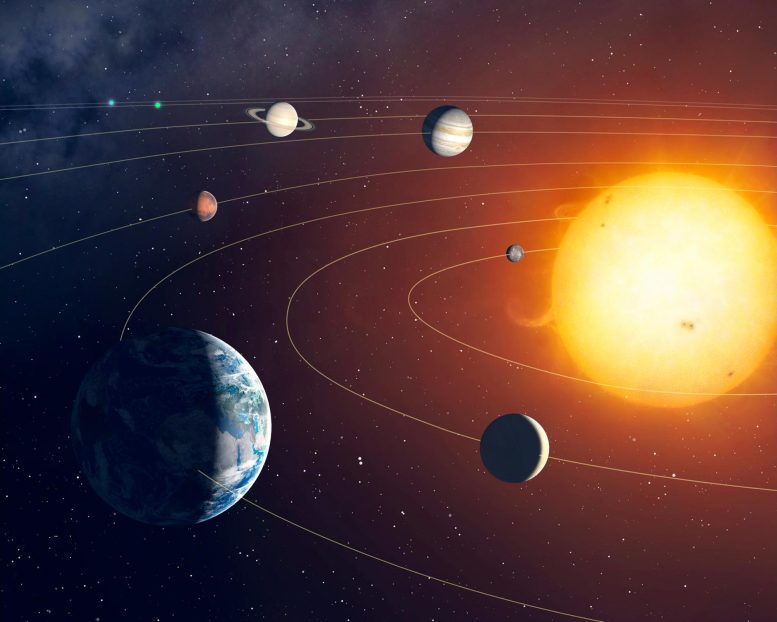
Newly published research from scientists at ASU suggests that the host star’s chemical makeup has a substantial impact on the evolution of the host star and the extent of its habitable zone.
The search for potentially habitable planets involves discussion of what is sometimes referred to as the Goldilocks Zone – the relatively thin band in a solar system in which conditions on a planet can support life.
Astrobiologists and planetary scientists agree that a planet’s distance from its parent star is of paramount importance for creating those optimum conditions – like Goldilocks’ porridge, it has to be just right.
A new study by Arizona State University researchers suggests that the host star’s chemical makeup also can impact conditions of habitability of planets that orbit them. The team’s paper, published in the August issue of The Astrophysical Journal Letters, demonstrates that subtle differences in a star’s internal chemistry can have huge effects on a planet’s chances of long-term habitability.
“We have identified changes in the ratios of different elements as particularly important for a given solar system’s habitability,” says Patrick Young, an assistant professor in ASU’s School of Earth and Space Exploration and lead author on the paper. “The more abundant elements carbon, oxygen, silicon, magnesium and sodium are particularly important. The greater the abundances of these four elements in a star, the slower it, and the location of its Goldilocks Zone, will evolve.”
As a star evolves, it becomes brighter, causing the habitable zone to move outwards through its solar system. The team’s study indicates that a greater abundance of oxygen, carbon, sodium, magnesium and silicon should be a plus for an inner solar system’s long-term habitability because the abundance of these elements make the star cooler and cause it to evolve more slowly, thereby giving planets in its habitable zone more time to develop life as we know it.
To explore whether stellar internal chemistry causes significant changes in the evolution of stars and therefore their habitable zones, Young and his colleagues, graduate students Mike Pagano and Kelley Liebst, did simulations of stars that are like our sun.
“We used spectra from 145 broadly sun-like stars targeted by planet to estimate the amount of variation in the abundance ratios of elements,” explains Pagano, who is a graduate student in the School of Earth and Space Exploration astrophysics program. “For each model, we varied the amount of one element to the extremes of variation we estimated from our analysis of the observations.”
The largest changes, unsurprisingly, arise from variation in oxygen.
“Oxygen is the most abundant element in the universe besides hydrogen and helium, so a change in the oxygen abundance results in a significant change in the total amount of heavy elements in the star,” Pagano said. “Oxygen turns out to be highly variable in abundance. The effect of increased heavy element abundance on a star is to make it harder for the energy produced by nuclear fusion to escape the star. This means less energy needs to be produced to support the star, and it can live longer.”
The stellar abundance of oxygen seems crucial in determining how long planets stay in the habitable zone around their host star. If there had been less oxygen in the Sun’s chemical makeup, for example, Earth likely would have been pushed out of the Sun’s habitable zone about a billion years ago, well before complex organisms evolved. Considering the first complex multicellular organisms only arose about 650 million years ago, such a move would have likely destroyed any chance of complex life taking hold on Earth.
Planets being searched for signs of life may be about to leave their habitable zones or only have just entered them.
“Habitability is very difficult to quantify because it depends on a huge number of variables, some of which we have yet to identify,” says Young. “It also depends on the definition of habitable that we choose to use. We chose to use a relatively simple model that predicts whether a planet can sustain liquid water on its surface with reasonable assumptions about planetary atmospheres.”
Reference: “The Impact of Stellar Abundance Variations on Stellar Habitable Zone Evolution” by Patrick A. Young, Kelley Liebst and Michael Pagano, 6 August 2012, The Astrophysical Journal Letters.
DOI: 10.1088/2041-8205/755/2/L31
Never miss a breakthrough: Join the SciTechDaily newsletter.
Follow us on Google and Google News.
1 Comment
Planet chemistry as told in the article suggests only host planet`s chemical make-up responsible for liveable planets around them. It is conveniently forgotten that water the elixir of life which is found on Moon and Mars suggests
that water is only extra-planetary source. The oort cloud hurling around cometary debris of ice and rocks are responsible for the formation of oceans on Earth, Moon, Mars and possibly Titans`s methyl alcohol oceans.The initial Hydrogen cloud in the cosmos which never formed stars are responsible for water cloud formations helped by the radiations of Gamma Ray surroundings of the universe. In the same way micro-mateors were formed and all the materos bombarded the planets to form its crust and tectonic plates. The water cloud surrounded the planet to form oceans or clouds around them.Who can forget Halley-Bopp`s impact on Jupiter in recent times? Thank You.