
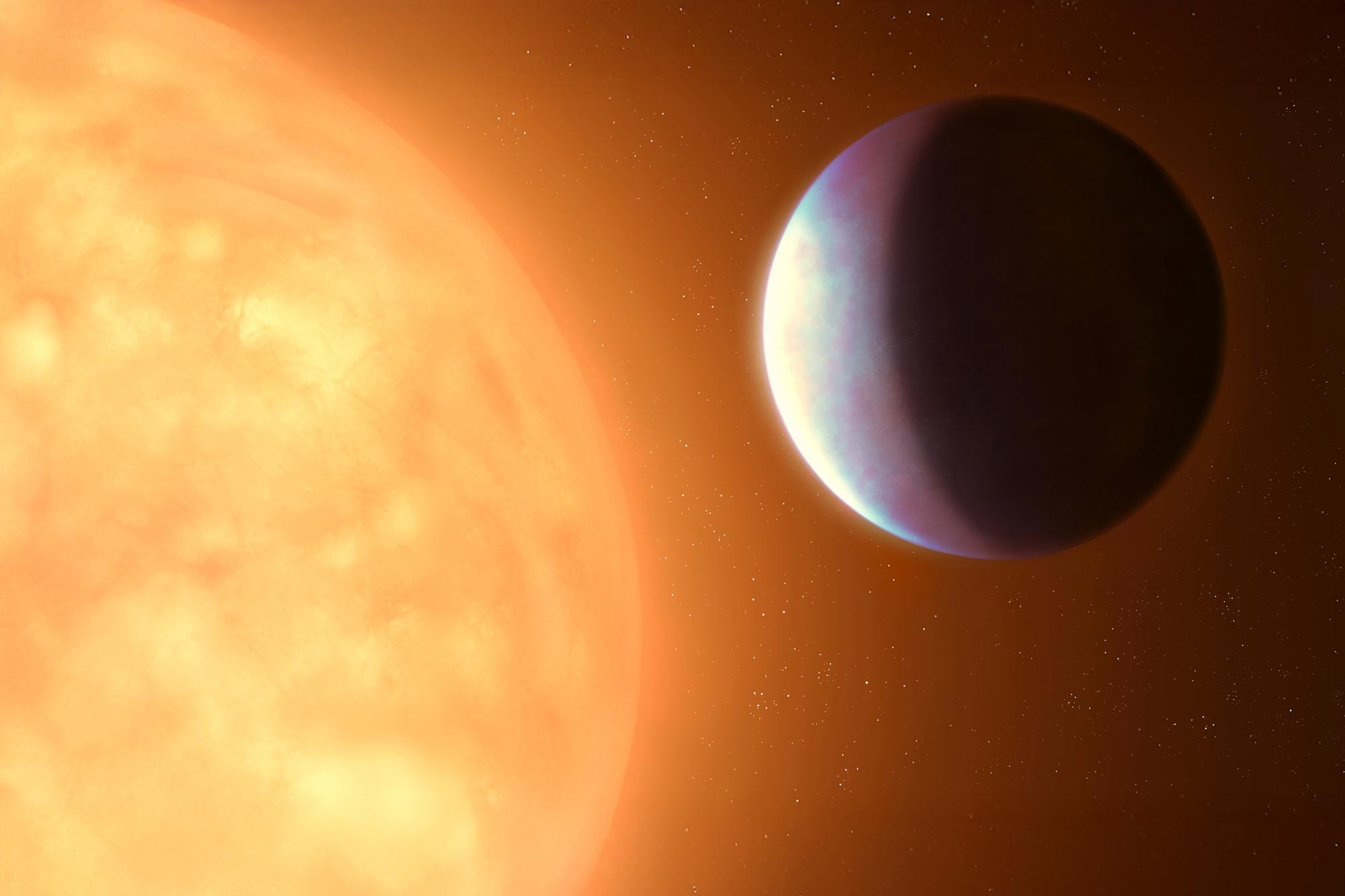
A new study challenges the traditional boundaries of the habitable zone, showing that liquid water could exist on the dark sides of tidally locked planets or beneath thick ice on distant worlds.
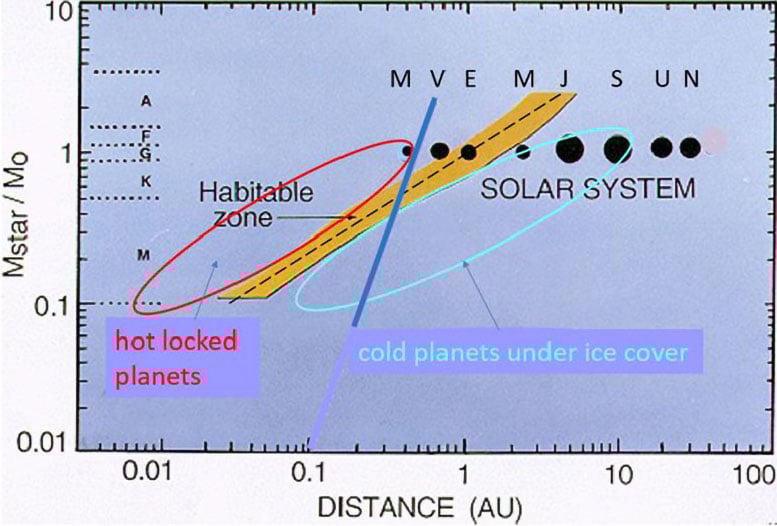
For decades, the search for alien life has been guided by a simple idea: find planets in the “habitable zone,” the region around a star where liquid water can remain on the surface. In our solar system, that familiar band stretches roughly from Earth’s orbit toward Mars.
That rule has been useful, but the growing catalog of exoplanets has made the picture far messier. Many newly found worlds circle stars unlike our sun, and many sit in places that older models would have dismissed as too hot or too cold for surface water.
A new study in The Astrophysical Journal takes aim at that older view. Astrophysicist Prof. Amri Wandel of the Hebrew University asks what happens when researchers stop treating the habitable zone as a rigid boundary and start looking more closely at how real planets distribute heat.
The research centers on tidally locked exoplanets. These planets always show the same side to their star. One hemisphere remains in constant daylight while the opposite side stays in permanent darkness. Such extreme conditions have often been considered unfavorable for maintaining surface liquid water or supporting life.
Wandel’s analysis suggests otherwise.
Night-Side Water on Tidally Locked Worlds
The study uses an analytical climate model that calculates temperature patterns across the surfaces of tidally locked planets. The results indicate that planets orbiting M-dwarf and K-dwarf stars could maintain liquid water on their night side, even when they orbit much closer to their star than traditional habitable zone models would permit.
Heat from the permanently illuminated day side can move through the atmosphere and warm parts of the dark hemisphere. In some regions, this transferred heat could keep temperatures above the freezing point of water. This mechanism expands the range of environments where liquid water might survive.
A broader definition of the habitable zone could also help explain recent findings from the James Webb Space Telescope. Observations from JWST have detected water vapor and other volatile gases in the atmospheres of warm, close in Super Earths that orbit M-dwarf stars. These planets were previously believed to fall outside the safe range where surface water could exist.
The study also explores planets that lie beyond the outer boundary of the traditional habitable zone. Even on very cold worlds far from their stars, liquid water might persist beneath thick layers of ice.
In these environments, intraglacial lakes or melting beneath the ice could create pockets of liquid water below the frozen surface. This possibility further expands the range of locations where water based environments could exist and greatly increases the number of planets that might host them.
By reexamining the assumptions behind the habitable zone and recalculating its limits, the research changes how astronomers may approach the search for life friendly environments. The results suggest that worlds once dismissed as too hot or too cold might still contain places where liquid water can exist.
Reference: “Exoplanets beyond the Conservative Habitable Zone. I. Habitability” by and Amri Wandel, 12 January 2026, The Astrophysical Journal.
DOI: 10.3847/1538-4357/ae21d7
Never miss a breakthrough: Join the SciTechDaily newsletter.
Follow us on Google and Google News.
10 Comments
thanks for this
There’s really nothing new about this. Astronomers and astrobiologists have long speculated that there could be life hidden under the surface of the ice in such locations, even on Europa, one of Jupiter’s four large Galilean moons! It would make more sense for us to look for extraterrestrial life there first, seeing as there’s no possibility of us ever travelling to any far away galaxies.
Sci-fi thougt experiment… If life evolved on a tidal locked planet… How would they organize their day? What arbitrary means would they use to break up sleep cycles? What would be the impact on society? How would they articulate the concept of tomorrow? Artificial lighting would be more symbolic rather than necessary. The concept of time would be from scientific exploration, rather than observation of day night cycles – which may lead to a deeper understanding of time – as mechanical clocks would have been developed much sooner out of necessity. Society may naturally function continuously. Different castes or groups, In offset cycling patterns. Megastructures built along the meridian. Starting as a circumstellar road around the entire planet… Alternatively, sun worship may dominate, The sun being seen as an ever present god, Even more so than in our own society.
It’s like this. I have a unifying field theory that is based on geometry and requires base 12 to process and comprehend. I’d like to start this off with the contention that the fine structure constant is actually the golden angle and the small amount of so-called remainder in between provides the granularity for the uniqueness and diversity that we call our beloved universe. My theory is called the Alexander Template and it happens to be quite robust from the quantum to the galactic. Planets, stars, the universe, is a Mobius loop. It is a one-sided surface, in the form of a sphere shall surrounding a degenerate stellar mass. It is a synchatronic generator whose dimensions can be inferred by the relation to the void that separates the shell from the degenerate star and the thickness of that shell. Gravity is not a force, neither is the week Force. Gravity is a synchatron pressure. Pretty cool right? It’s pretty tough to discredit airglow especially when it doesn’t have a spectrum relative to the Sun.
You are assuming such life is advanced and intelligent, whereas if it existed at all, it would likely be simple and probably unicellular, and kept that way by the restraints you describe.
The beings evolving on such a world may not need day/night cycles. They would probably see in the dark like cats.
A lot harder would be the ability to grow food without sunlight.
For that reason I would guess that you would probably not find anything larger than bacteria or viruses on such worlds.
It’s like this. I have a unifying field theory that is based on geometry and requires base 12 to process and comprehend. I’d like to start this off with the contention that the fine structure constant is actually the golden angle and the small amount of so-called remainder in between provides the granularity for the uniqueness and diversity that we call our beloved universe. My theory is called the Alexander Template and it happens to be quite robust from the quantum to the galactic. Planets, stars, the universe, is a Mobius loop. It is a one-sided surface, in the form of a sphere shall surrounding a degenerate stellar mass. It is a synchatronic generator whose dimensions can be inferred by the relation to the void that separates the shell from the degenerate star and the thickness of that shell. Gravity is not a force, neither is the week Force. Gravity is a synchatron pressure. Pretty cool right? It’s pretty tough to discredit airglow especially when it doesn’t have a spectrum relative to the Sun.
When will science see that of all known forces really have to bow to life. Time after time, right before our eyes, life is the absolute abundance and living on life and death of life, on,under,around, in, out, high and low, through and even in the most extremes known and unknown by man. Apparently life is important to the universe or none would ever exist. Life is different in vast ways. Evolution is probably of the universe as well as here on our planet. Whatever it’s takes, adaption to live will ensue, to carry out the rules, no matter the surroundings, nutritions, breathing, absorbtion digestion, to what ever is necessary. God is a life God. That’s what he loves to do and does it well. He didn’t just make man and retire. He’s always done it and probably always will. There is life everywhere. Look in all places, it’s there.
There’s more to life than water.
Most important; is there a magnetic field of the right strength to shield the planet from gamma radiation from whatever star it is orbiting? Is there sufficient carbon? Are there big enough planets close by that can attract life destroying asteroids?
What is always forgotten is that life doesn’t always begin even if all the right factors are in place.
Life began once, maybe twice on Earth
, nearly 3 billion years ago and not since.
There is life ONLY on this Earth, so sayeth God Almighty in the Holy Bible!🙏