
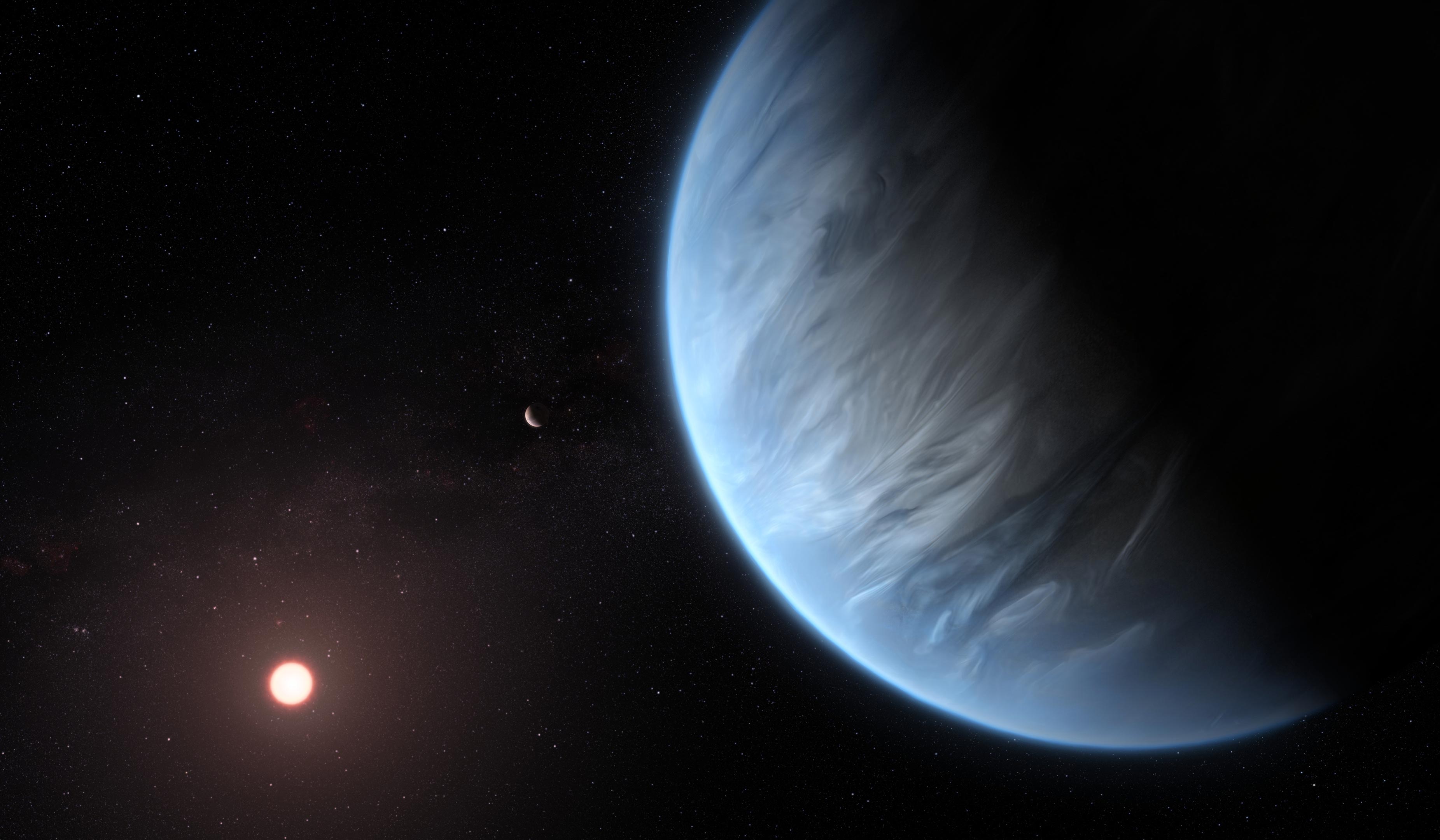
New research suggests that planets outside our solar system contain far less surface water than scientists once believed. Contrary to earlier theories that these exoplanets might be covered by deep global oceans, the study shows they lack the thick water layers that were often imagined.
In April 2025, the discovery of an exoplanet circling a dwarf star 124 light-years away captured worldwide attention. Scientists at the University of Cambridge suggested that this planet, known as K2-18b, might be an ocean-covered world with the potential to support life. A new study, however, challenges that idea, revealing that sub-Neptune planets like K2-18b are unlikely to be dominated by water and are not favorable environments for life.
“Water on planets is much more limited than previously believed,” notes Caroline Dorn, professor of exoplanets at ETH Zurich.
The research was led by ETH Zurich in collaboration with the Max Planck Institute for Astronomy in Heidelberg and the University of California in Los Angeles. K2-18b falls into a planetary category larger than Earth but smaller than Neptune, a type absent from our own solar system yet frequently observed across the galaxy. Many of these sub-Neptunes likely formed at great distances from their stars, past the so-called snow line where water turns to ice, before gradually migrating closer in.
For years, scientists thought such planets might collect vast amounts of water during their formation and later sustain massive global oceans beneath hydrogen-rich atmospheres. These hypothetical worlds have been called Hycean planets, a term derived from “hydrogen” and “ocean.”
Factoring in the chemistry
“Our calculations show that this scenario is not possible,” says Dorn. This is because a fundamental vulnerability of previous studies was that they ignored any chemical coupling between the atmosphere and the interior of the planet. “We have now factored in the interactions between the planet’s interior and its atmosphere,” explains Aaron Werlen, a researcher on Dorn’s team and lead author of the study, which was published in The Astrophysical Journal Letters.
The researchers assume that, in an early stage of their formation, the sub-Neptunes went through a phase in which they were covered by a deep, hot magma ocean. A shell of hydrogen gas ensured that this phase was maintained for millions of years.
“In our study, we investigated how the chemical interactions between magma oceans and atmospheres affect the water content of young sub-Neptune exoplanets,” says Werlen.
To do this, the researchers used an existing model that describes planetary evolution over a specific period of time. They combined this with a new model that calculates the chemical processes that take place between the gas in the atmosphere, and the metals and silicates in the magma.
Water disappearing into the interior
The researchers calculated the chemical equilibrium state of 26 different components for a total of 248 model planets. The computer simulations showed that the chemical processes destroy most H2O water molecules. Hydrogen (H) and oxygen (O) attach themselves to metallic compounds, and these largely disappear into the planet’s core.
Even though the accuracy of such calculations has some limitations, the researchers are convinced by the results. “We focus on the major trends and can clearly see in the simulations that the planets have much less water than they originally accumulated,” explains Werlen. “The water that actually remains on the surface as H2O is limited to a few per cent at most.”
In an earlier publication, Dorn’s group was already able to show how most of a planet’s water is hidden in the interior. “In the current study, we analyzed how much water there is in total on these sub-Neptunes,” explains the researcher, “According to the calculations, there are no distant worlds with massive layers of water where water makes up around 50 percent of the planet’s mass, as was previously thought. Hycean worlds with 10-90 percent water are therefore very unlikely.”
This makes the search for extra-terrestrial life more difficult than hoped for. Conditions conducive to life, with sufficient liquid water on the surface, are likely to exist only on smaller planets, which will probably be observable only with observatories even better than the James Webb Space Telescope.
Earth not a special case
Dorn finds the role of our Earth particularly exciting in light of the new calculations which show that most distant planets have similar water content to our planet. “The Earth may not be as extraordinary as we think. In our study, at least, it appears to be a typical planet,” she says.
The researchers were also surprised by a seemingly paradoxical difference: the planets with the most water-rich atmospheres are not those that have accumulated the most ice beyond the snow line, but rather planets that formed within the snow line. On these planets, the water did not come from ice crystals, but was produced chemically when hydrogen in the planetary atmosphere reacted with oxygen from the silicates in the magma ocean to form H2O molecules.
“These findings challenge the classic link between ice-rich formation and water-rich atmospheres. Instead, they highlight the dominant role of the equilibrium between magma ocean and atmosphere in shaping planetary composition,” concludes Werlen. This will have far-reaching implications for theories of planetary formation and the interpretation of exoplanetary atmospheres in the age of the James Webb Telescope.
Reference: “Sub-Neptunes Are Drier than They Seem: Rethinking the Origins of Water-rich Worlds” by Aaron Werlen, Caroline Dorn, Remo Burn, Hilke E. Schlichting, Simon L. Grimm and Edward D. Young, 18 September 2025, The Astrophysical Journal Letters.
DOI: 10.3847/2041-8213/adff73
Never miss a breakthrough: Join the SciTechDaily newsletter.
Follow us on Google and Google News.
20 Comments
Bit it’s still special to us! 😊
Scientists say they are super intelligent minds and we must obey what they say!
Maybe you are right; maybe you are wrong. Either way. How we treat this planet, each other; different races and animals In particular, is an Indication or our morality as a species. Perhaps these other races are fully aware of us and don’t want to establish contact with the people of this planet. Who can blame them? I wouldn’t want to either.
I would like to see precious resources used to help preserve lifeforms on this overly polluted, over populated and heating up planet..
Absolutely agree.
It could also be that they all live a dog eat dog existence. My guess is it’s somewhere between the super considerate ETs that you envision and the dog eat dog crowd.
Absolutely agree.
Who hurt you lol
Super intelligent ? The scientists or the planets …….?
Thank you for providing opportunity for people to opine snd comment.
I have nothing to say. Good article.
Suggestion: provide the chance to erase one’s own comment after posting it.
Or edit it.
Oh, Earth is special, trust me. Have you seen the people here? Lots of issues.
Indeed. Very, very special. Like, extra chromosomal special. 🤭😉
Whether extra- terrestrial life exists or not, given that nothing with mass can travel faster than the speed of light, it’s highly unlikely that our civilisation and any alien civilisation out there will ever make contact.
Contact may not be possible but knowing other life exists beyound our solar system would be profound.
Poor babies no waterworld for you.
People of earth we have been here for thousands of years and don’t want to leave this planet to you just yet peace
O. U. T
This used to be a beautiful world. Thanks to just a couple of families that have all the wealth, and people that specifically deny climate change to provide greater income to themselves, are going to be responsible for the death of all life on this planet. We literally have the ability to change course from where we are heading, but it’s more important for a couple of people to become wealthier. C’est la vie.